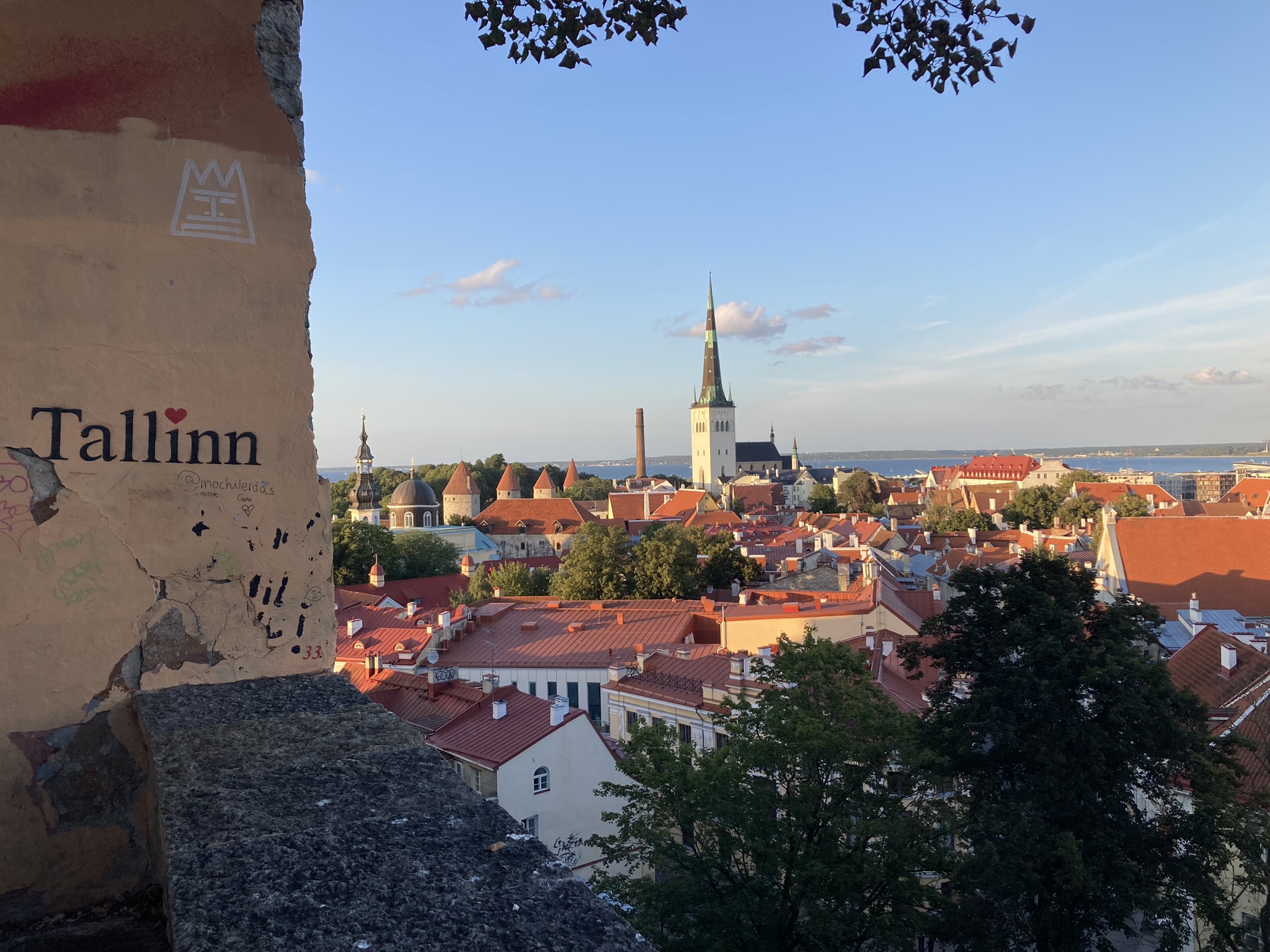
As an amateur pharologist, visiting lighthouses is one of my favorite things in the world. The rough collection of run-on sentences here will hopefully be of interest as I slowly work to recall the dozens of stations I've visited over the years.
Estonia, Finland, and some Northern Lighthouses
August 26-31, 2024
This page has thus far been devoted to the lighthouse components of my trips. However, I’d like to try something somewhat different– rather than focus solely on the lighthouses, I want to provide a holistic recollection of my recent trip to Estonia– including, but not limited to the beautiful lighthouses there.
For whatever reason, most people seem to not know much about Estonia. It’s a country in eastern Europe, between Finland, Russia, and Latvia, and has a long history. The Baltic region was the last part of Europe to be Christianized, and the Pope ordered the Livonian Crusade in the 13th century for that purpose. Around that time, the Hanseatic League, a confederation of Low German merchant cities, began investing in the city of Reval, today known as Tallinn, the Estonian capital. Since then, Estonia has passed hands between Denmark, Sweden, Russia, and the USSR, and is now a proudly independent country and member of the EU.
I’ve been fascinated with Estonia for a very long time, and have written songs about it (The Urchin’s Ballad) and so now that I have the financial capital to do such things, I planned a solo trip to visit some of the country’s highlights. I flew from Austin to Frankfurt to Tallinn, arriving late in the evening with just a backpack and a very loose plan.
Monday, August 26th
The first morning, jetlag hit like a truck. I hesitate to use that expression, considering my friend Shawn was hit by a truck in the twelfth grade, but the way I was launched headfirst and exhausted into the day necessitates such wording. By the onset of dawn I was wide awake, bone tired, and more than ready to hit the cobblestone streets of Tallinn.
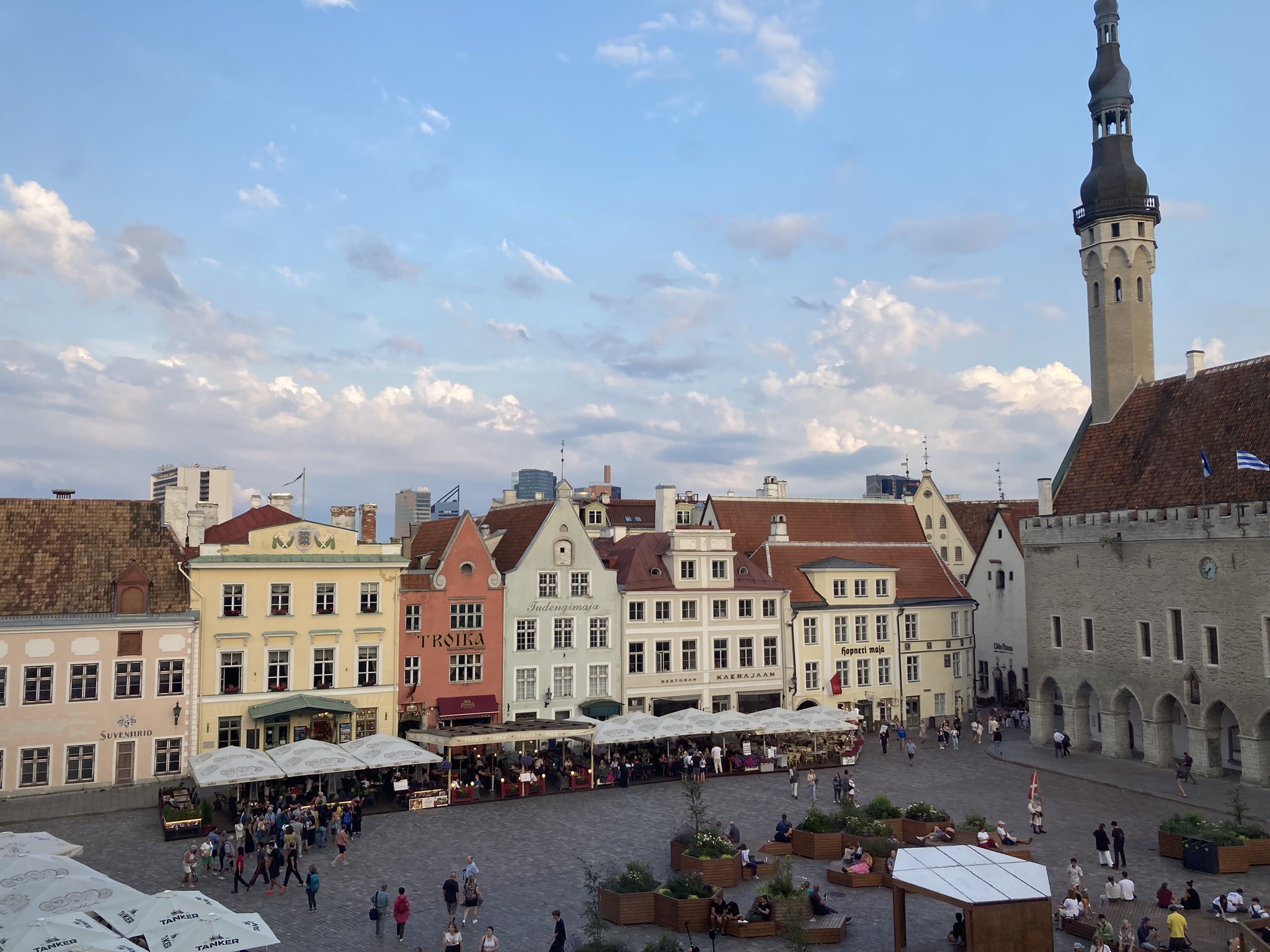
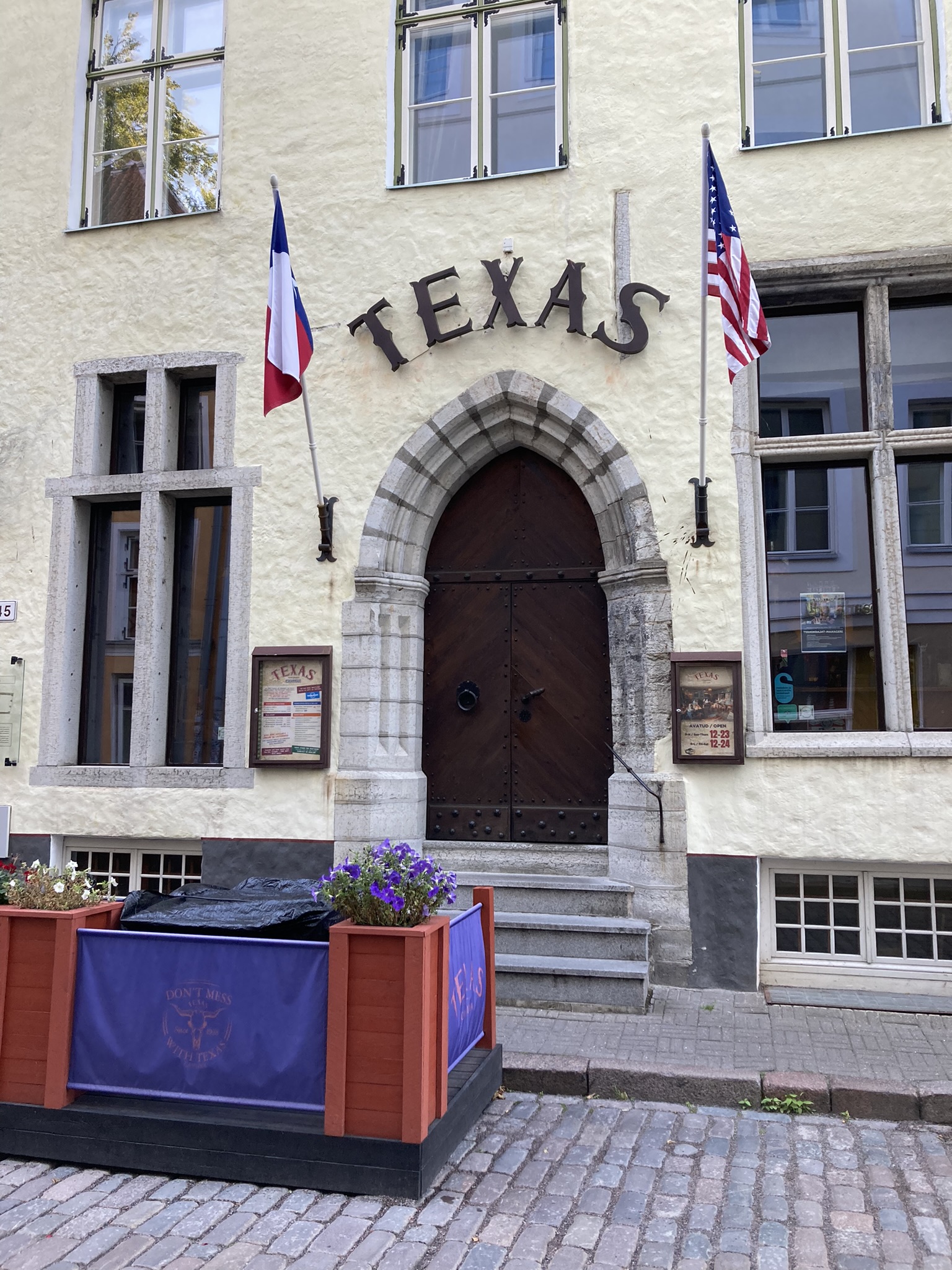
My apartment was in the main square, overlooking the town hall and a couple restaurants, which was a wonderful base for not only exploration but lounging at my windowsill, window agape, listening to the murmur of the crowd below and the chirps of the bird squadrons spiraling about the town hall’s weather vane. I thought I’d find coffee, so I chose an arbitrary direction and began walking. At seven in the morning, hardly anyone is on the streets. I soon found out why. Not even the cafes open until nine. I’ve been spoiled by America’s pre-dawn coffee starts, which probably ties into its more aggressive work culture somewhere. But I wasn’t too sad about it, given how genuinely incredible the old town part of Tallinn is. It feels like nothing has changed in the past six hundred years— winding streets of brightly painted wooden buildings built in the medieval style recall the architecture of the Hansa, and getting lost was a genuine pleasure. Somewhere on the north side I saw a Texas flag hanging limp on its pole, but realized it was almost certainly a Chilean flag. But no, it was Texas. What the hell.
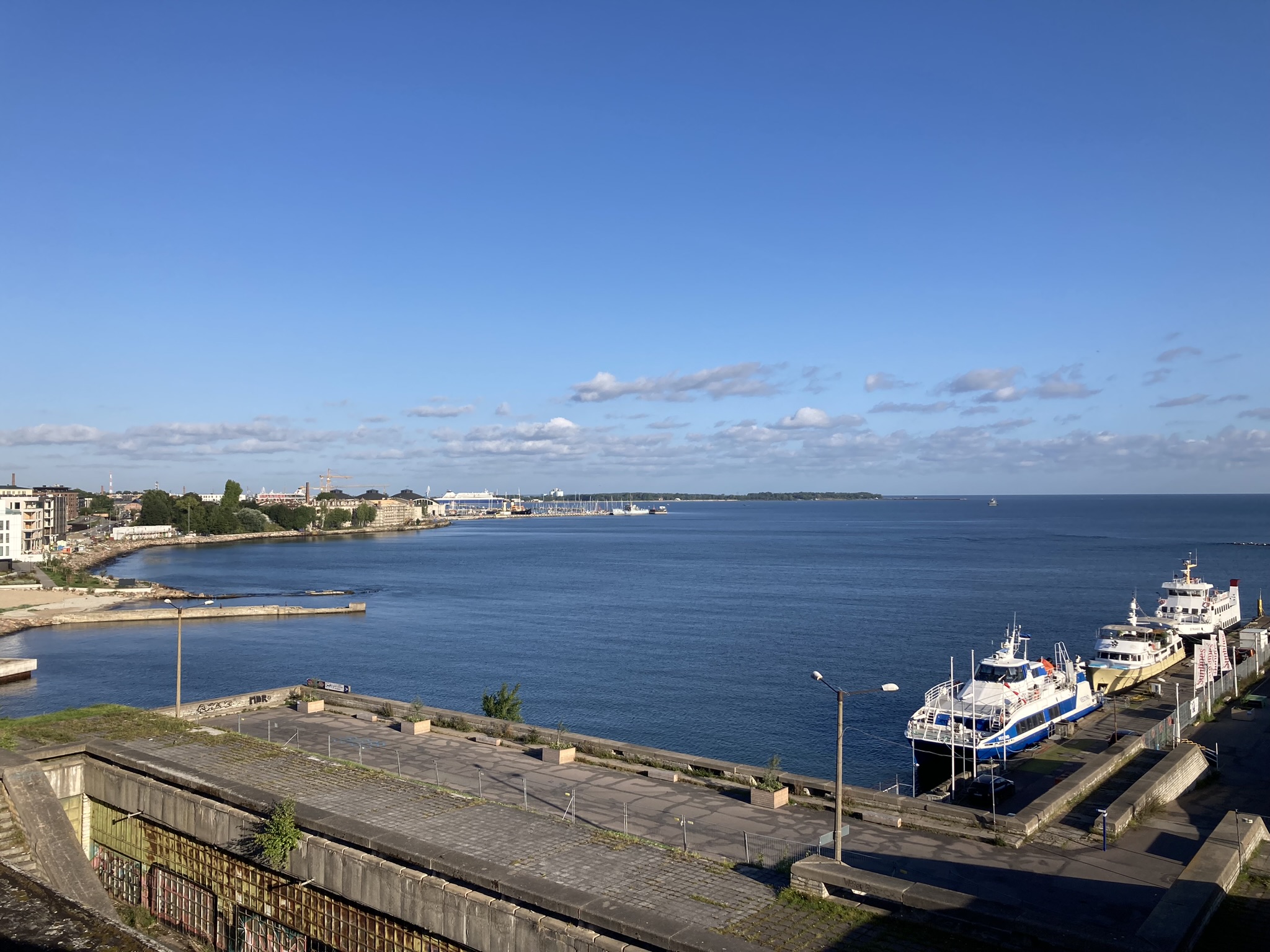
Eventually I tumbled out of the medieval maze into Tallinn’s harbor district, where I was met with a view of a gigantic stone monolith stained with graffiti. I found a lady walking her dog.
“Hi, what is that?”
She glanced over her shoulder. “Oh, have you seen the movie \random European movie?\> it’s like that.”
I said I hadn’t, and her confident smile melted into puzzlement. “Uhm, well, it’s a Soviet building, from the Olympics! But yeah, it’s a building. An old, forgotten building. You can climb it from that side!”
So I did. The view of the harbor was decent.
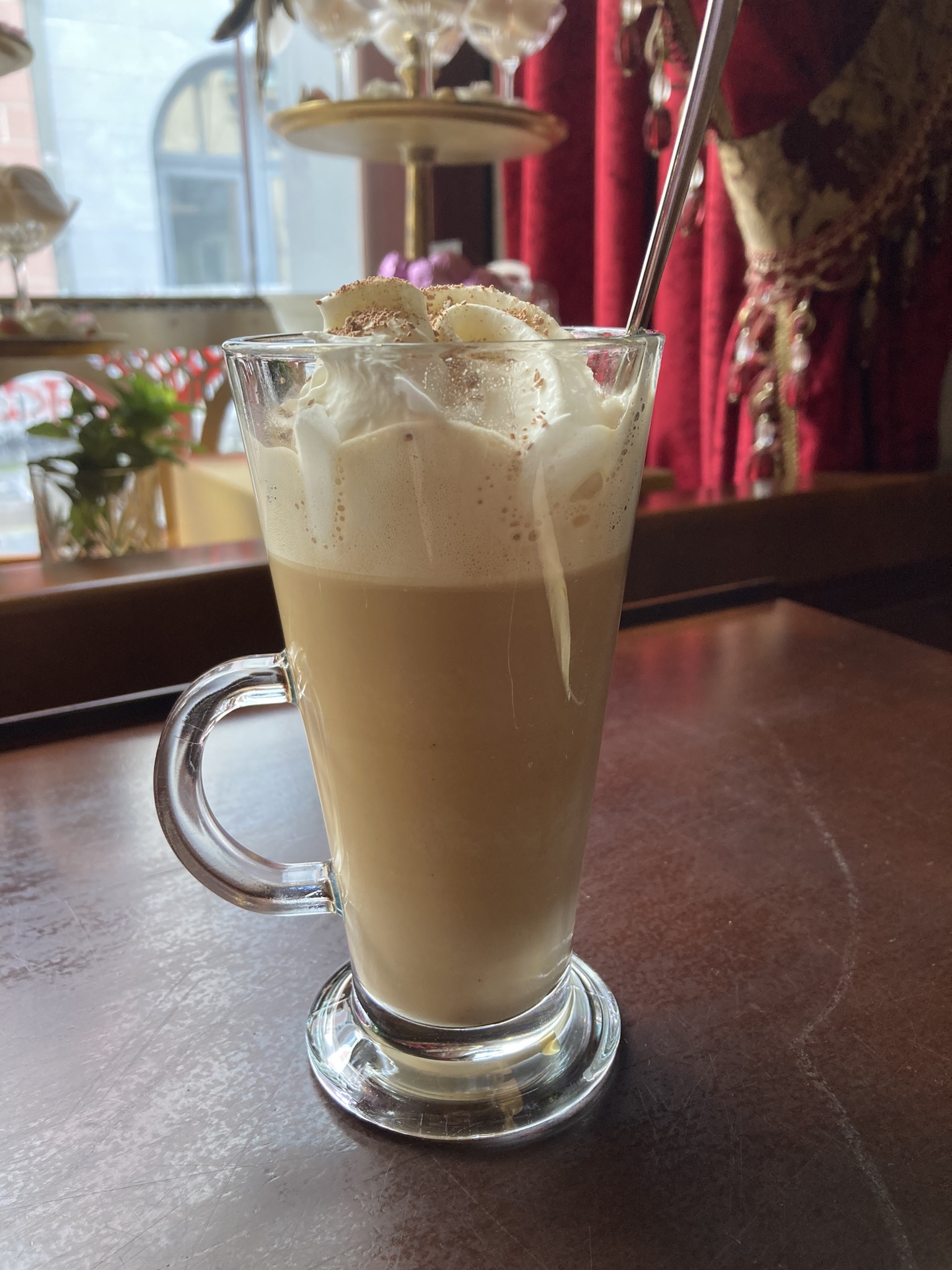
At this point, my watch was finally in sync with my coffee craving, and I found the cobblestones again and became the day’s first patron of Maiasmokk, a few-hundred year old cafe that titles itself the oldest in Estonia. The inside would truly take one of those bourgeoise 19th century Russian novels to describe it. Everything was covered in red velvet, the ceilings ornate and shiny, mahogany tables, chairs and bars, massive red curtains— it felt more like a French palace than a neighborhood coffeeshop. I ordered an omelet and the fanciest sounding coffee on the menu. Turns out it had liquor in it. Heh.
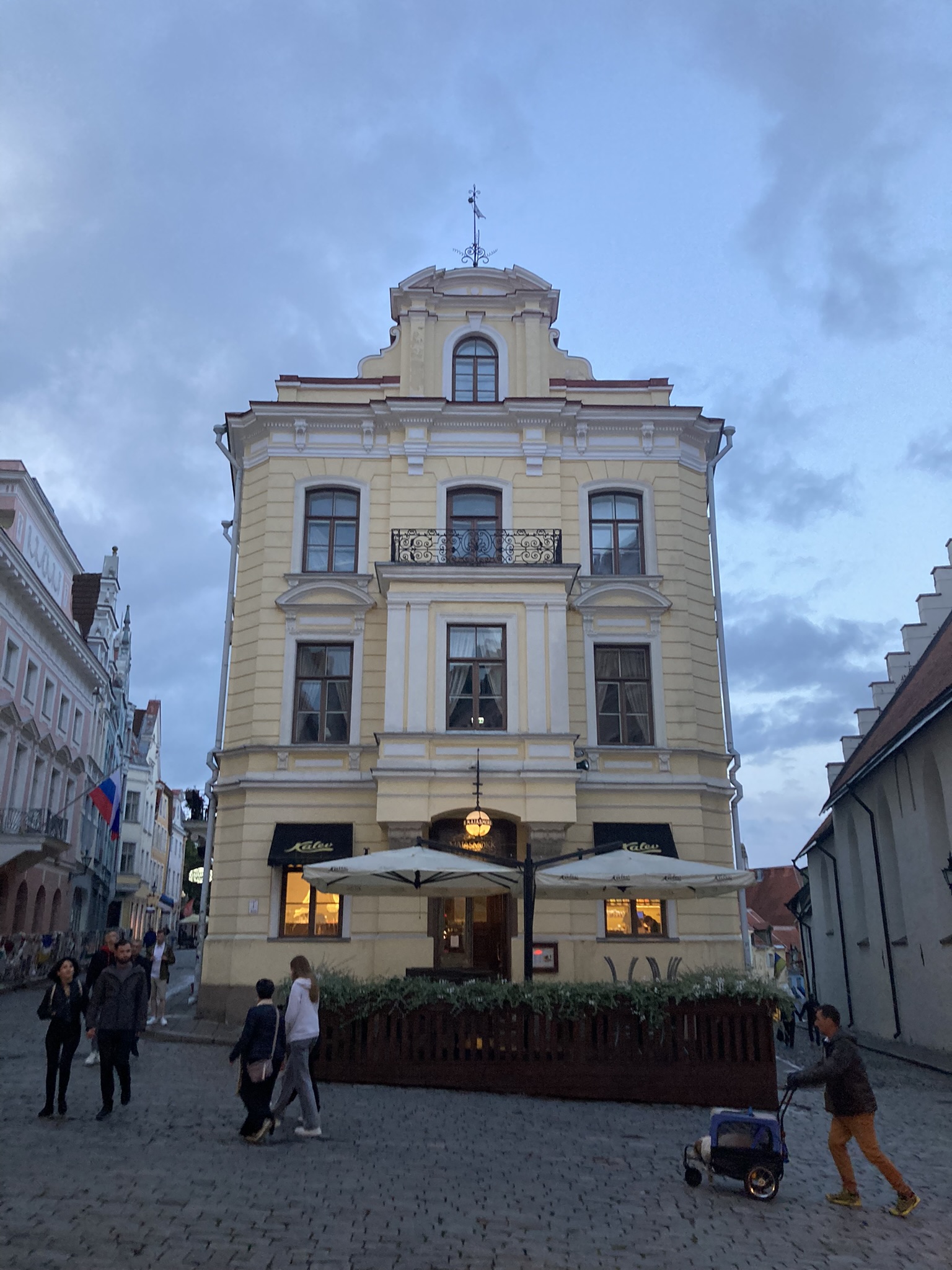
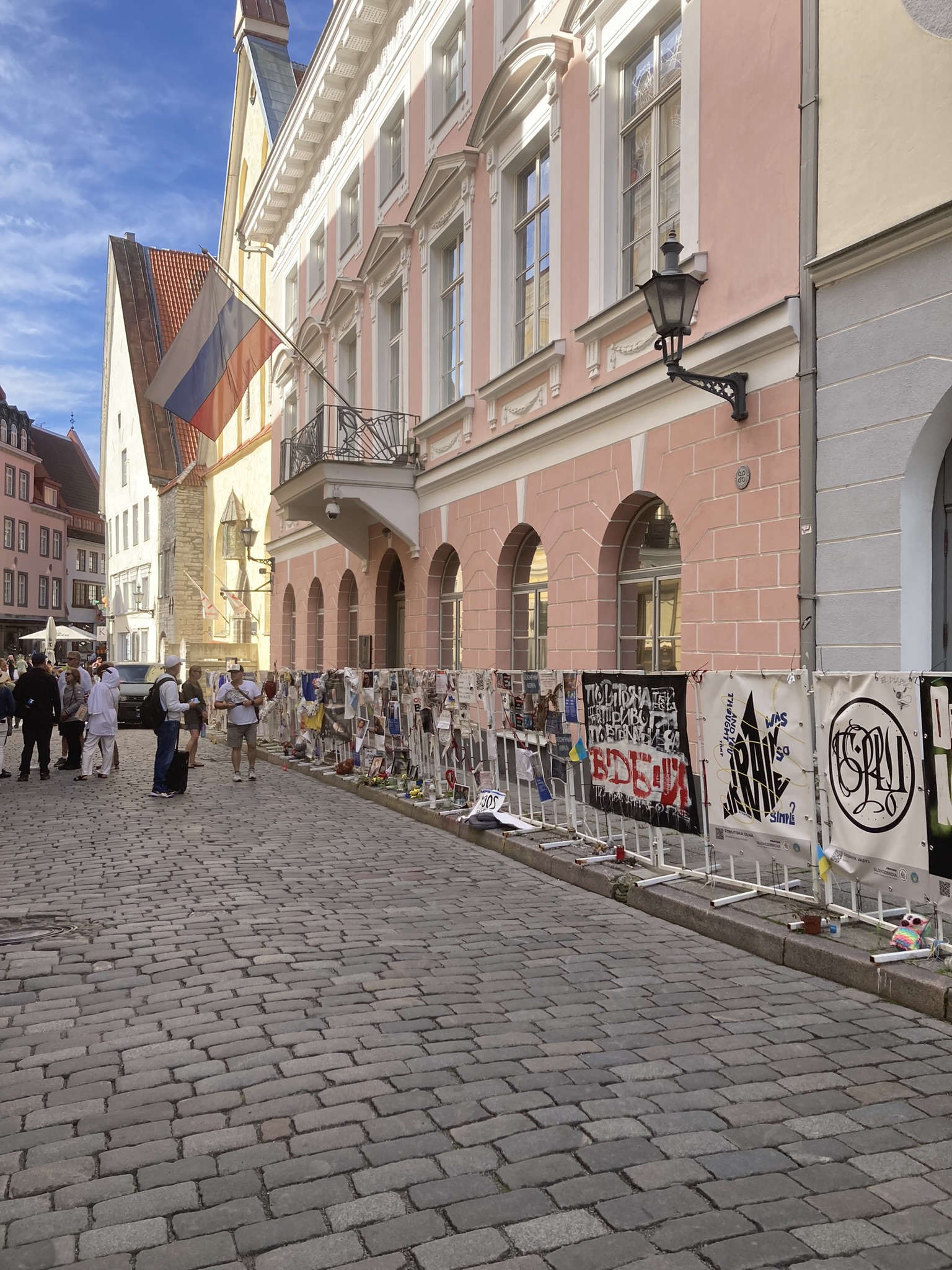
Right outside Maiasmokk was the Russian embassy, and I watched it through the window from my position at the counter. The Russian hung proudly over the door, but blocking the facade of the building from those that might seek ingress was a chain link fence, of which every square inch was plastered with anti-war posters. It was interesting, and reassuring to know the Estonian population held no sympathy for its former overlord.
After getting some liquor in me I thought it would be a good idea to climb something really tall, so I went over to the town hall and bought a ticket to the museum. The museum inside is really interesting, and a lot of the reliefs on the wall are really well preserved. I learned the weather vane has been up there for 594 years. His name is Old Toomas. The spire was a fun climb, especially with the extremely steep stairs, but the view of the town was worth it. There were a couple dudes up there at the top, which is a couple dudes too many for such a tight space, but they weren’t getting the hint that I didn’t like their butts pressed against mine so I went back down.
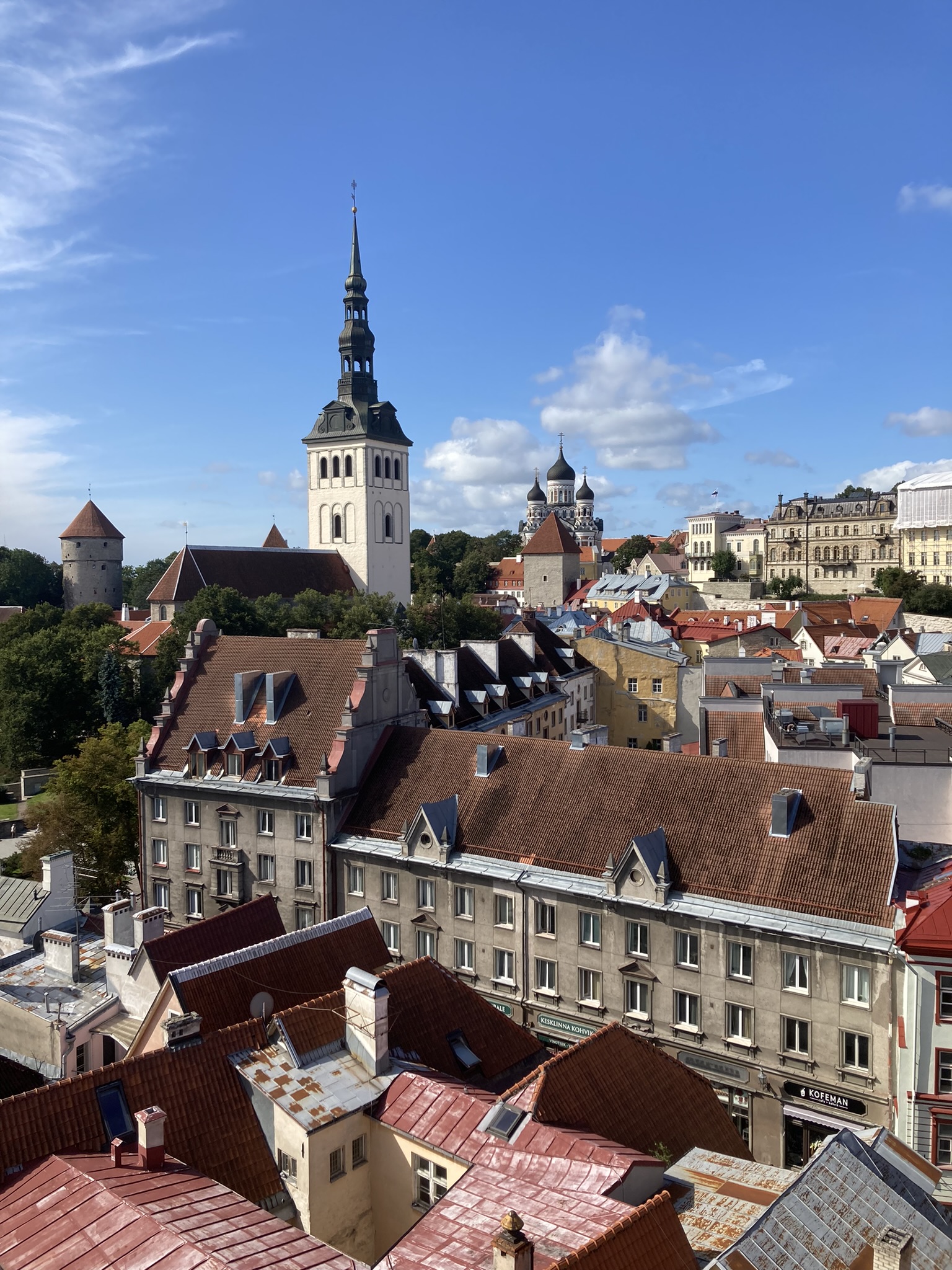
Next up was the Alexander Nevsky cathedral, which might be my favorite church in Tallinn. I’m a tad bit of a complete slut for Russian orthodox architecture. Entrance was free, since it’s an active church, but it was haunted by phone shaming babushkas so I didn’t get any pictures of the ornate inside.
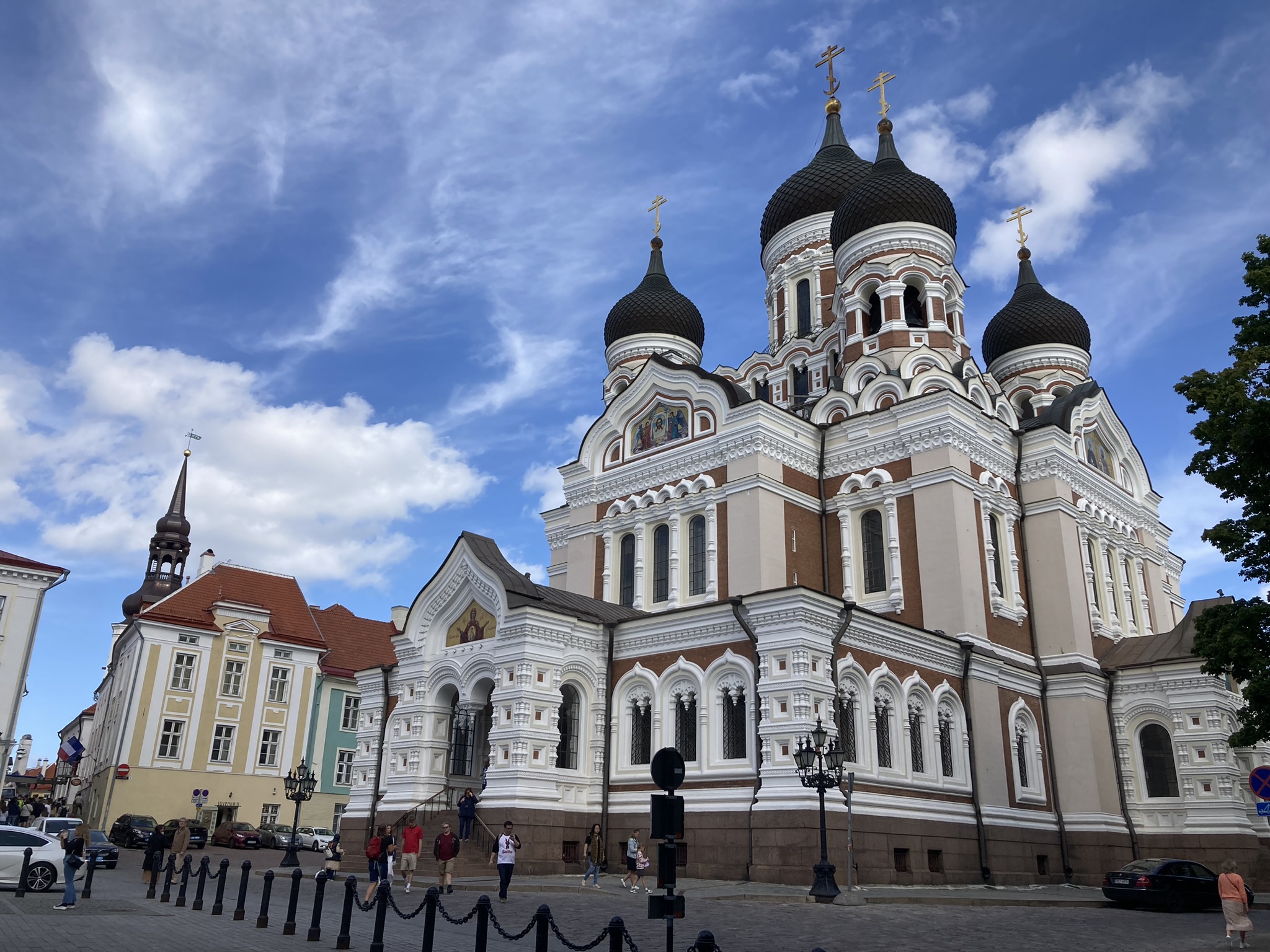
I continued on to Toompea hill, the tallest point in town, and took some pictures from an overlook. It was crowded with tourists and vendors trying to sell me traditional Estonian nuts. I didn’t want any traditional Estonian nuts, and I was feeling hot so I went back to the main square. Tarun requested I get boba in his honor, and I did. It was awful. Boba is not a thing yet in Estonia. Sorry, Tarun.
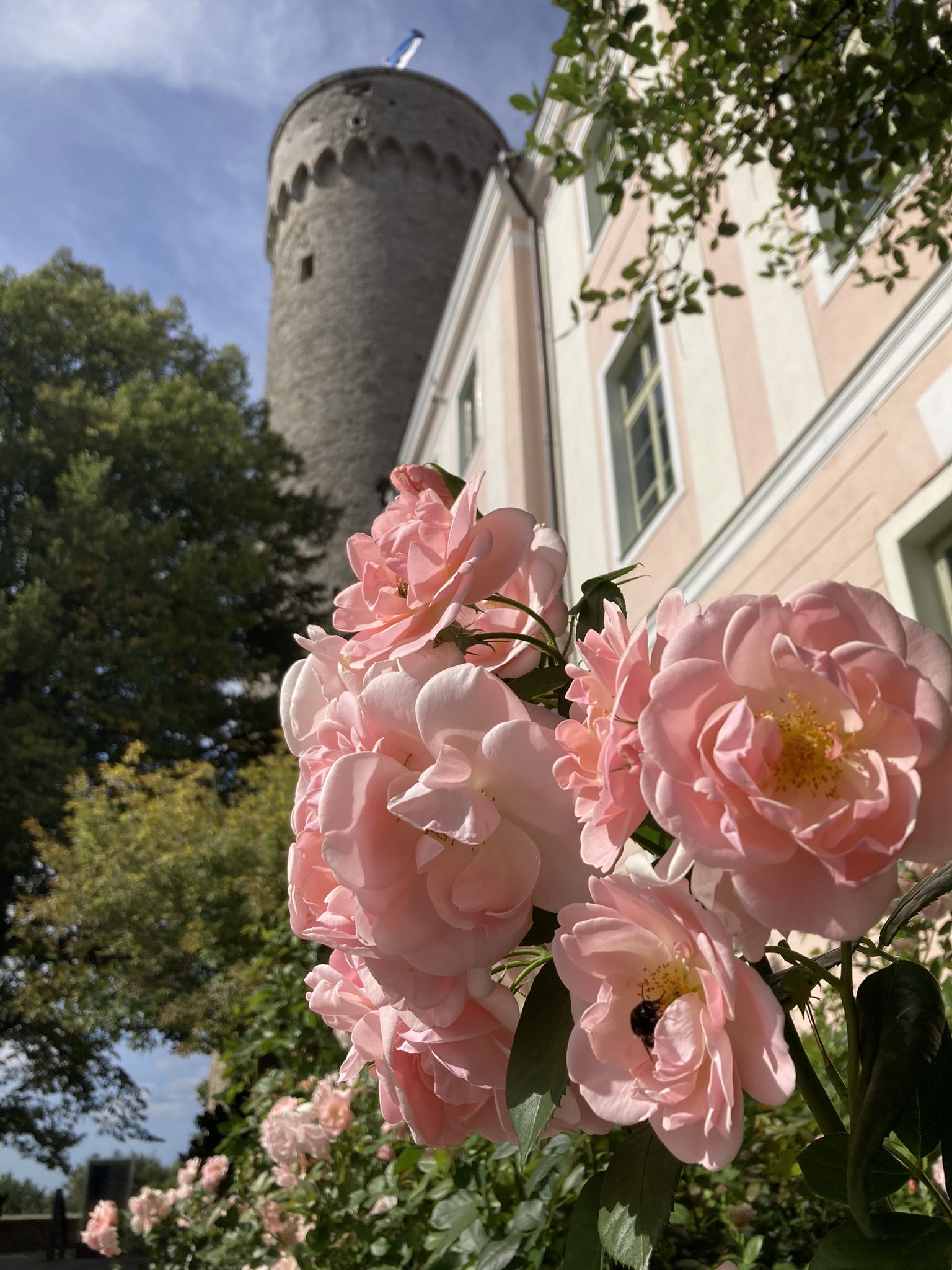
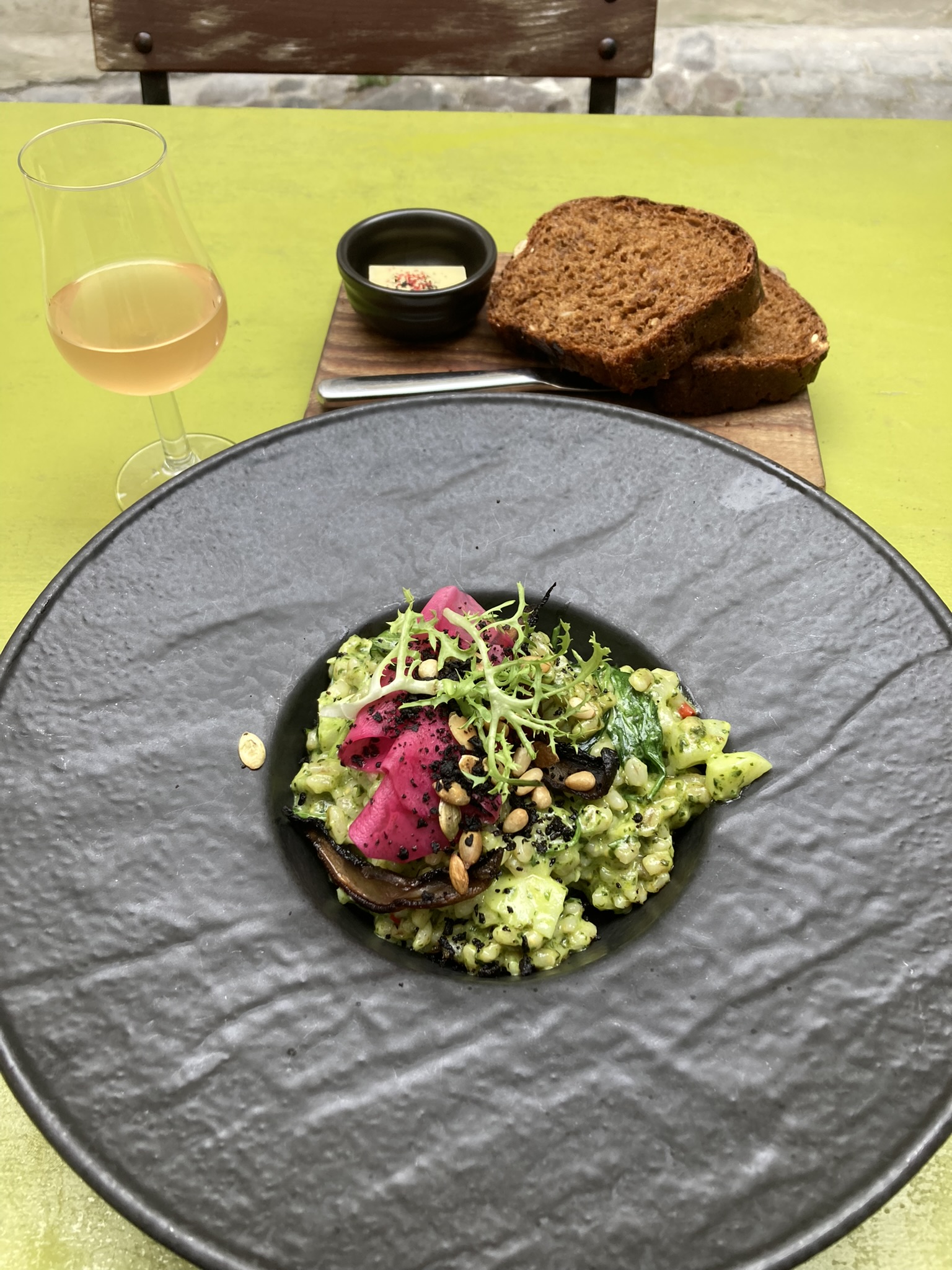
After some good old fashioned people watching I found myself in the mood for dinner, and went to a famous Tallinn spot called Rataskaevu 16. I had some spinach orzotto, fresh Estonian black bread, and rhubarb schnapps. I didn’t know what orzotto was before ordering, and I still don’t know, but it was delicious. I read in their garden a while afterwards and sipped my schnapps (I’m not gonna pound something I spent six euros on) until I noticed the sun was starting to set, and that overlook on the Toompea probably looks really pretty about now. I might be able to do some #goldenhour white girl nonsense. So I climbed the Toompea again and found the ledge.
There were still a bunch of tourists. Oh well. I waited for a pair of elderly Russians that made the siege of Leningrad look fast until the angle I wanted opened up and I flagged down a girl nearby to take my picture. Naturally, I took hers as well. I commented on her French accent, which stood out in the sea of Estonian accents I was getting accustomed to. She asked if I spoke French, since she was more comfortable with that than English, which afforded me the opportunity to continue my long streak of disappointing women. She was a PhD student from France, studying Tang dynasty poetry, and was in Tallinn this week to present at a conference at the university. We shot the breeze about linguistics and history and all sorts of fun stuff, wandered the town a bit, and then got dinner at one of the restaurants surrounding the square. Sure, it was my second dinner, but I wasn’t trying to kill the mood.
It got to be pretty late and I walked her to the tram, and we exchanged emails since I’m a weirdo that doesn’t have Instagram. Or Facebook. Or Twitter. Or WhatsApp. Or a working phone number in Europe. I returned to my apartment, showered, and crashed hard.
Tuesday, August 27th
I woke up naturally to the light streaming through the window, and stretched like a cat as I tried to remember what I was going to do today. Oh right, today I wanted to go to Finland. It’s a two hour ride on the ferry, and I wondered if I should book at the docks or online.
After browsing the time tables, I eventually pulled the trigger on a 45 euro round trip ticket departing at 1030 and returning at 730. Seven hours should be a good wholesome day trip, and honestly I didn’t have much I wanted to see in Helsinki. Or Helsingi, as the Estonians say. I gathered my stuff and started walking toward the harbor.
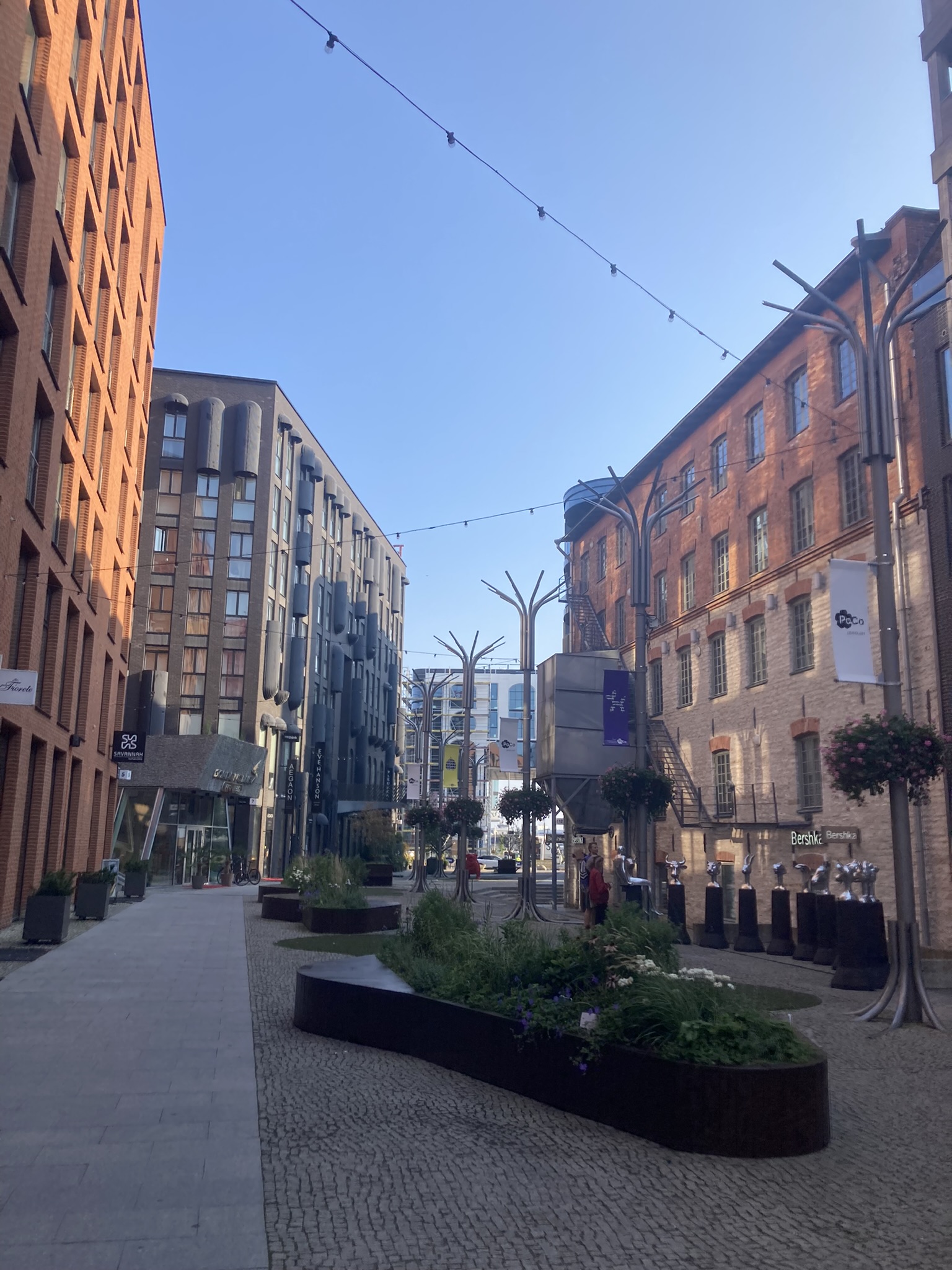
I had some time to kill, so I decided to seek out breakfast. Tallinn has a warehouse district near the harbor that has been gentrified into this trendy neighborhood filled with shops. It’s called the Rottermani Quarter, and it’s pretty aesthetically interesting. There was a Scandinavian-style coffeeshop I’d heard wonderful things about called Røst that was supposed to be one of the best in Tallinn, and I wandered between the warehouses until the world realized the magnitude of my frustration and hunger and finally allowed me to find the damn cafe.
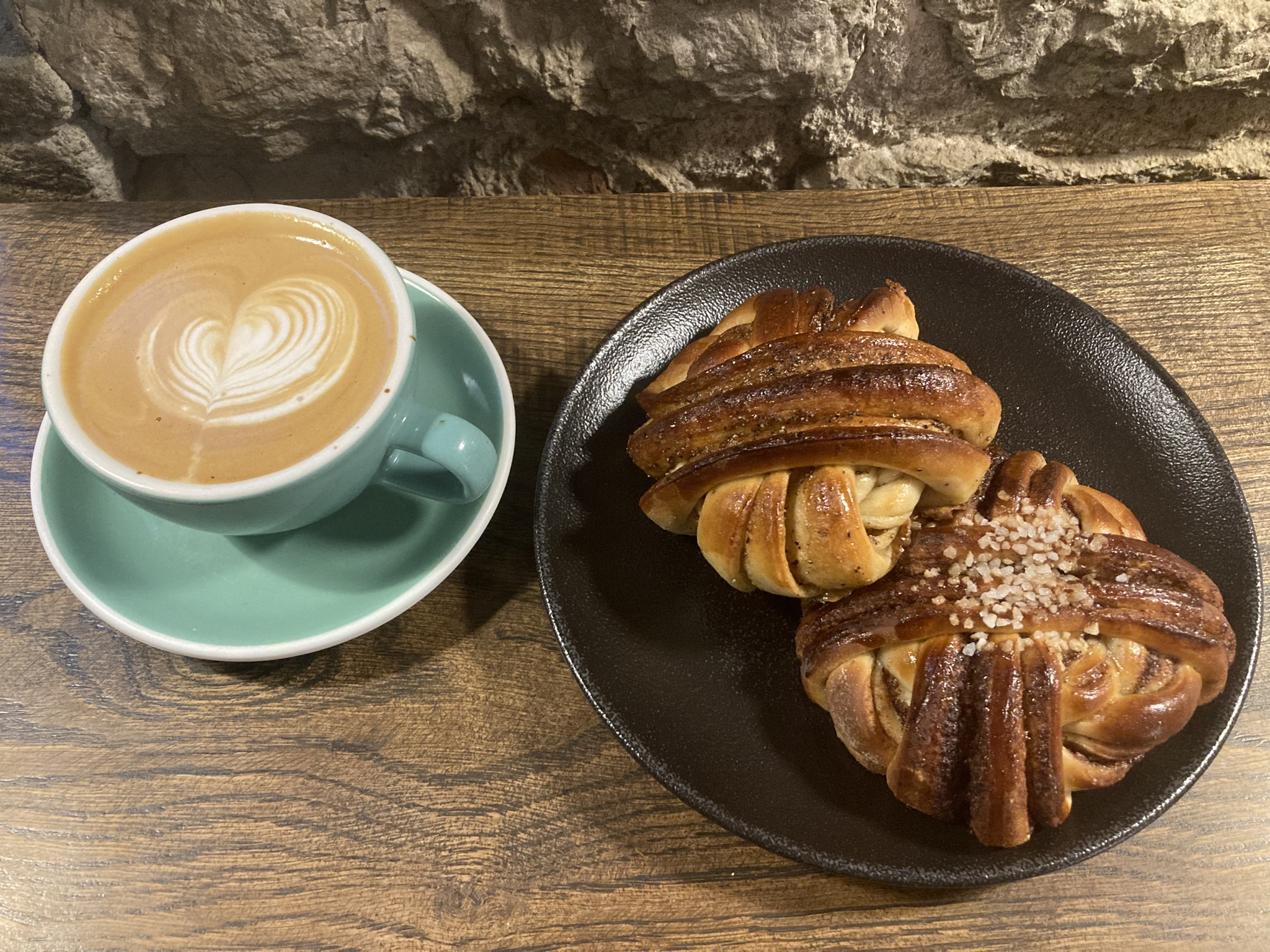
The queue was out the door. There didn’t seem to be any tourists, and about half of the patrons seemed to be students. That’s how you know a place is good. The vibe inside was quite nice— dark wooden tables and a very cozy ‘hygge’ decor. I had a cappuccino and two pastries and read a little by a window.
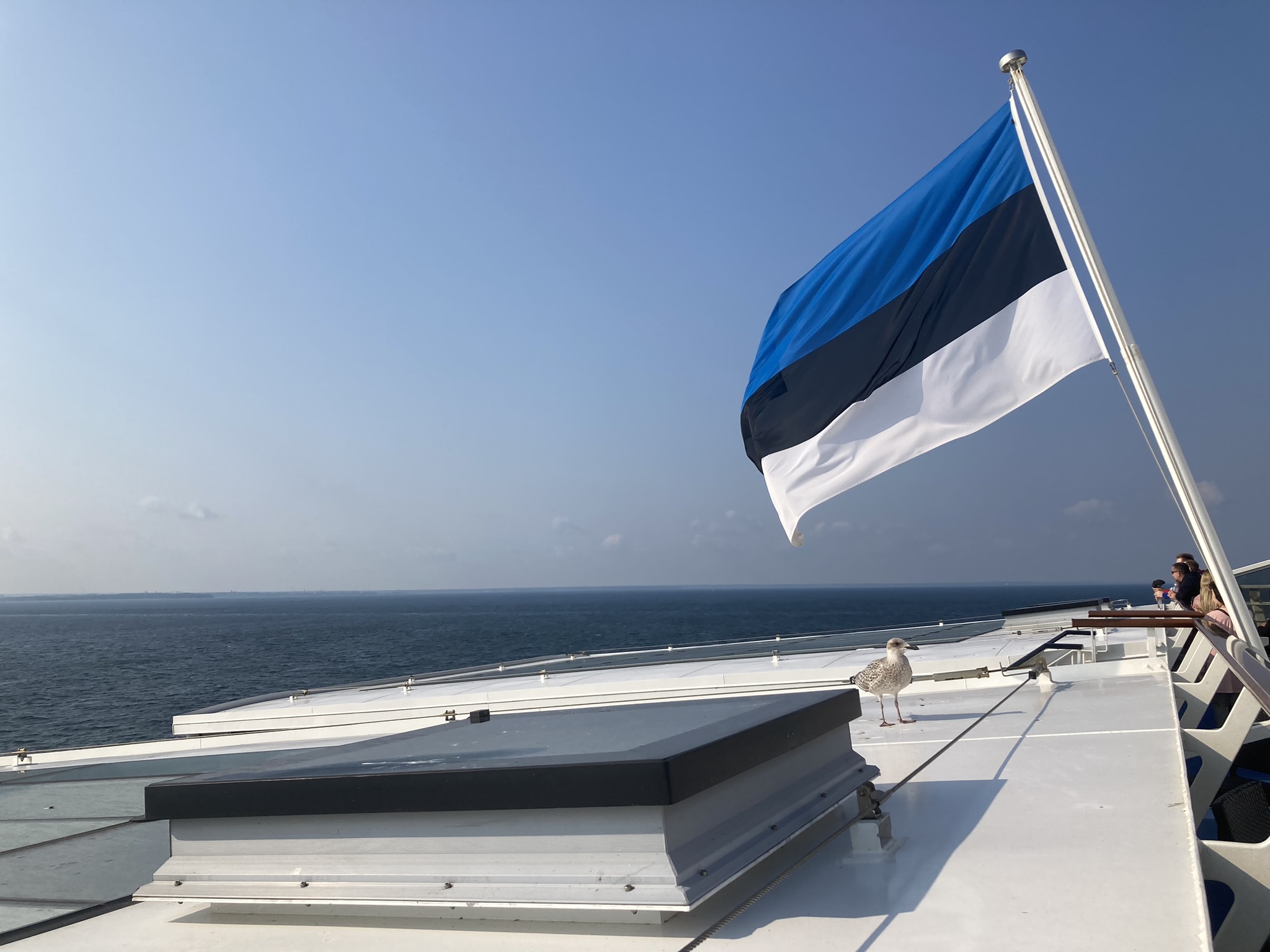
At about 9:55 I figured I should probably try to get to the ferry a bit early, so I stowed my book and walked to the dock. I’ve been on a lot of ferries in my life. The boat between Galveston and Port Bolivar is a ferry. The boat between Door County and Washington Island is most definitely a ferry. What I was standing in front of was not a ferry. It was most certainly a cruise ship. I climbed the four escalators in the terminal after scanning my ticket and wondered why the building was near empty. Surely with a boat this big they’d need a pretty hefty guest list to make any money. I looked at my watch the moment I stepped onto the ship— 10:09. Then an announcement in three languages graced the intercom. “All passengers have boarded, prepare for departure. I turned a corner and realized the thousand other people were already here, and had merely arrived at a responsible time.
The boat was comically big, with several floors of cabins, a parking garage, a buffet, a food court, a casino, a bar, and more lounge chairs than the population of Estonia could fill. I had very little interest in any of this though, I wanted to get outside. By complete luck, directions came through the cacophony of post-Babel chatter in Japanese— go up to deck 9, go through the casino, take a left after the first bar, go out into the sunroom, and take the staircase up. Duh.
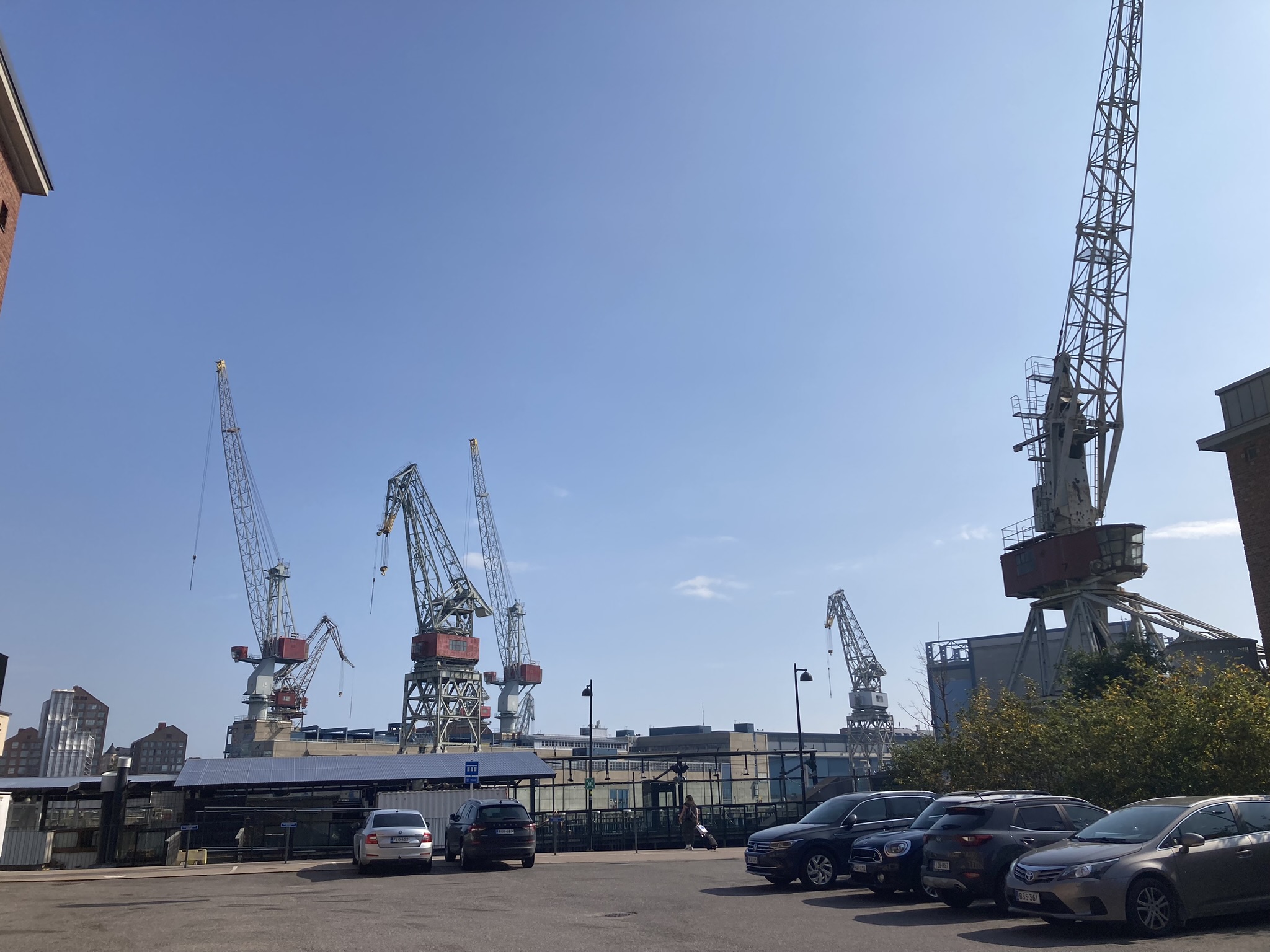
After an uneventful boat ride we made it to Helsinki and disembarked in the harbor. A bunch of people immediately hopped on a tram and I considered it, but figured it would be fine to walk into town. How far could it be? I checked Google maps. One hour. That’s how far it could be. Damn. Fortunately, the walk was nice, and I found all the cranes offloading cargo from freighters pretty cool.
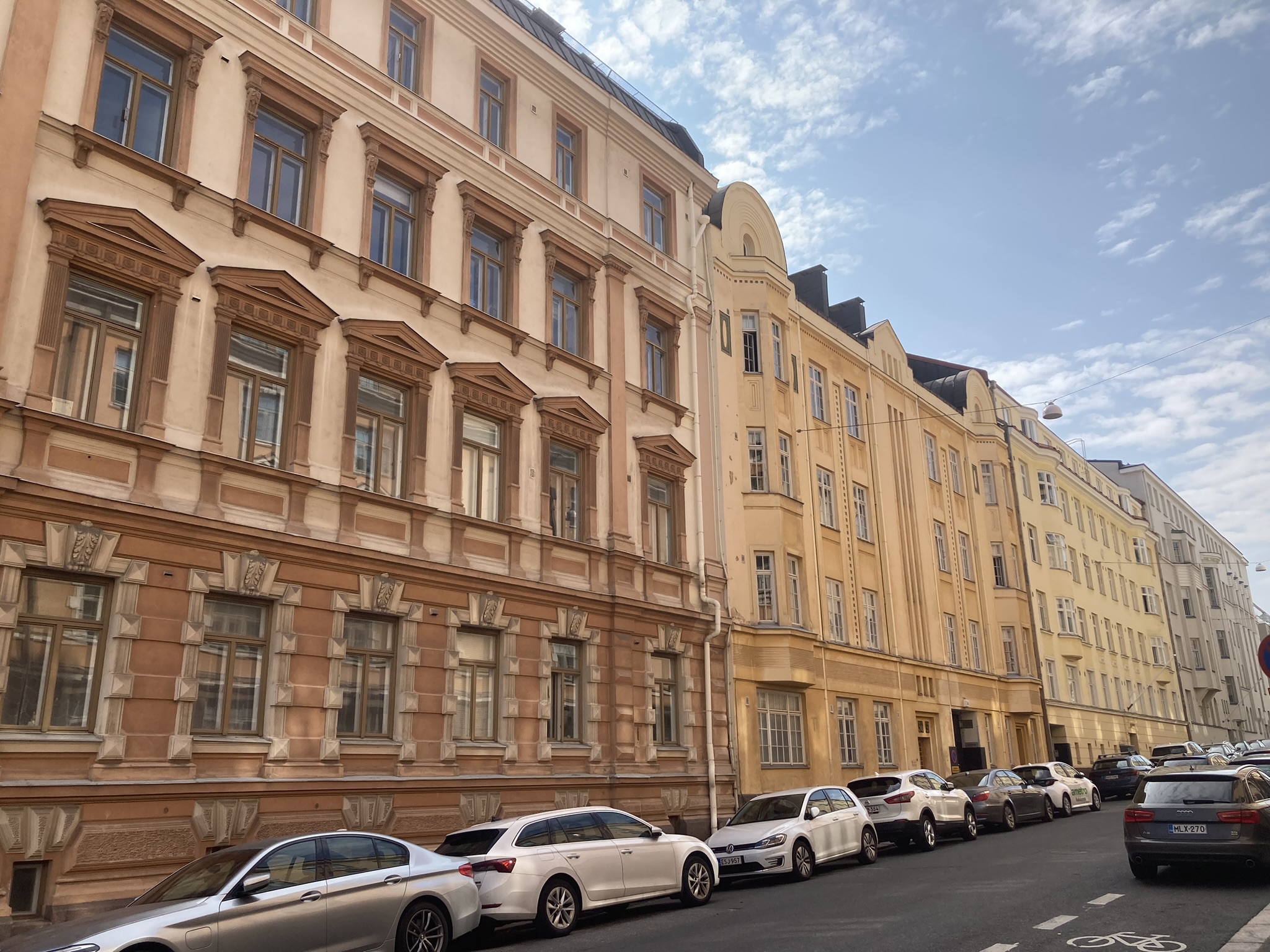
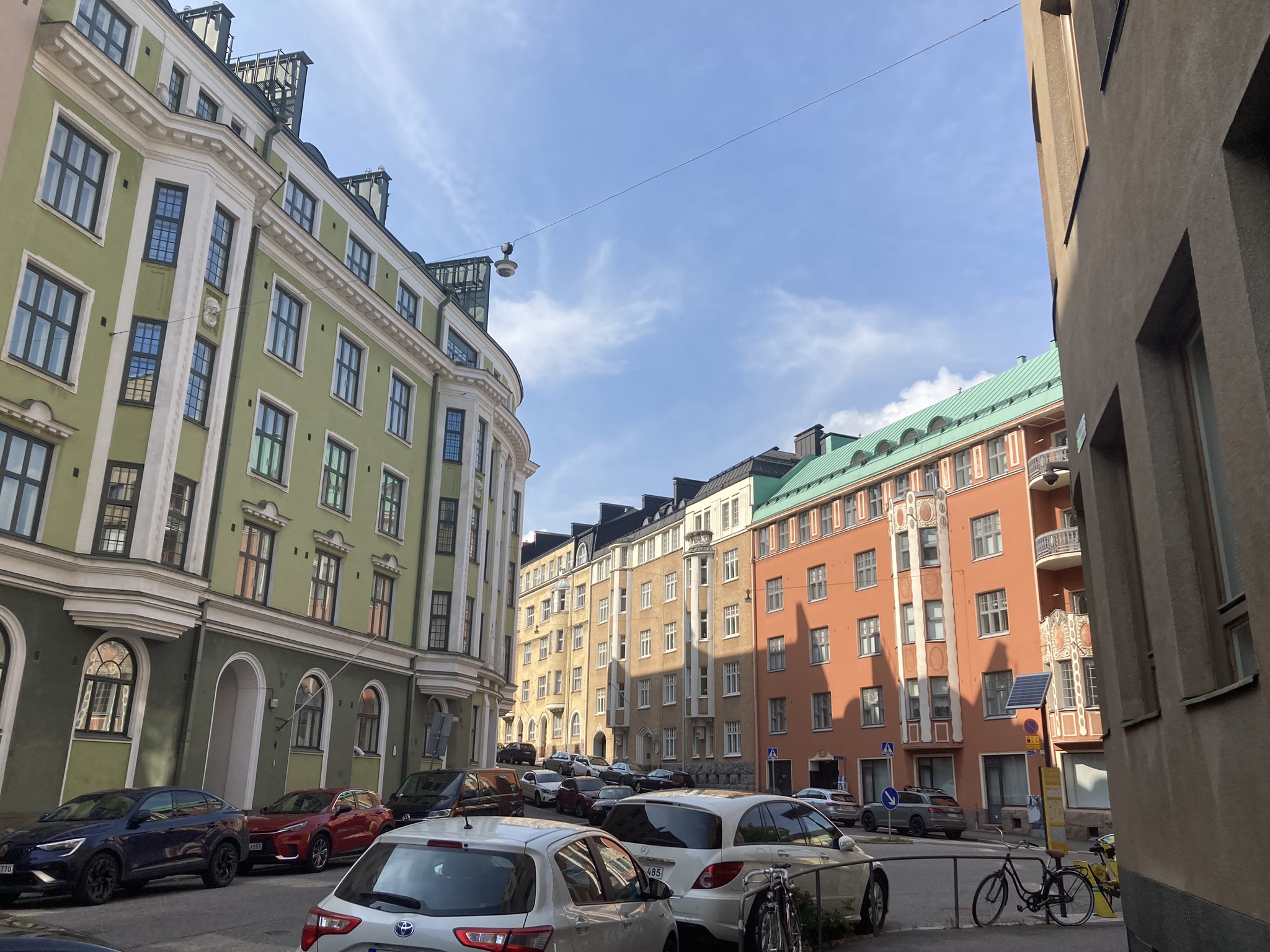
Helsinki, if you’ve never been, is a pretty cool city in general. I think the architecture is my favorite part— the streets are lined with buildings of 6 to 8 stories, with flat faces and neoclassical flare. The buildings are all connected, and painted orange, or yellow, or green, or beige. It gives the effect that you’re walking in a hedge maze, but the hedges are pastel and vaguely Corinthian. I assume there is some benefit to this— it probably keeps heat inside to have less surface area, and might protect the streets from the winds as well. A design as iconic as it is intelligent.
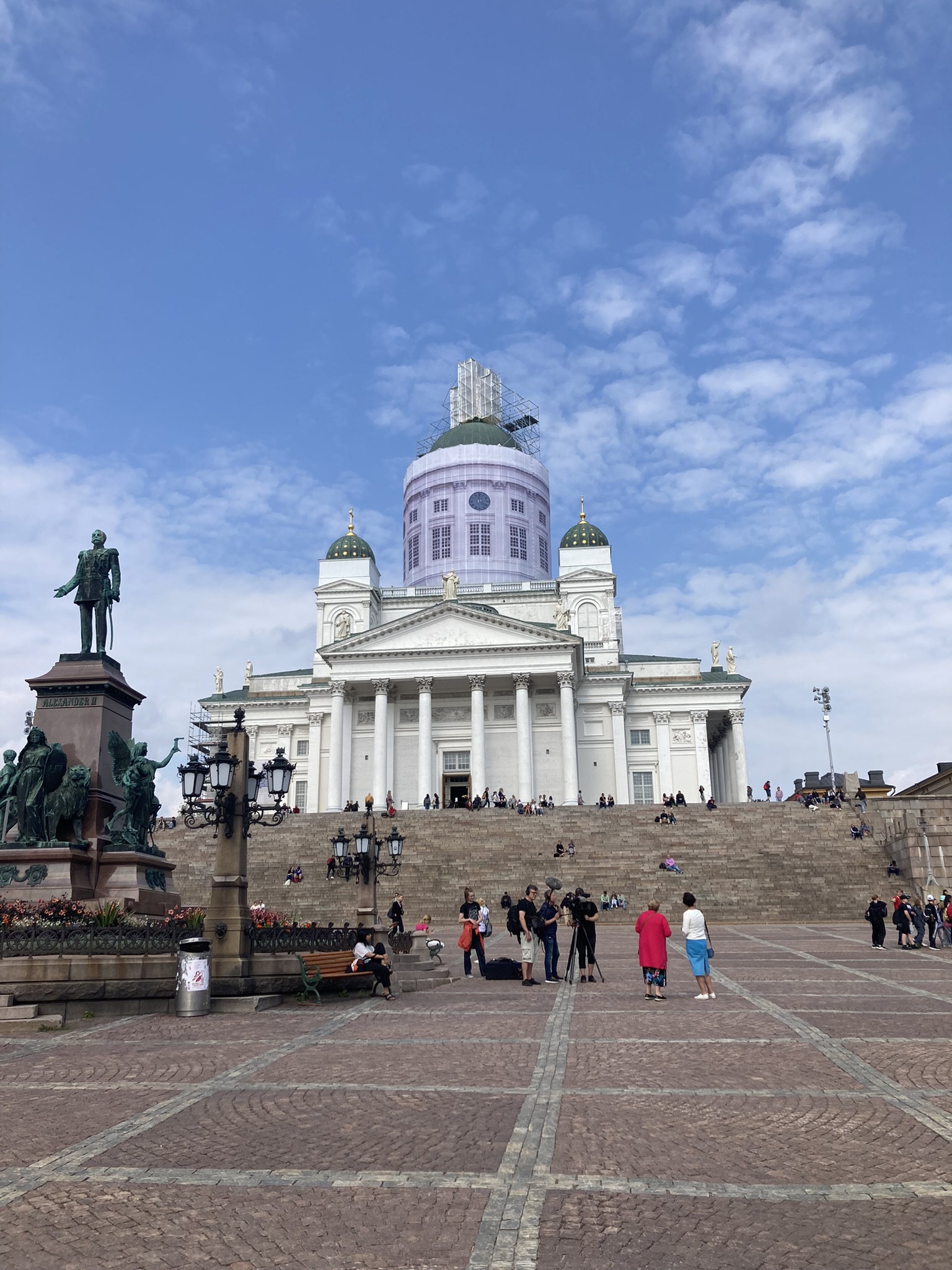
I found Senate Square at the center of town and bought a ticket into the cathedral. The Helsinki Cathedral was really the only thing in Helsinki I explicitly wanted to see, so I shelled out eight euros for a ticket and went inside. And looked around. And thought, ‘I paid two cappuccinos for this??’ The inside of the cathedral was incredibly spartan. Lots of pews, a large organ, and a busload of elderly Germans. I took the elevator down to the crypt, which was slightly cooler. They had a cafe down there. While in the cafe, an old lady bumped into me. “失礼します,” I said reflexively. “すごい!日本語上手!” I got out of there.
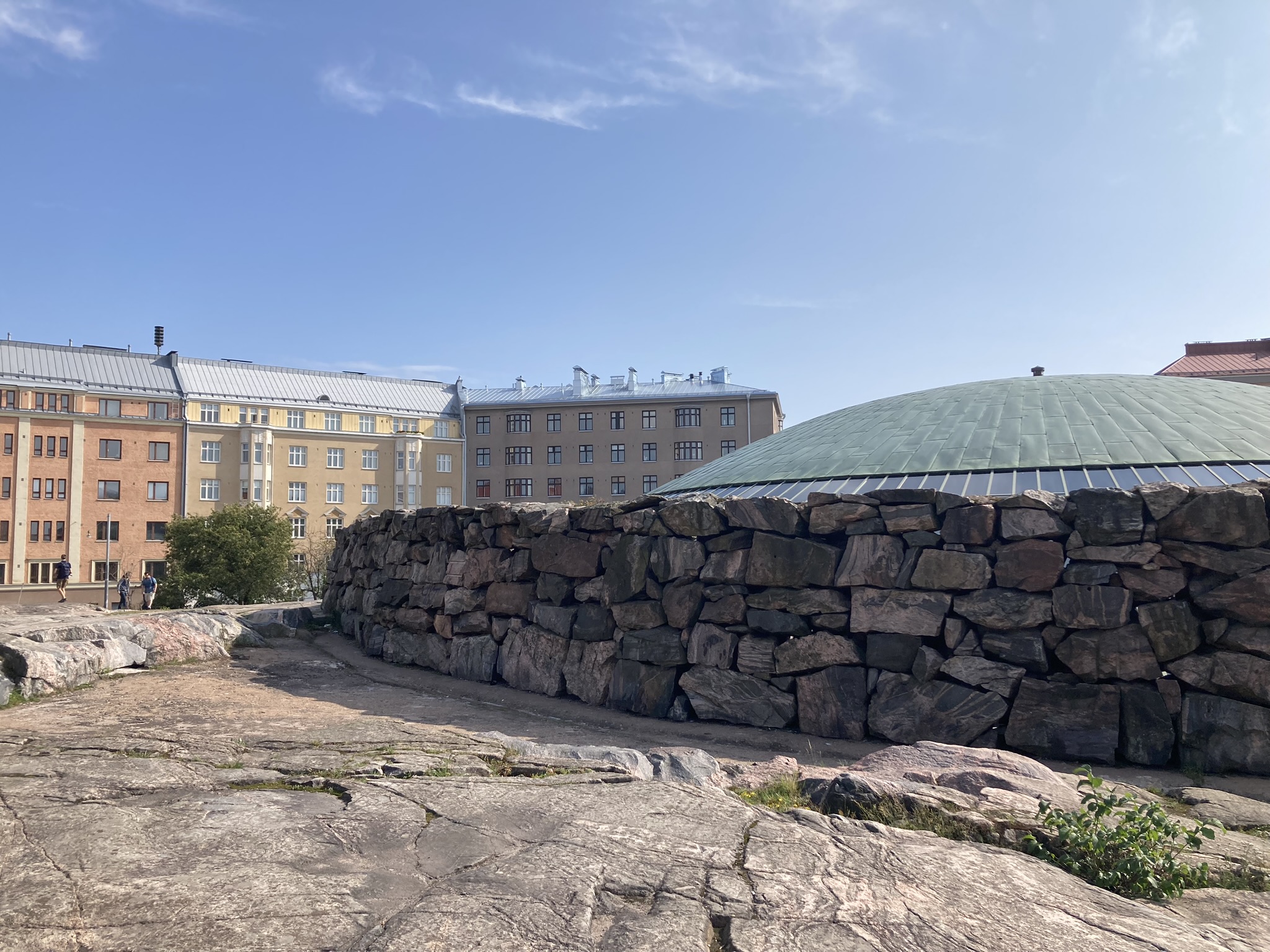
I didn’t really have anywhere in mind, so I just wandered roughly north until I spotted something I recognized– the Chapel of Silence in what looked like the square of a mall. It’s pretty famous and is supposed to be a shelter of silence in the middle of the city, but it was eight euros to get in so I decided I was fine with the noise. Seeing the chapel reminded me of another famous Helsinki church, the Lutheran Rock Church, which is a church carved into solid rock (who would have guessed.) I quickly found the church. “Yes of course you can go in!” the lady at the front told me. “Tickets are eight euros.” I did not go in.
Eventually my hunger drove me to check out local food recommendations, and I crossed over to the highly lauded Kahvila Rakastan, a little cafe in some lady’s house. It had vegetarian Karelian pies, a savory Finnish food, that I was excited to try.
“I’m sorry, I can’t read Finnish, are these vegetarian?” I said, pointing through the glass.
She looked slightly offended. “Everything is vegan.”
The effort the Finns go through in order to have vegan choices everywhere has my utmost respect. It feels like every third restaurant in Helsinki is vegan, and I noticed stickers on some of the lamp posts throughout town with little ‘Eat Vegan!’ style slogans.
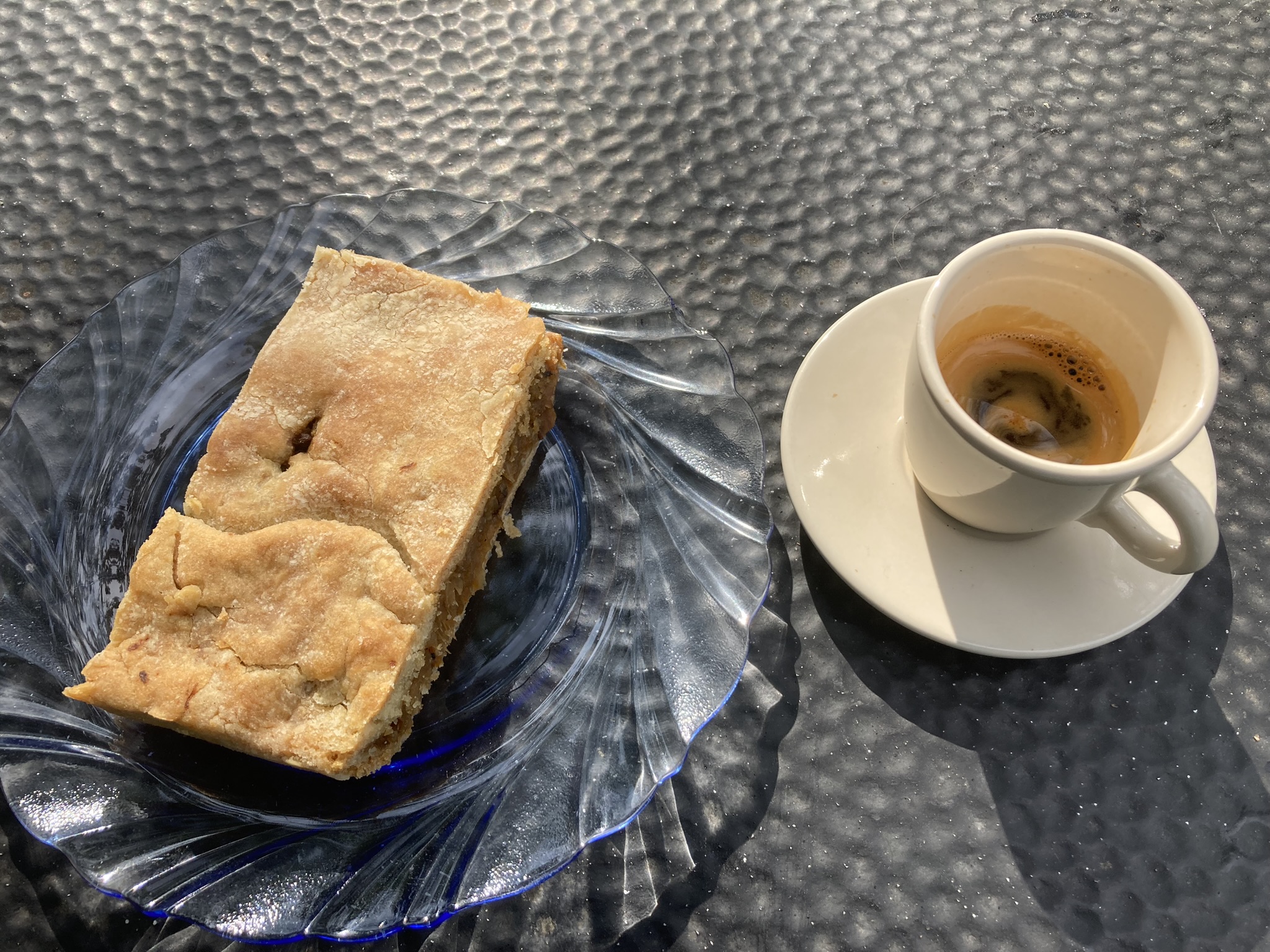
After finishing my Karelian pie and an espresso in the garden, I decided it was about time to start moving back through town, but the siren song of the Helsinki library as I walked by pulled me to my doom. I’m a bit of a library enthusiast. I think they’re one of the final third spaces we have as a society in which we can comfortably be around other people without the prerequisite of spending money, and I always like to see the libraries that other places enjoy, because in my head that’s directly equivalent to the quality of the place’s social value. And yeah Helsinki absolutely dominates.
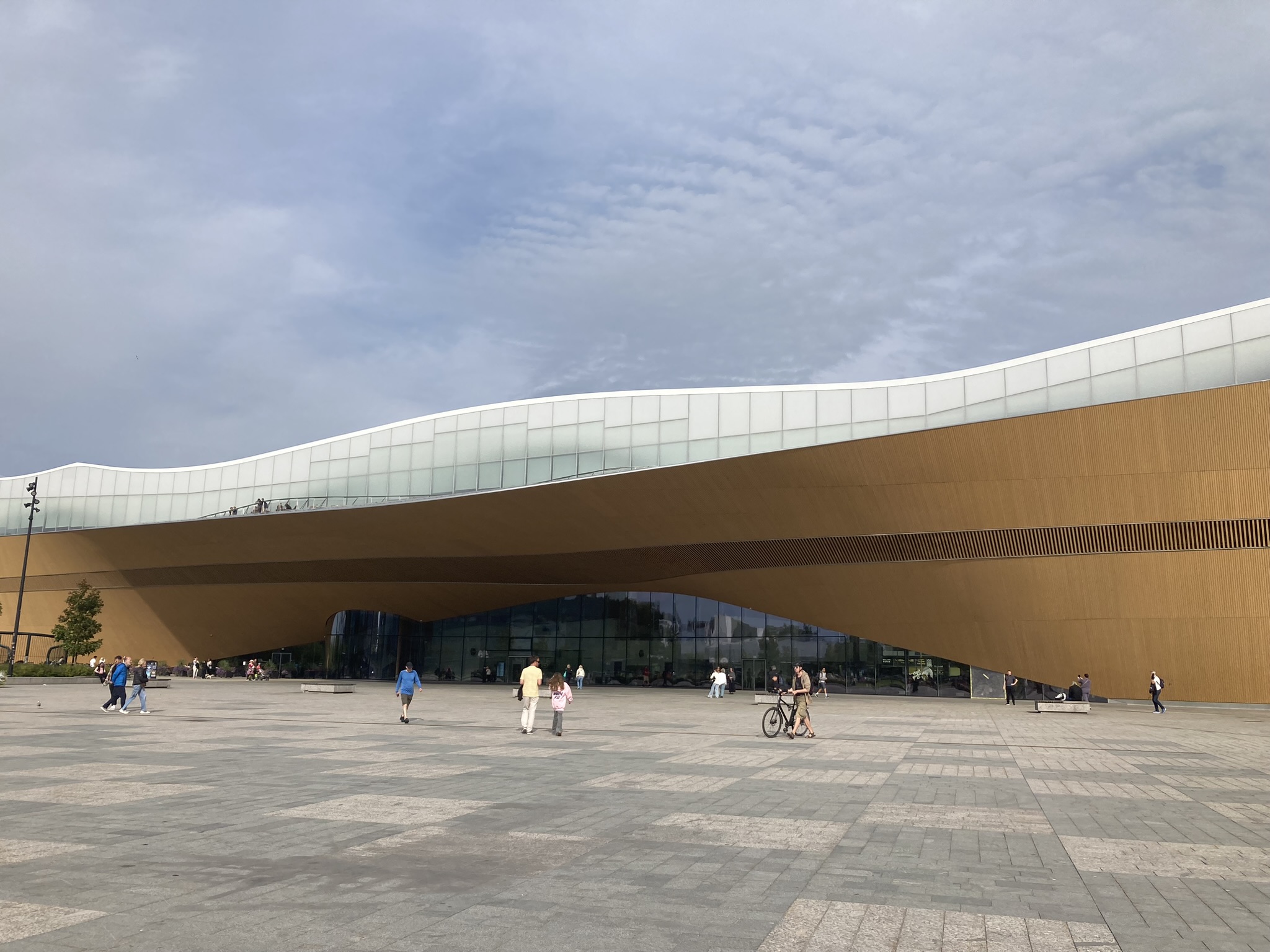
The library was packed with people of all ages, and it felt incredibly lively. There was a floor filled with 3D printers, and a kid informed me about the toy he and his friend were currently printing. I saw glass-walled study rooms where two men were playing Mario Kart next door to a gaggle of high school girls projecting biology notes onto the wall. A few left turns led me to a series of sound-proofed recording booths where people were borrowing instruments to track the latest Finnish coffeepop EP. And of course, a floor with books.
So let’s count them off. Finland has a neat history and culture. Finland has an extremely high freedom index and global happiness score. Finland reinvests its tax dollars back into the community. Finland has a robust public transportation system. Finland is vegan. What a terrible country to know about but not live in.
Wallowing in my sadness, I find myself approaching the harbor once more when I notice a lightship. I’ll admit it takes me a few glances before it locks in. Lightships are never in places you expect them, but once I realized what I was looking at I practically ran on deck. Right up to the bar. It was a bar-turned-lightship. What the hell, Finland.
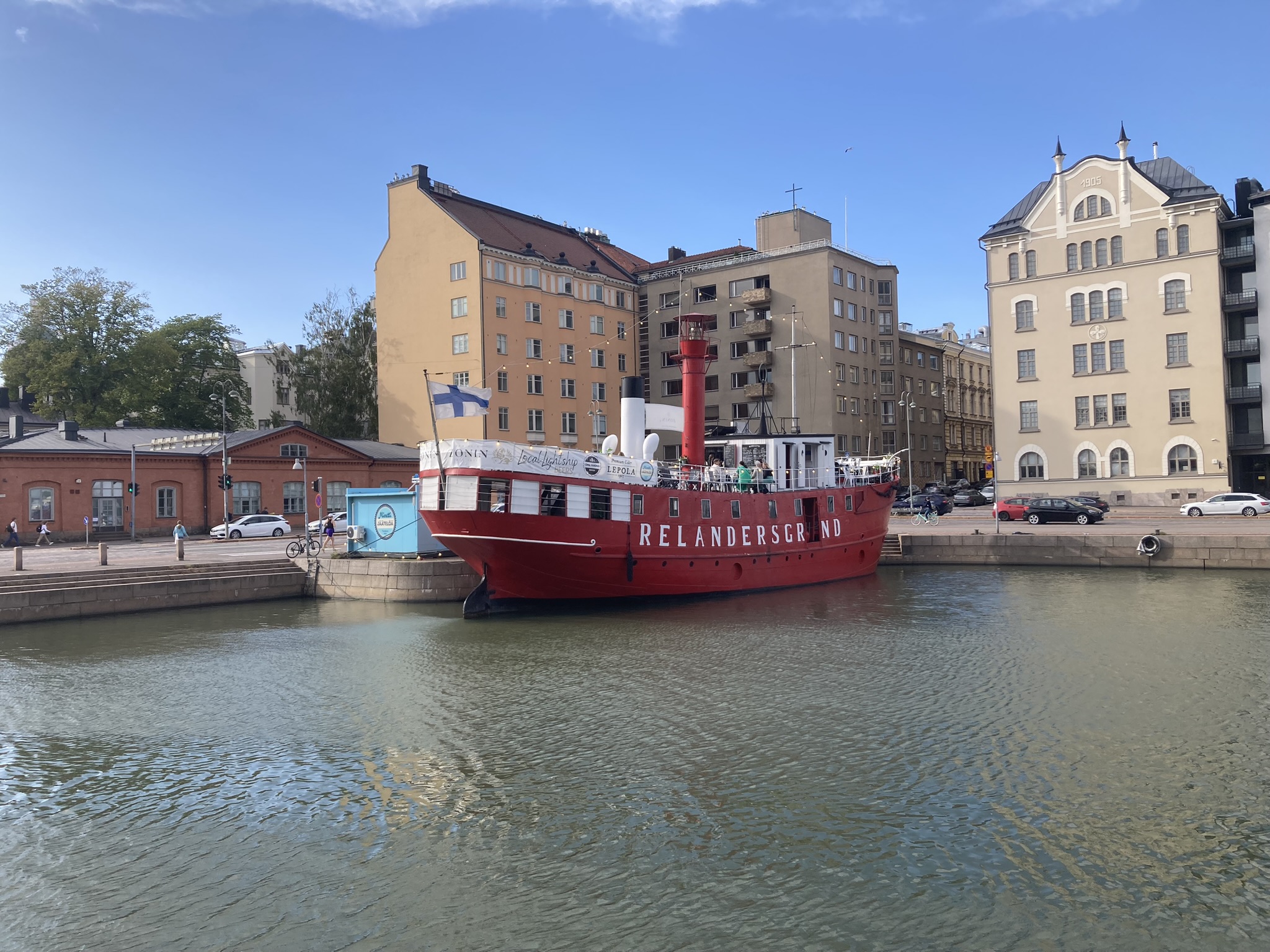
After chatting with the bartender and later the owner, I came to learn that this vessel, the Majakkalaiva, was one of several lightships built by imperial Russia in the 19th century. This one sank during the October Revolution when some drunk sailors took it for a celebratory joy ride and wrecked it in the Tallinn harbor, but the Finnish government pulled it back up and it passed between hands until it eventually wound up a restaurant in downtown Helsinki.
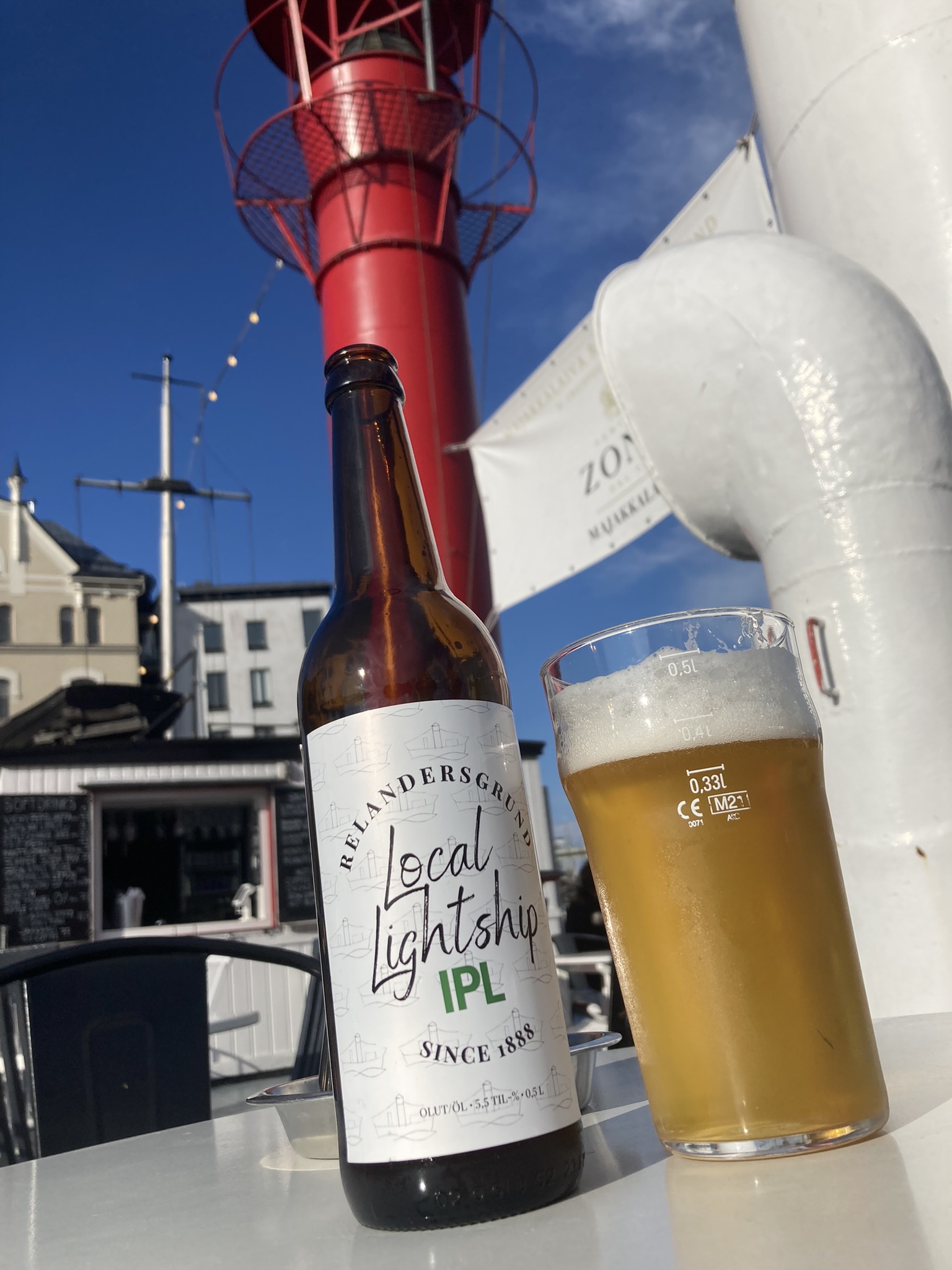
I wanted to be supportive, so I ordered a beer. I drank about half of it and realized I had to get going, so I brought it back up to the counter.
“It’s really good, but I’ve forgotten I don’t like beer. Take care!”
The bartender looked stupefied.
With my time in Finland at its end, I returned to the ferry exhausted and overstimulated. I had some plant based chicken nuggets off of Burger King’s vegan menu (what the hell, Finland) and took the long way home from the harbor.
Wednesday, August 28th
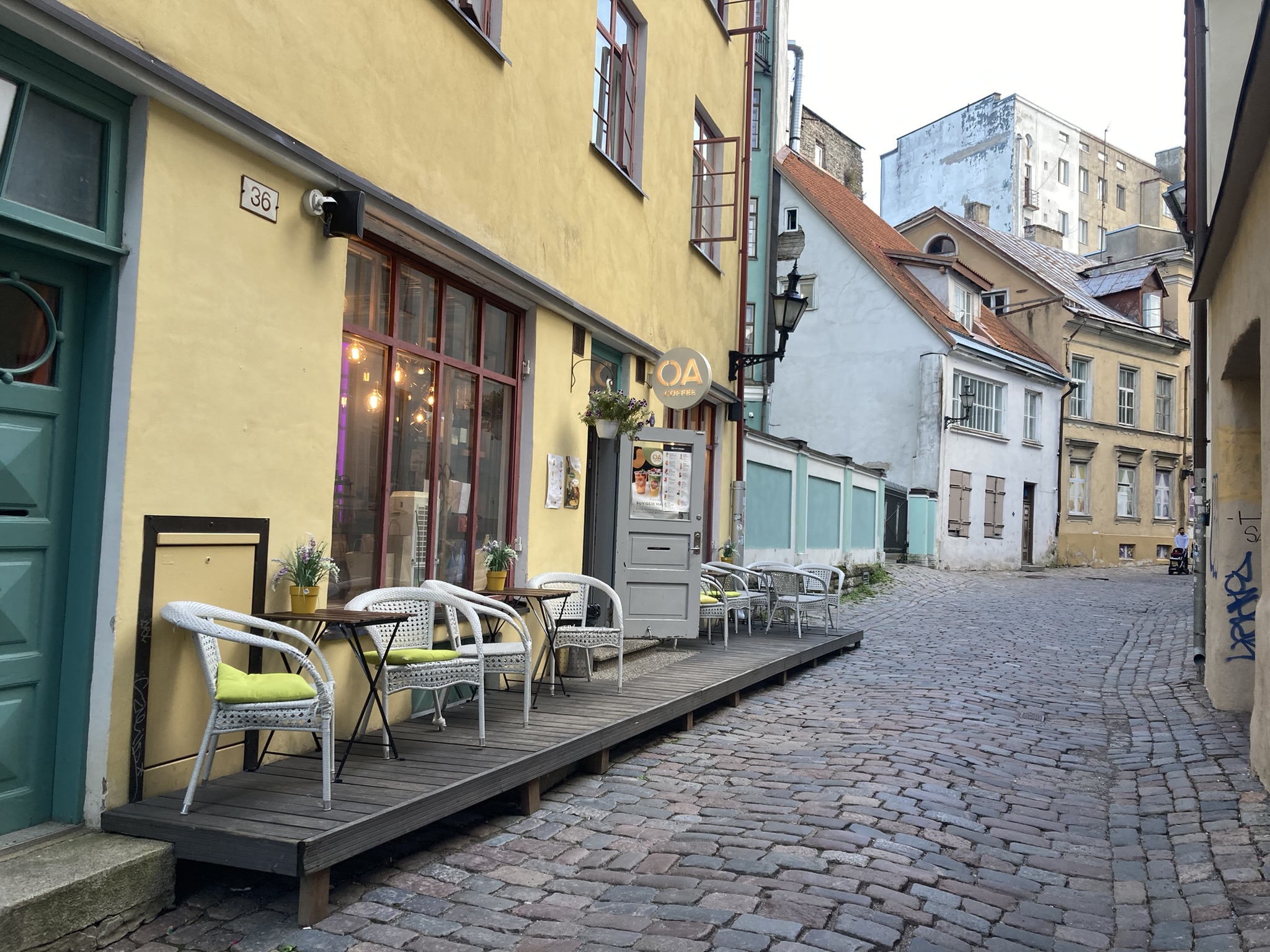
Having mostly conquered my jetlag, I woke up around nine and reveled (there’s a pun there) in the idea that for once, I wouldn’t have to wait for a coffeeshop to open. There was a place in particular I’ve had my eye on, Oa Coffee, a tiny little establishment in the town wall by the Viru gate. The walk over was uneventful. The day was uncharacteristically warm, but still pleasant to my Texas sensibilities, and not many people were out and about yet. The girl behind the counter at the cafe suggested an avocado and hummus sandwich to go with my cappuccino, and I took both of them at a small table on the street outside the cafe where I read a bit and watched the first tourists of the day discover this narrow alley of a street. I hadn’t had bad coffee at all since arriving, but this was probably the best I’d had thus far– bitter, but not too bitter, and something of a chocolatey undertone.
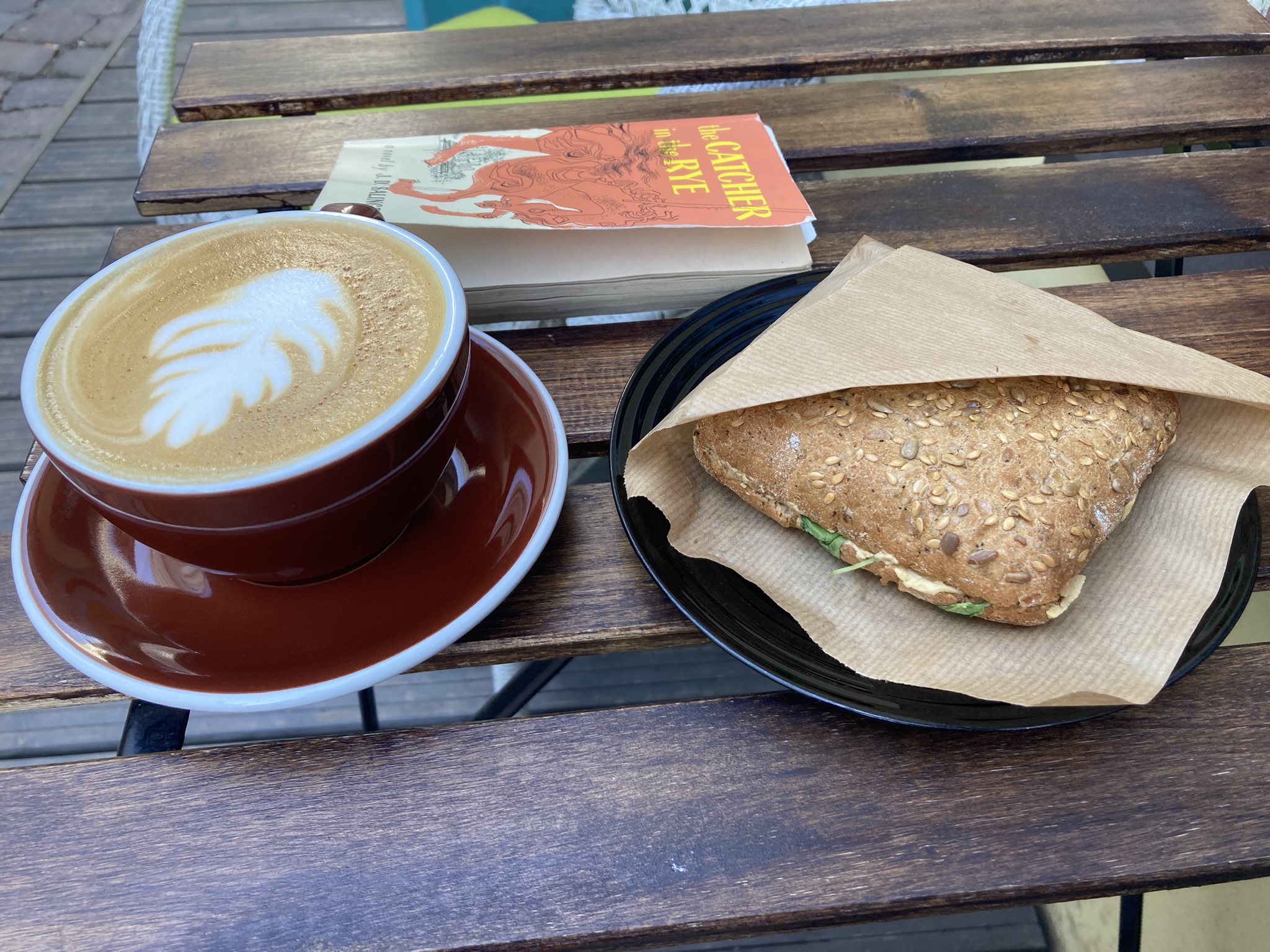
The barista met me in the doorway to take my plates and cup (I always forget they come come pick it up for you here after you leave) and I set out on my merry way to the eastern half of Tallinn, where I planned to find the two range lights that the city had to offer. As I walked, I stumbled across some extremely pretty neighborhoods that reminded me of Hyde Park in Austin, and I couldn’t help but listen to Beabadoobee as I sauntered along.
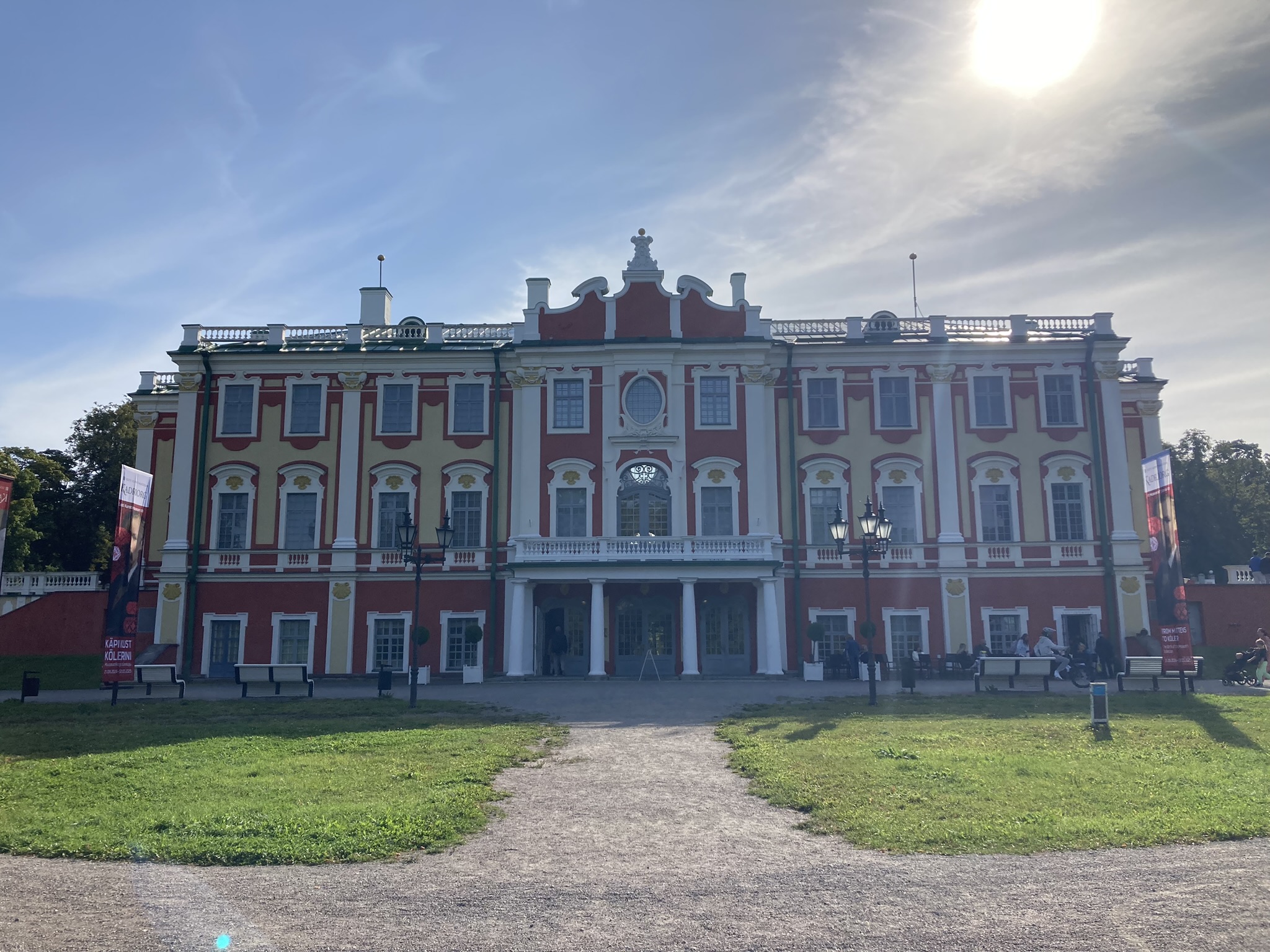
Eventually I turned into a park and came across a massive and ornate building that I initially thought a school, but upon interrogating a passerby I learned was actually an old Russian imperial palace. The Kadriorg Palace, finished in 1725, was a gift by czar Peter the Great for his wife Catherine to commemorate the successful Siege of Reval a few years prior. Today, the building houses an art museum, as well as a very elegant garden in the back. I skipped the museum but walked through the garden, taking special care to appear in the background of as many tourist photos as possible.
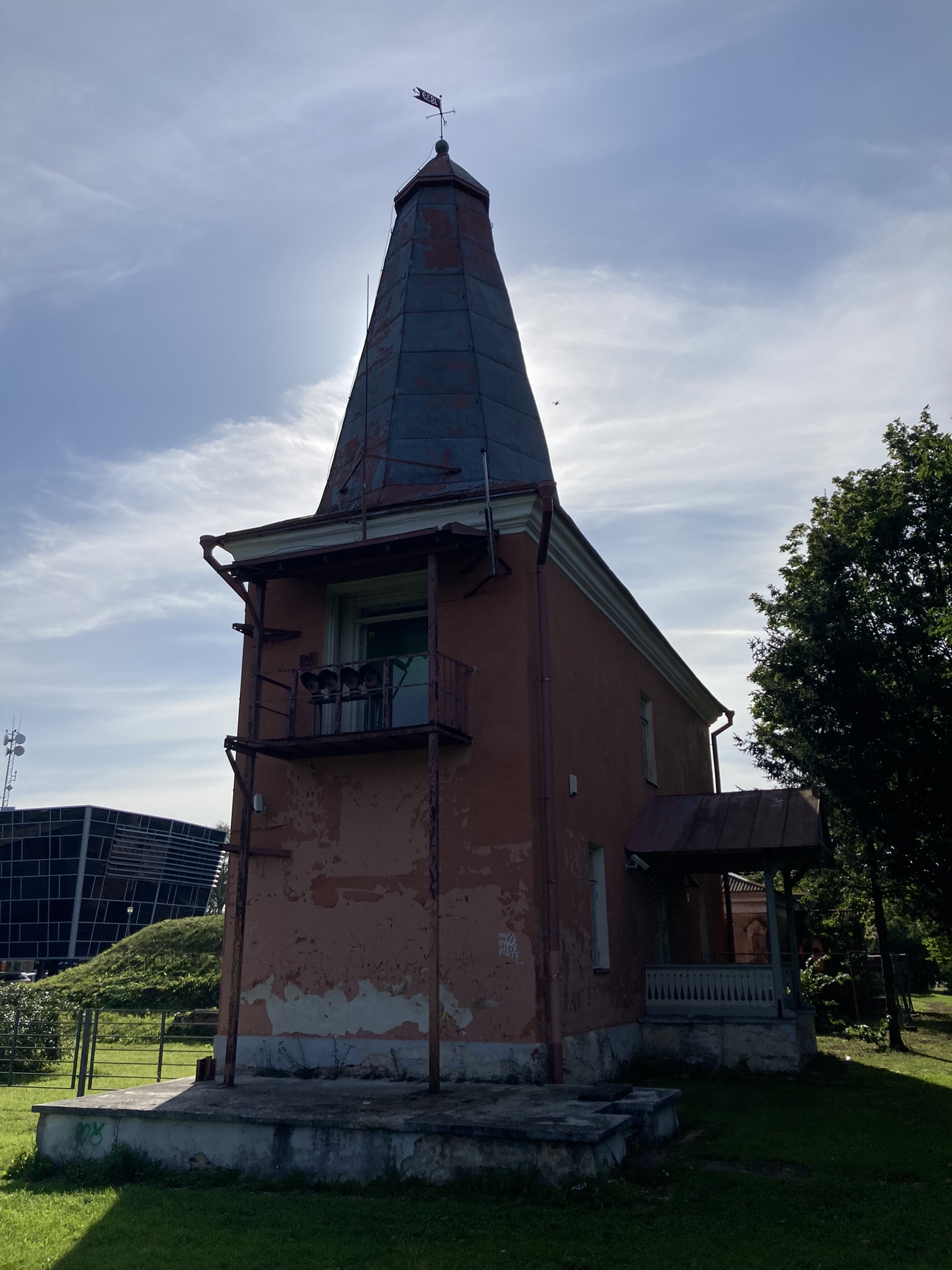
Pressing on, I finally came across my first Estonian lighthouse– the front tower in Tallinn’s range light system. I had to double check Russ Rowlett’s light list to make sure I was in the right place– it looked like no lighthouse I’d ever seen before. The lighthouse was finished in 1806, and what I thought was the light tower from the street is actually just a daybeacon, and the 6th order fresnel lens is barely visible through a window on the second floor. I watched it click on and off for a bit and snapped a few mediocre pictures.
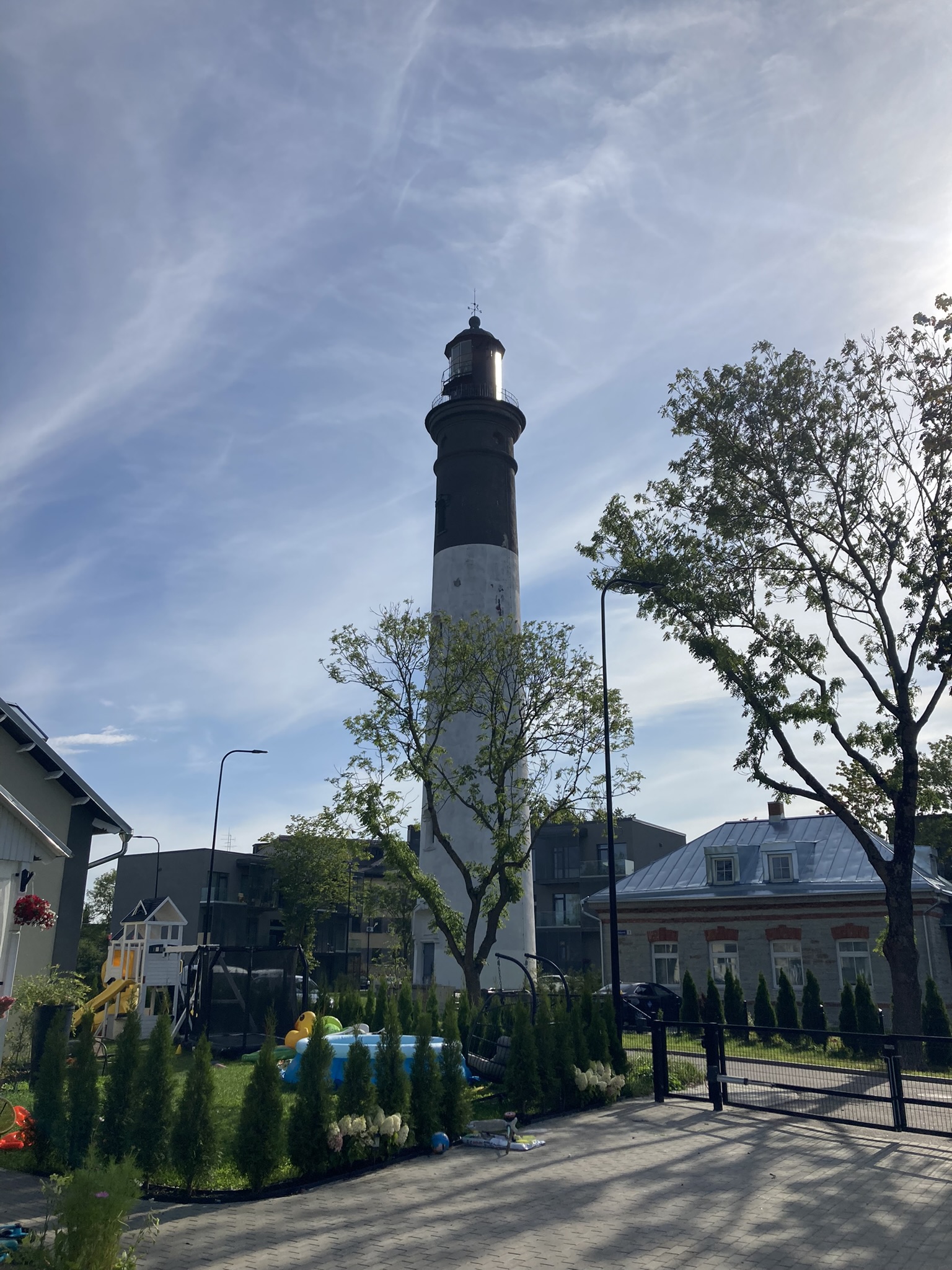
The other half of this range system was another half hour down the road, and by now the sun was out and I was starting to feel a bit too hot with my long sleeves and pants. I didn’t take them off because I prefer being hot to being incarcerated. The rear range appears more like a traditional lighthouse, and is 90 years younger than its partner. I read somewhere that the tower had plans to be opened for visitors, but I wasn’t able to even get close as it was behind a fence and was quite possible in someone’s backyard. I took a few more pictures and hiked back to the old part of town.
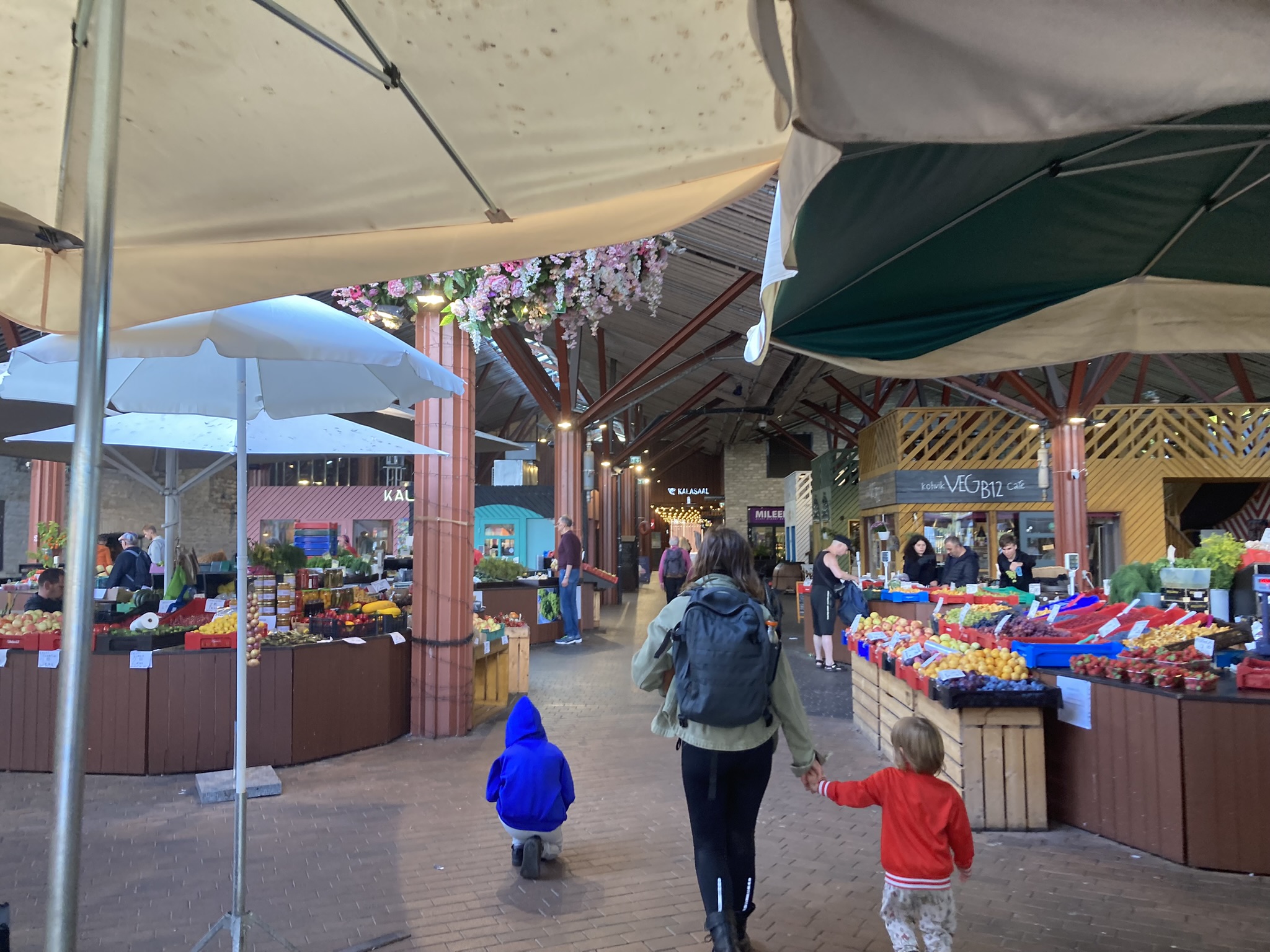
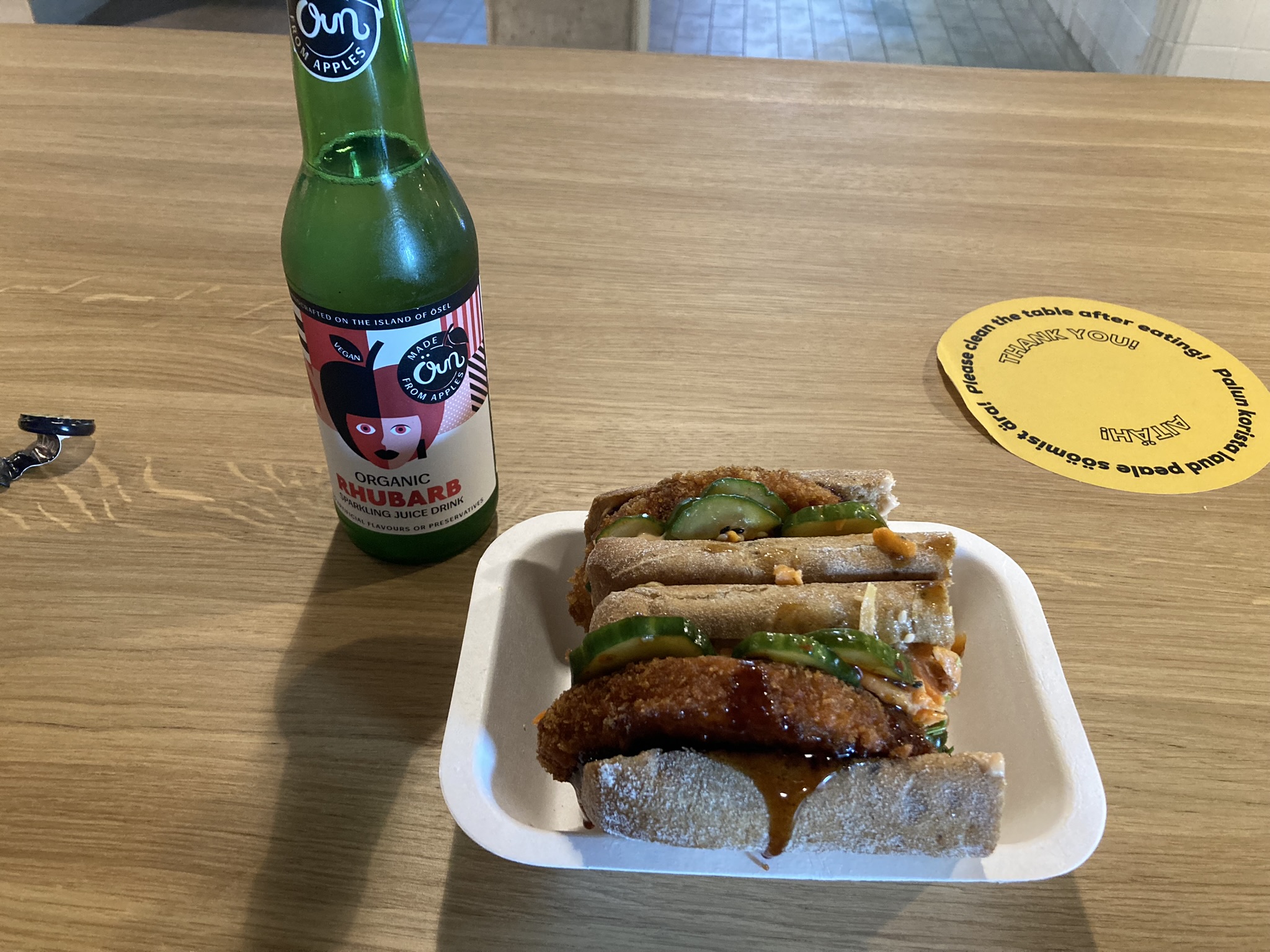
Balti Jaam Turg is an old train station converted into a market, and where I elected to have lunch. It’s a pretty impressive setup– there are stalls everywhere where people were selling fresh produce and bread, farmer’s market style, but scattered around were old shipping containers tastefully converted into tiny cafes where one could step inside to sit and sample their purchases. The second floor comprises of dozens of counters, one of which was the legendary Veg Machine, a vegan streetfood vendor. I ordered a Japanese sando and some fizzy rhubarb juice. I found it a bit funny that I wasn’t able to find a sando that I could eat in all of Japan, but here I was now eating one in an Estonian train station.
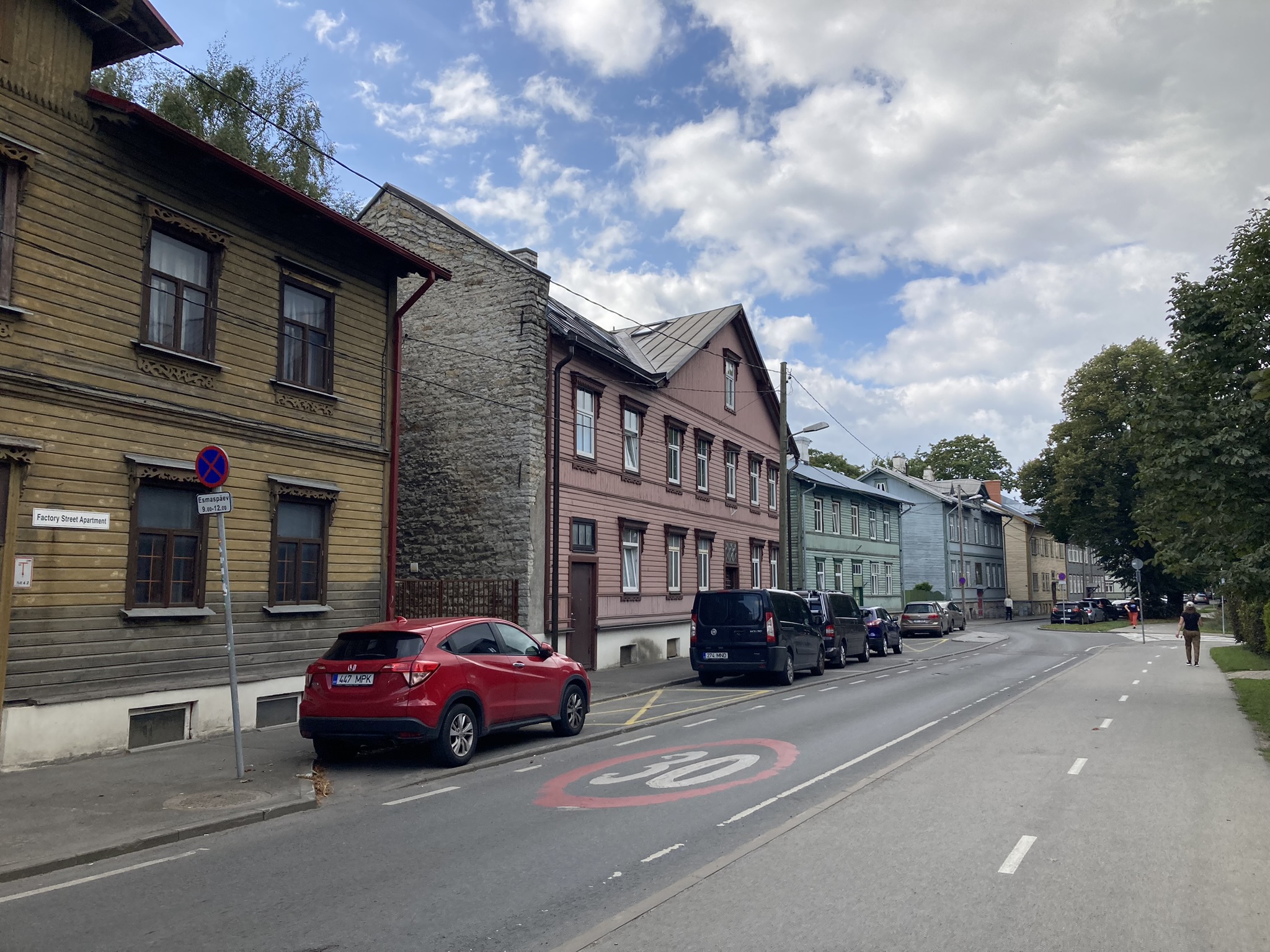
Next door to Balti Jaam Turg is Kalamaja, an old working class neighborhood that is becoming quite gentrified and lots of cute coffee shops are popping up. I wandered the leafy streets and the colorful houses and didn’t see anyone below the age of thirty, save for two women at a bus stop watching some really cool looking birds that I’ve seen all over Tallinn.
“Excuse me, do you know what these birds are called in English?”
The ladies pondered. “Hmm… not sure. They’re called ‘cornacchia’ in Italian if that helps.”
“My Latin isn’t really helping me here. Maybe crow?”
“No! Crow is corvo! These are not crows.”
I continued to wander the neighborhood in search of a cafe that fit the vibe of what I was feeling, eventually finding one but not the key to get the door open. Depressed, I returned to the train station and ordered a banana smoothie.
“Here you are, enjoy.”
I took the smoothie but stood my ground at the counter. “Hey, you know those birds that are all over Tallinn? They’re about this big, and they’re black with gray on the chest.”
The girl looked at me thoughtfully and then called over her friend. They spoke in rapid fire Estonian, giggled, and typed something into a phone.
“You mean this?” It was a picture of a pigeon.
“No, I know what that is. It’s something else. It’s a lot bigger… nobler?”
More chatter and typing. “What about this?”
“Yes! That! What is it called?”
The girls exchanged a pitying glance. “A crow.”
“That’s not a crow! Crows are all black. Can you open the Wikipedia page for it and then switch to English maybe?”
So it turned out that there are two types of crows in Europe– the carrion crow, native to the western part, is all black. The hooded crow, native to the east, is black but wears a handsome gray vest. And this time of year, hooded crows abound around the Baltic. In my entire stay I was unable to snap a good picture, and I think that’s one of my chief regrets about this trip. They’re cool looking birds.
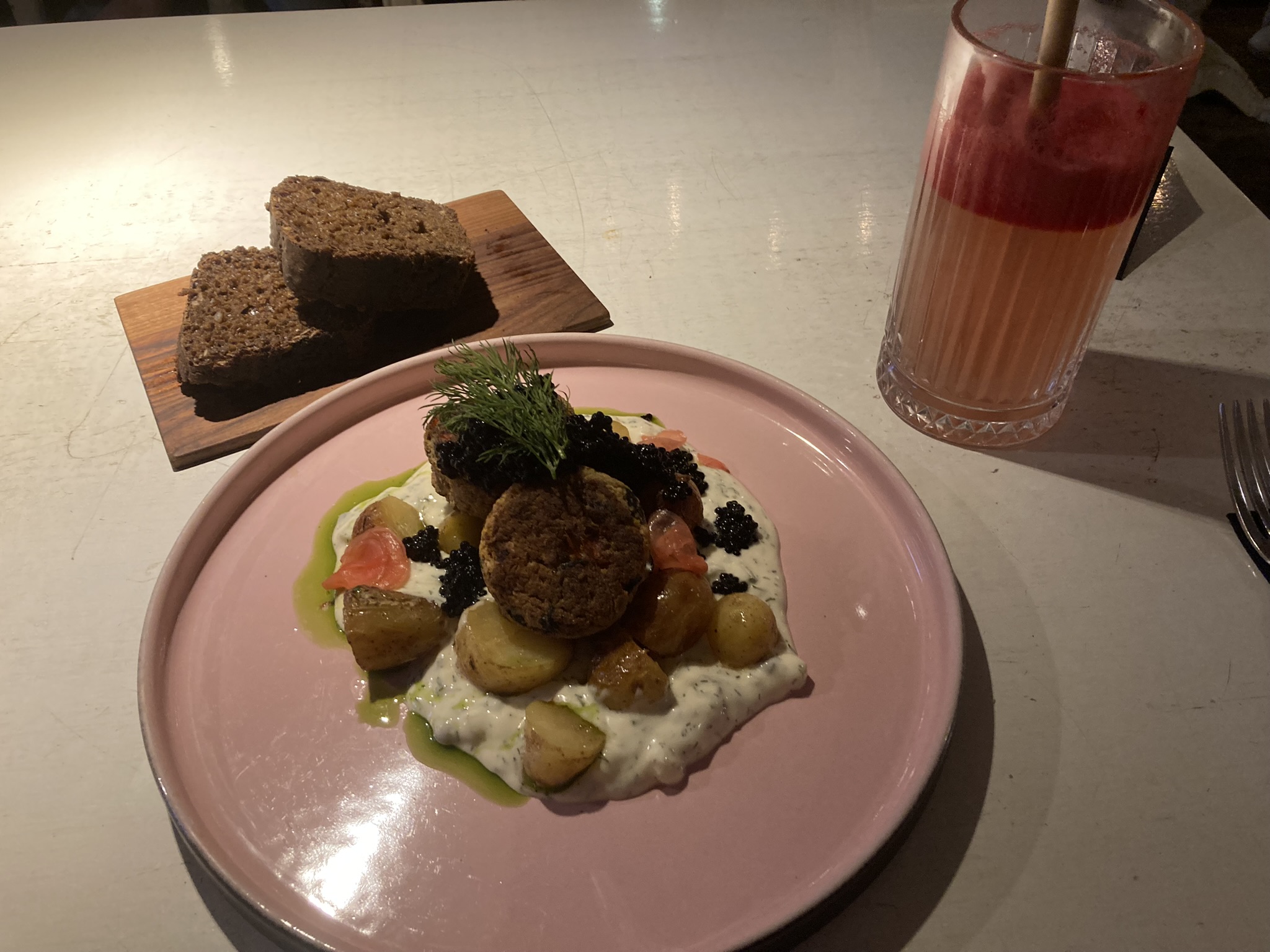
The rest of the afternoon was spent birdwatching in front of the station, and before I knew it, dinnertime had arrived. I wasn’t terribly hungry, but I had a reservation at one of the most famous restaurants in Estonia and I sure as hell wasn’t going to miss it. The Vegan V has a very small menu, but my chronic analysis paralysis meant I’d spent the past three months trying to choose my dinner. It came down to the wire, and I ordered the tofu fish cutlet with vegan caviar and fresh potatoes, a side of black rye bread, and watermelon juice. It was beyond delicious.
The waitress brought me my bill, I paid with card, and stood up to leave, but the older fellow at the table next to me stood up and called me over.
“Excuse me, are you a local or a… a… tourist?” he asked.
“I’m a tourist,” I admitted, slightly embarrassed by the label.
“Then can you explain how tipping works here?”
“Oh. Yeah. I mean, when you pay with card, it doesn’t give you an option to tip,” I replied, subconsciously contrasting the European point–of-sale system with that which I was familiar with in America. My assumption was naturally that if it didn’t give you the option to tip, and given my general knowledge that tipping is chiefly an American custom, I was off the hook for it on The Continent.
“Great, so I should tip with cash. Got it, thank you so much!”
“Yeah… that works. Enjoy your meal!” I was mildly confused. As I made for the exit, a waiter that was apparently listening to our conversation stopped me.
“Good advice,” he smiled. “Tipping is important. Tipping makes me happy.” He smiled again at me. Suddenly, I couldn’t tell if he was being passive aggressive or not. Suddenly, I wondered if the gentleman who initiated that conversation did so because he noticed I didn’t tip before leaving. Suddenly, I became aware of every meal I’d had in Estonia thus far in which I didn’t leave a tip, purely because of the card reader not asking me to. I was a monster. Wordlessly, I left the restaurant and fled into the streets.
I wandered the neighborhood in a cloud of self loathing and shame, unsure of how to handle the guilt. I didn’t have any cash on me, I couldn’t tip even if I wanted to. Should I find an ATM? Should I go back to every place with a few euros and beg for forgiveness? Should I throw myself from the spire of St. Olaf’s Church in a westernized seppuku? Before I even realized it, I had wandered down the same alleyway in which I had had coffee that morning, and was standing exactly before the Oa coffeeshop. I looked in the open door and saw the same barista that had served me coffee cleaning a cup. I walked inside unconsciously.
“Excuse me. I’m not sure if you remember, I came in here this morning for coffee. Which was very good by the way.”
She looked up, a bit perplexed. “Ah. Thank you.”
“And I had a question. A dumb tourist question. So, how does tipping work here? Like at what stage do you leave a tip? Cause when I pay, there’s no option or anything to add a tip when paying by card. Am I expected to use cash?”
The weathering of my questions eroded a warm crack into her stone face, just between her chin and her nose.
“Are you from the States?”
“Yes.”
“Ah that explains it. Americans are very worried about tipping. Here and in Europe, tipping is not expected. For reference, I only made one euro in tips today, and I thought my service today was pretty good. If you think the service really goes above and beyond what’s expected, then sure, you can leave a small tip, but it’s not like in the States where you tip at every meal. Only when you feel like it. It’s really no big deal.”
I really can’t describe the relief I felt after hearing this. It was something akin to the weightlessness of falling asleep, and it softened every muscle in my body. I thanked her and floated back into the street, where a small cushion of air caught each of my footsteps before they would have touched cobblestone. I climbed up the Toompea and watched the sunset, feeling mostly okay.
Thursday, August 29th
My alarm went off at 5am, and I packed my bags and met a Bolt outside the Viru gate for the ten minute drive to the airport. Today I was flying to Hiiumaa, the smaller and more isolated of the two large islands off of Estonia’s western coast. The airport was more crowded than I expected, thanks to a plane leaving for somewhere in the Baltics, and the long line at security stressed me out just a tiny bit.
Just like any post-9/11 American, I have a natural amount of unease around TSA security. I try as hard as I can do all the steps perfectly, as to not hold up the line for even a millisecond, and my lack of experience with European airport security offered just enough unknowns to make me sick to my stomach. But even though the line was long, it was moving quickly, and I soon realized why. There was no need to take liquids out of the bag. People weren’t taking off their shoes, belts, and jackets. It was basically TSA Precheck for everyone. TSA Precheck is, at the end of the day, a poverty tax, and the extra measures TSA has adopted in recent years haven’t shown to be statistically significant in boosting security. But in less time than it took to think all these thoughts, I was at my gate, and after an hour of weather delay, I and four others were bussed from the gate to the plane.
The plane was the Saab that I was hoping to ride in, and the flight was fairly smooth and fairly quick. Upon arrival, I was sent through an airport smaller than my living room back home and out front to meet a bus, where I paid a small fare to be driven into the village of Kärdla, the only human settlement on the island of any note.
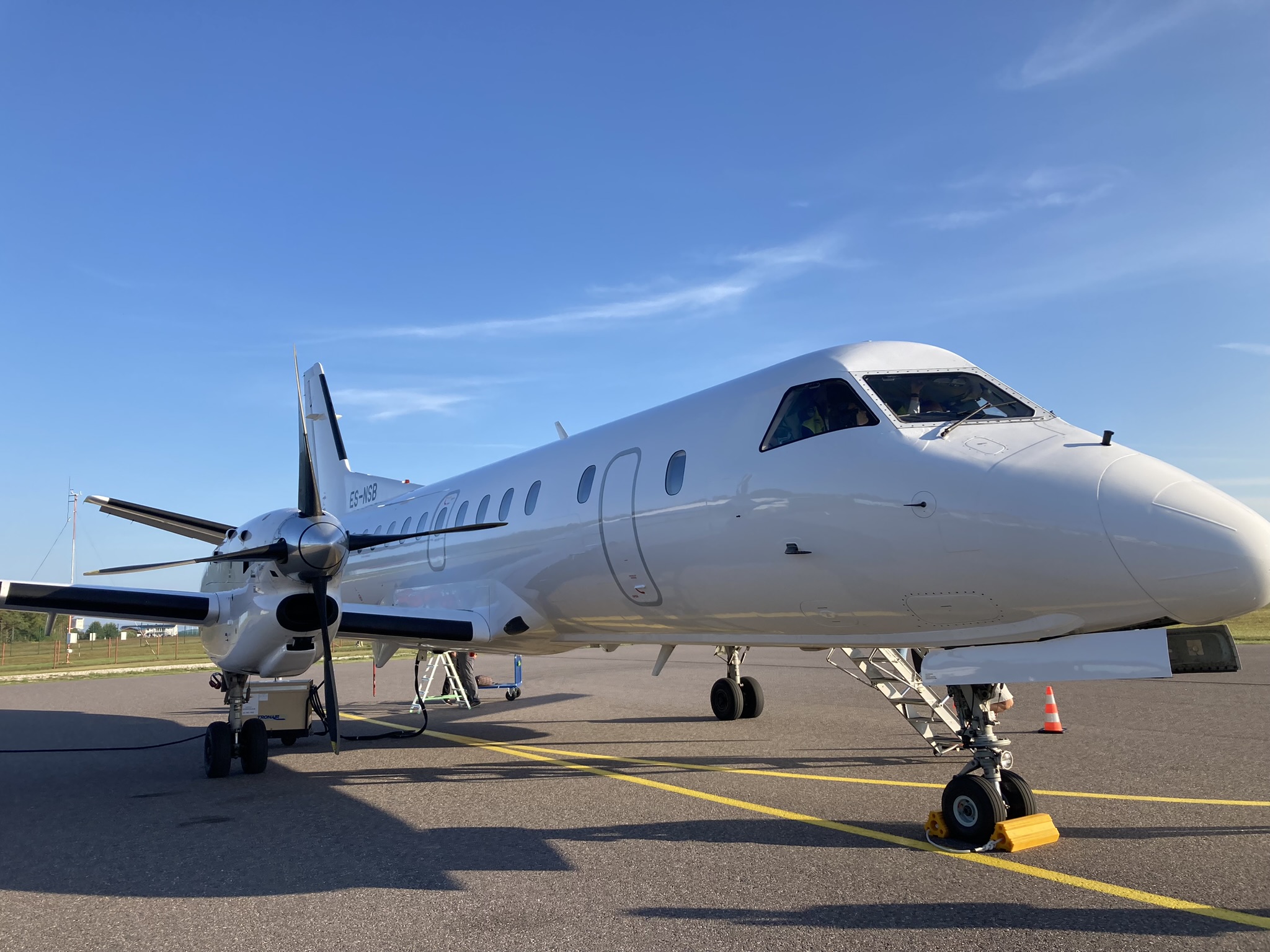
There’s very little to say about Kärdla. It’s small. It has a grocery store and a bus station. It has a cafe, where I was the first customer of the day. I looked at the menu, scrawled on a chalkboard.
“Do you have anything vegetarian?”
“No. But I can try to use vegetarian ingredients to make you something.”
“That’s fine. I’ll just have a cappuccino then.”
At around ten I left the cafe and went next door to the grocer, which could fit comfortably inside of a Walgreens. I bought two waterbottles and a loaf of bread, and then called the only Bolt on the island to Tahkana, my first lighthouse of the day. While driving, we kept stopping so the driver could point out various birds.
“That is a white-tailed eagle. It’s very rare here. I’ve lived here my whole life but have only seen a few. You are very lucky to see two in one day.”
We arrived at the lighthouse, and the driver asked me if I’d be okay getting back.
“Yeah. Probably. I’ll figure it out.” I said these things with no confidence.
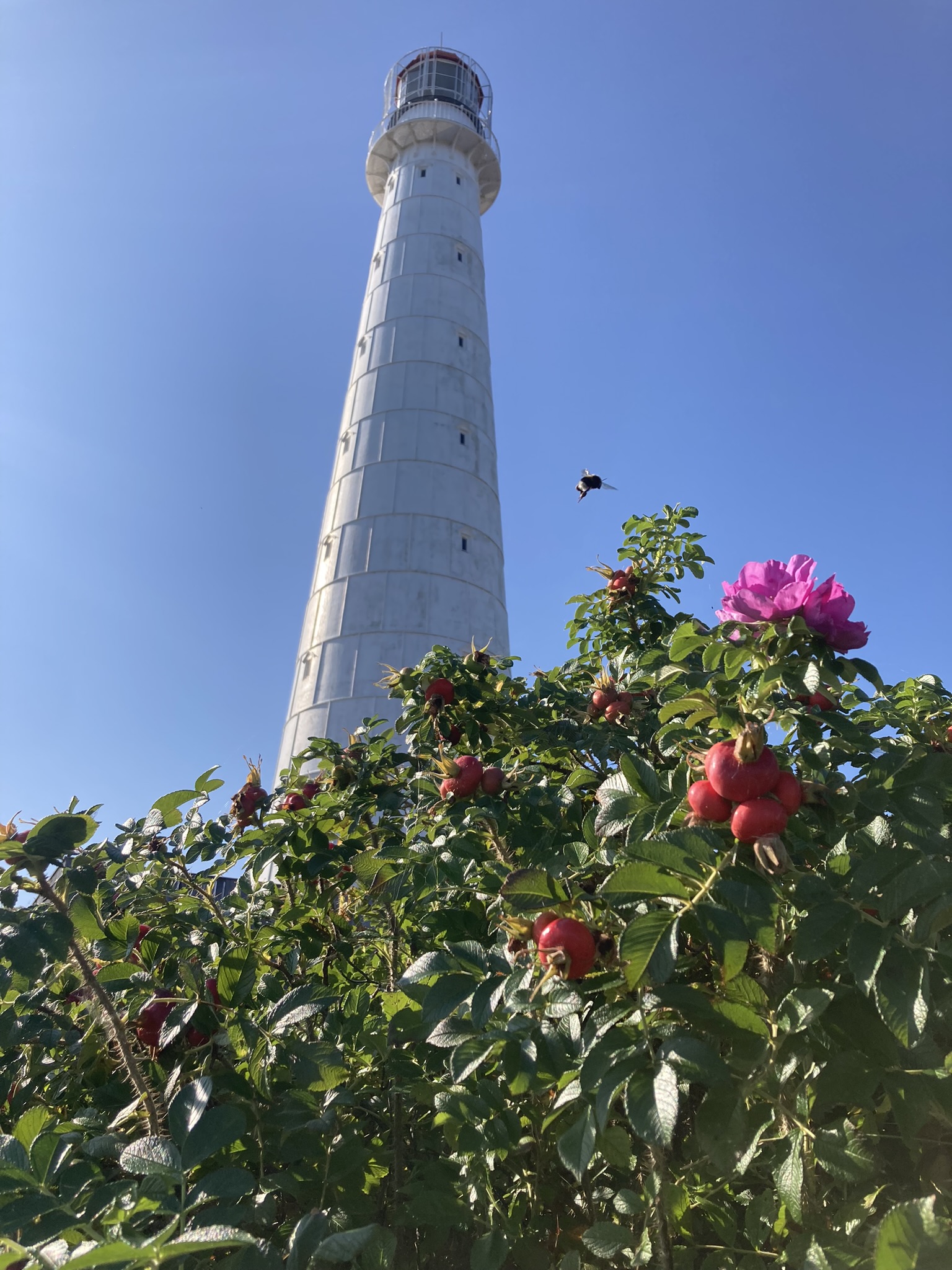
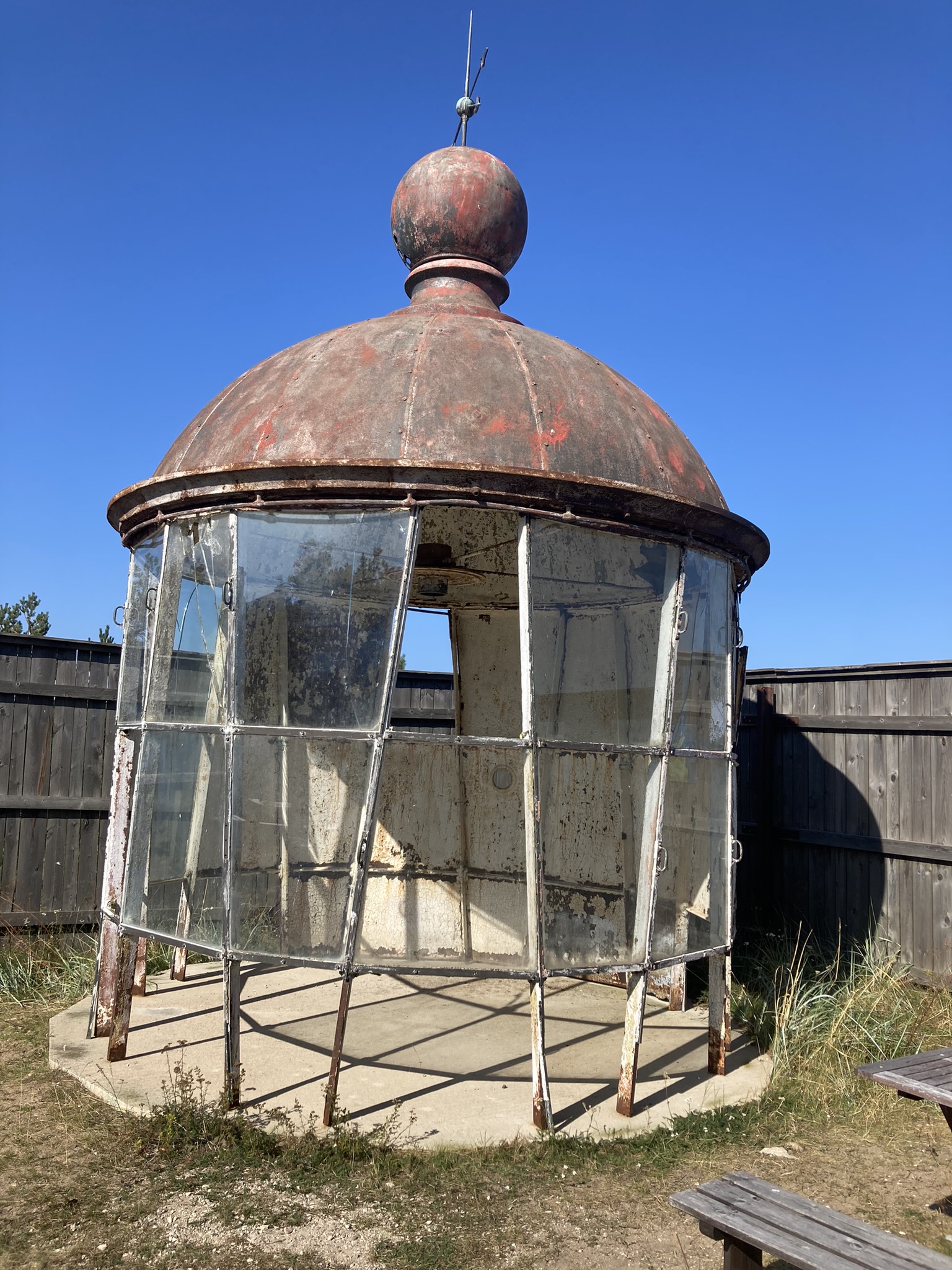
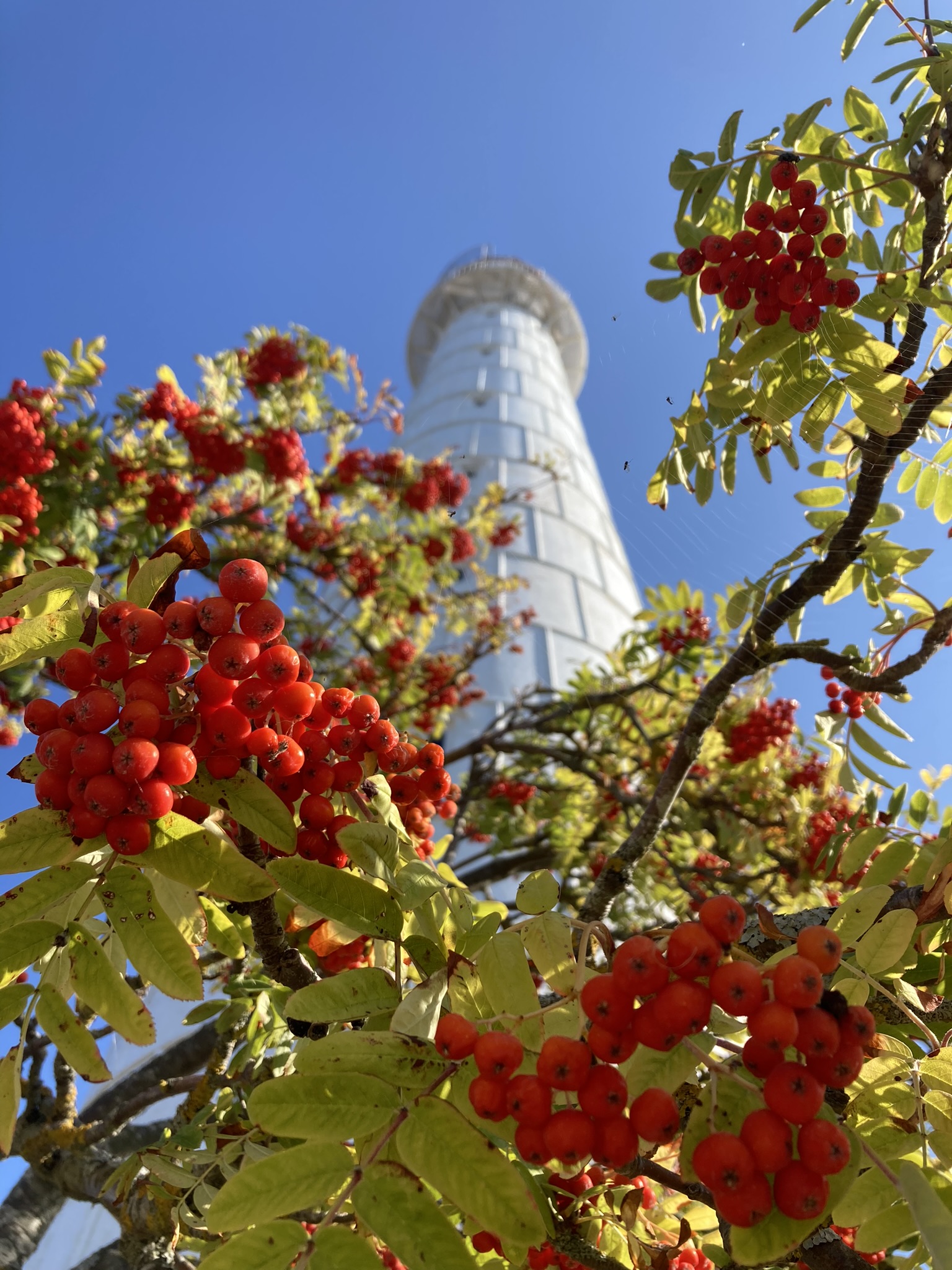
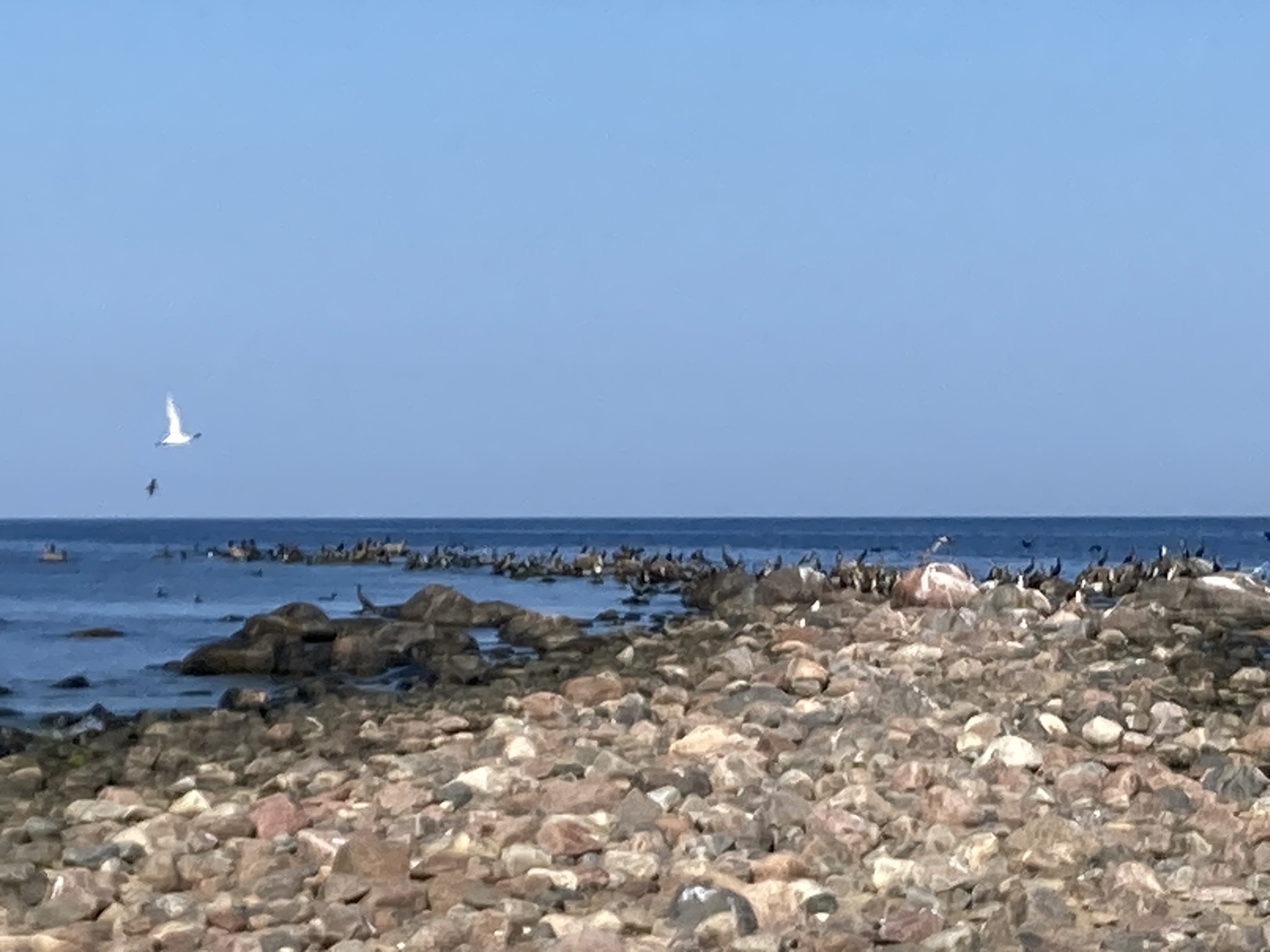
I took the lighthouse at Tahkana slow, exploring the grounds thoroughly and taking pictures of the hundreds of cormorants and swans in the water just off the cape. I climbed to the top and admired the view, and played the non-verbal communication game with a pair of elderly Germans on holiday. One of them was happy to take my picture. Around lunchtime, I found a shady spot under a tree and had some water and ate about half of my loaf of bread. It was perfectly pleasant.
At some point, a man of about sixty years walked by, and I waved him over. “Excuse me, where are you going? Are you going to Kõpu?” I asked without embarrassment in my embarrassingly bad Estonian.
He frowned. “Bloody hell, I knew me Estonian was bad, but I didn’t know it was this bad! Do ya speak any English?”
I grinned. “I do, actually. I’m pretty good at English.”
This man wasn’t going all the way to Kõpu, but he was happy to take me about halfway and drop me off on the main road. He was quite the talker. His mother was an Estonian that fled the USSR to England, and when the Soviets fell and she died, my new friend inherited her family farm close to the border with Latvia and Russia. He was retired IT, and very happily chose the rustic life as soon as he could.
“Ya see the thing about these Estonians, is they’re very advanced. They have the most advanced banks in the world, I reckon. Did you know they don’t even do paper paychecks here? Everything is digital!”
“No! Really?”
“Really! And they’ve mastered the art of currency conversion. If you have an American bank and you try to buy something in euros, you’re gonta get a glitch if you have no euros left. But if you have an Estonian bank, then it’ll just make the conversion automatically!”
He was an interesting character. Sometime in the middle of his explanation on why Finnish tires are the best for winter, we arrived at Kõpu– he had been so distracted that he’d forgotten his original plans to turn off earlier.
“By the way, you said you blog about your lighthouses– maybe you could tell me what the blog name is and I’ll give it a look later, eh?”
“Ah, you won’t remember it.”
“Aw, I’ll certainly do my best. Me minds not that bad.”
“Okay, it’s opiter, o-p-i-t-e-r, dot s h, slash lighthouses.”
“...I’ll just search up lighthouses then.”
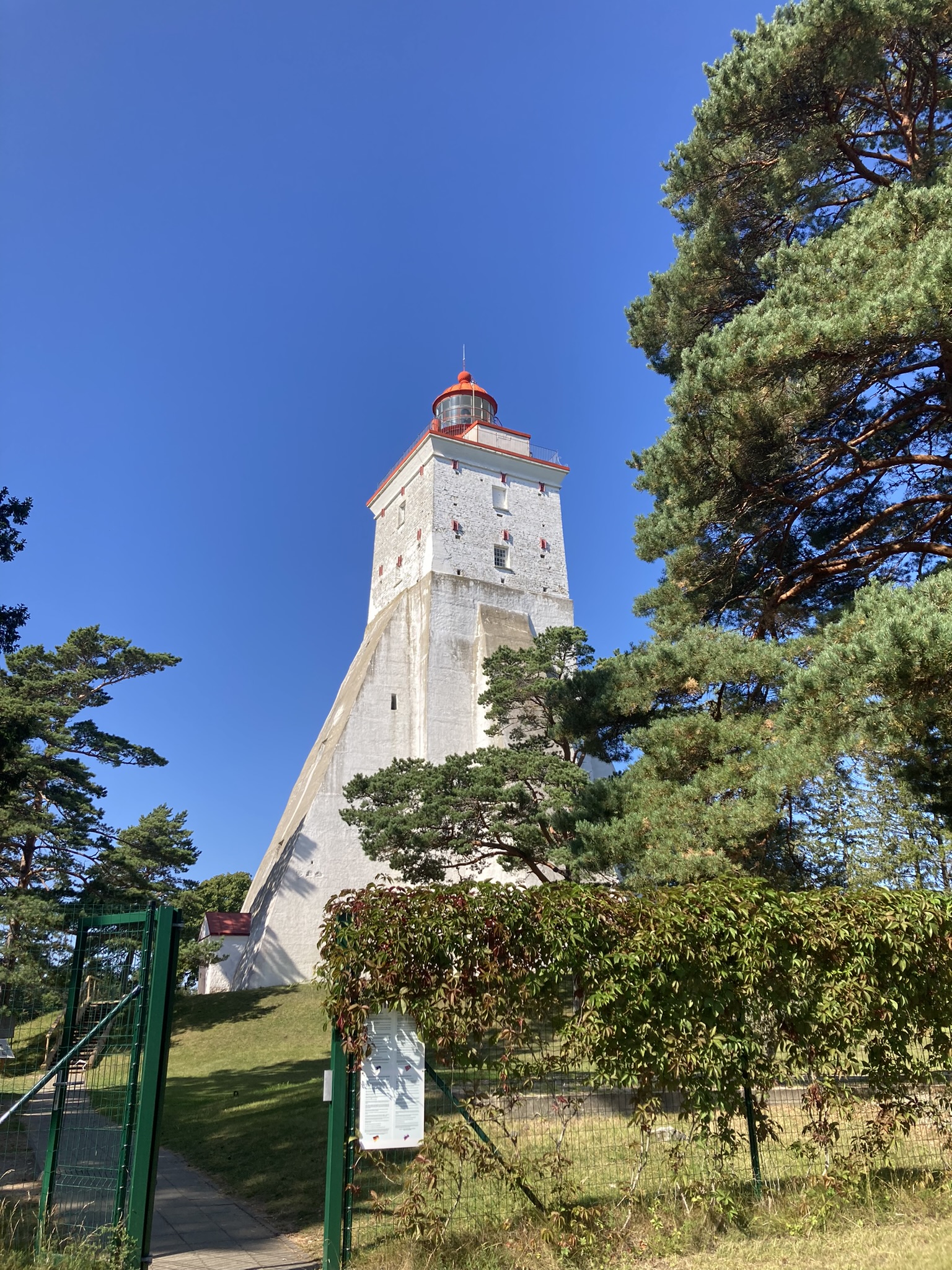
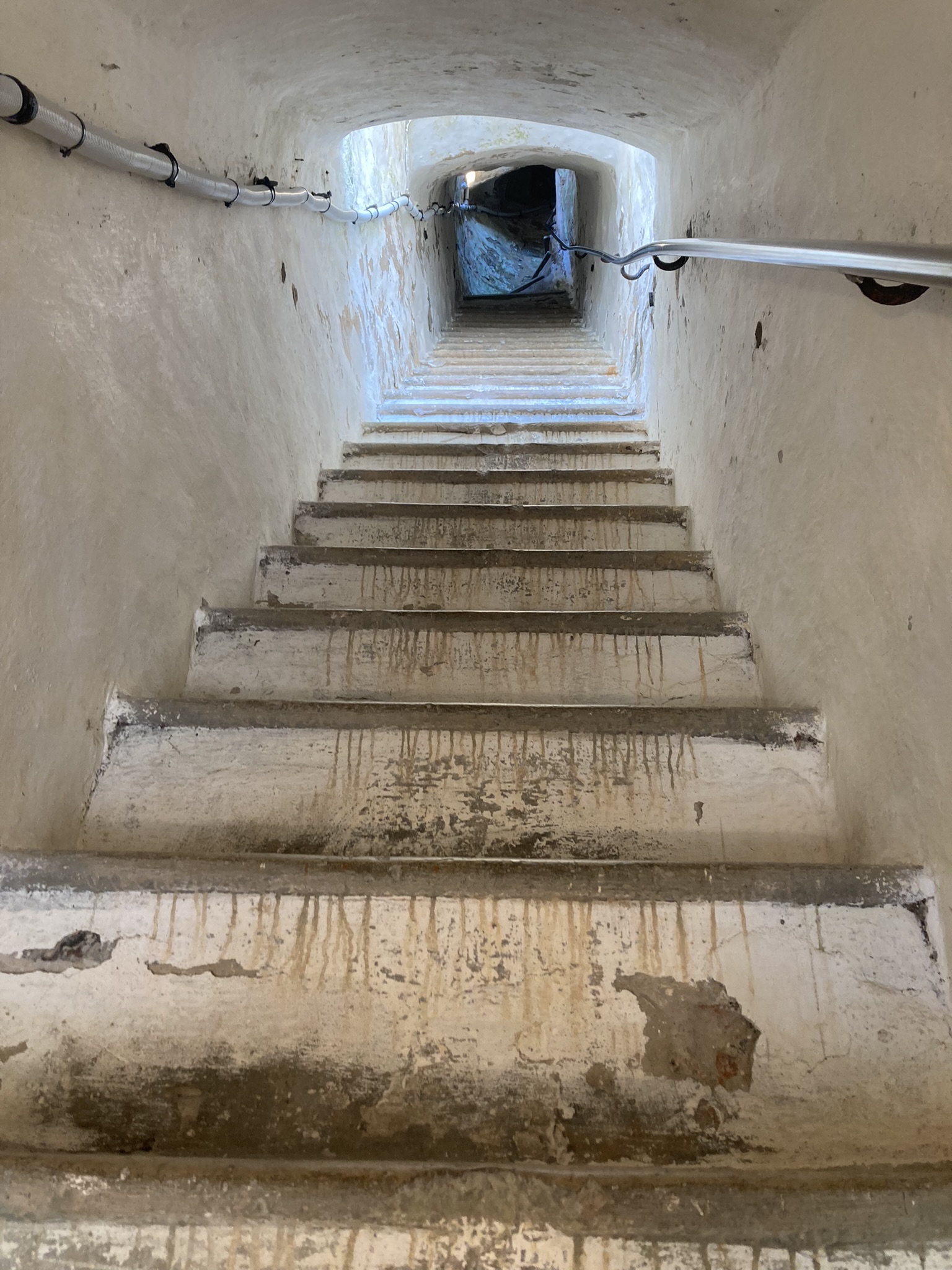
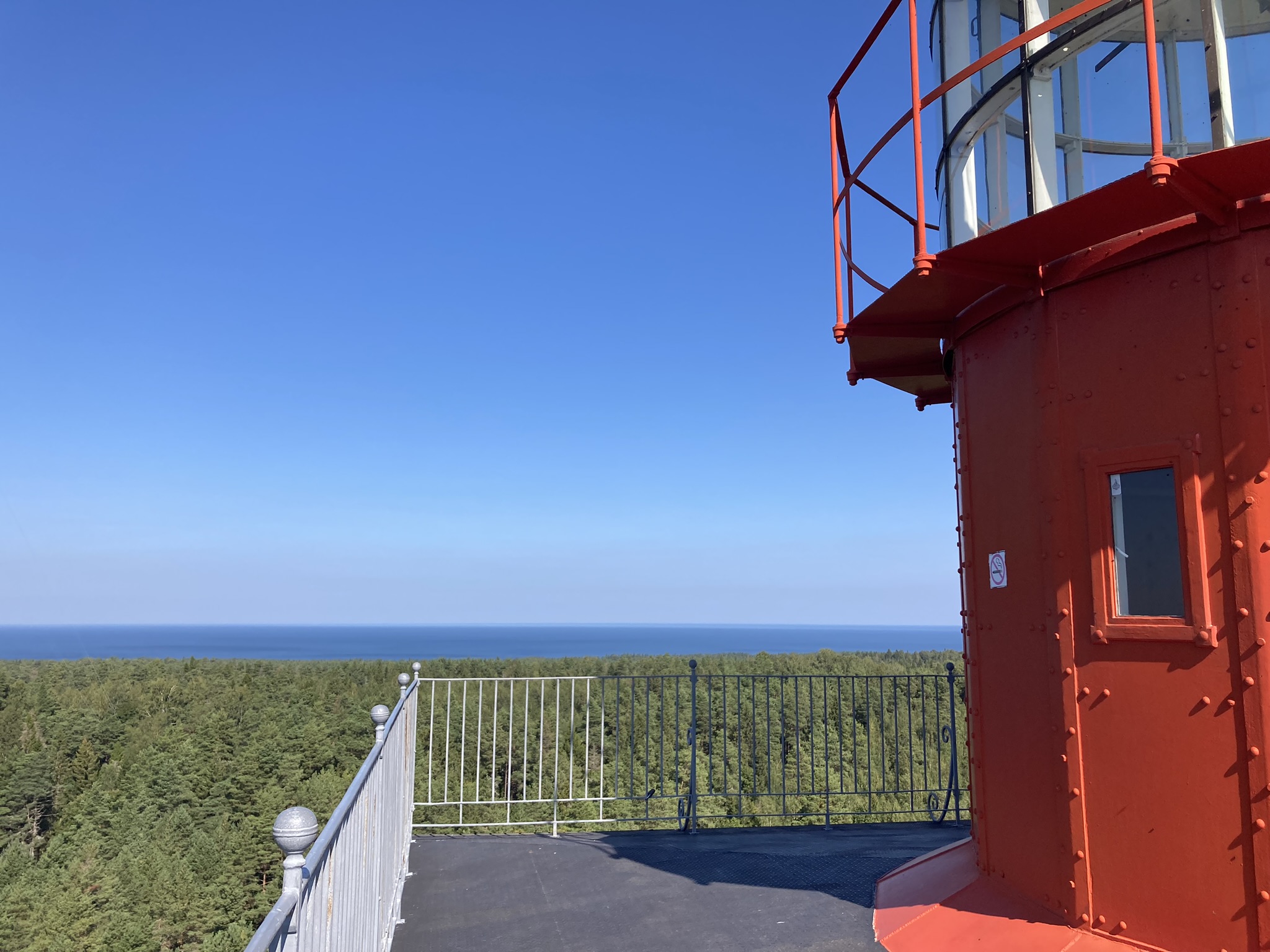
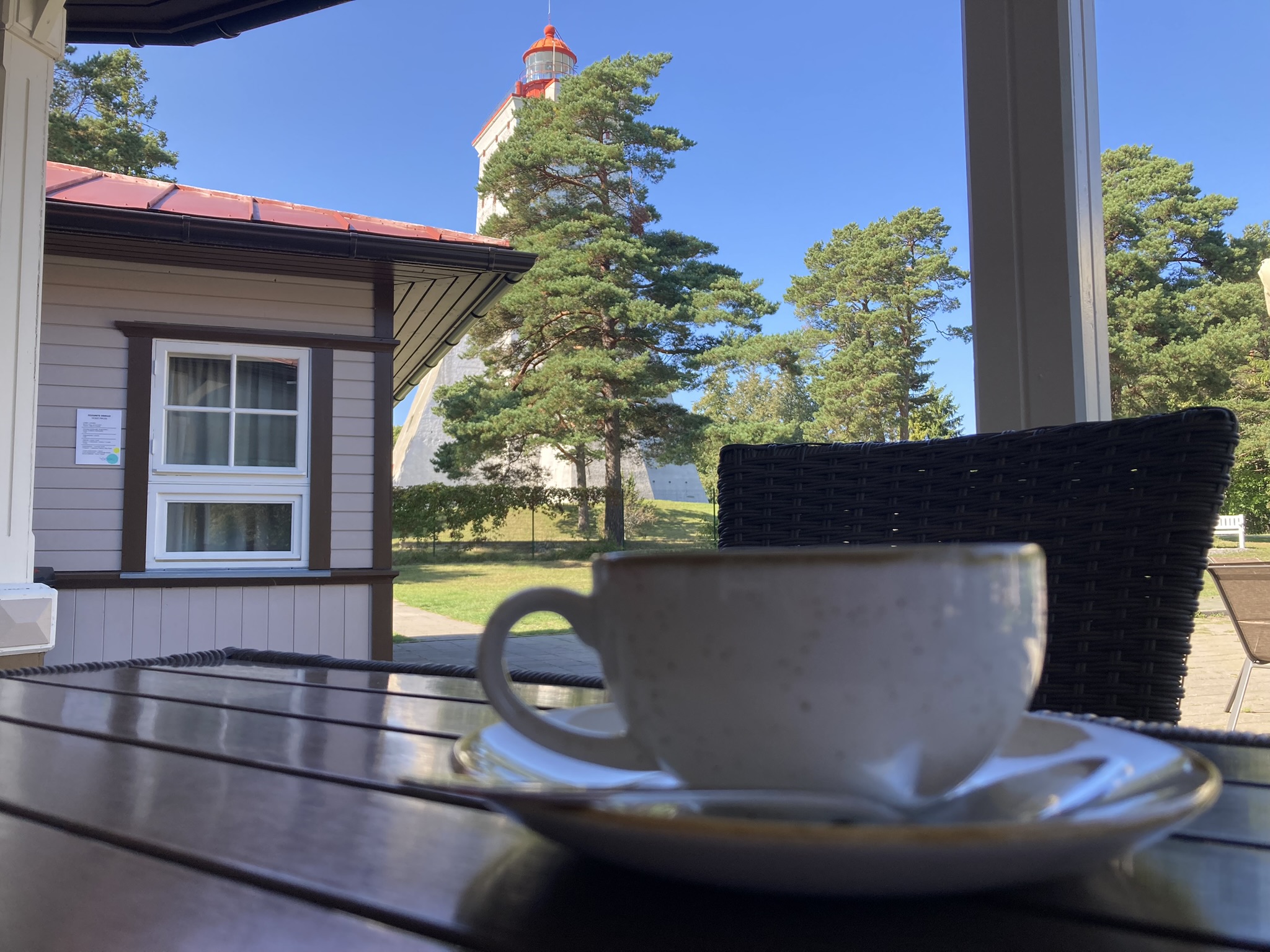
The Kõpu lighthouse was somehow more impressive than I had imagined. This was a lighthouse I’d dreamed of visiting since I was in middle school, and here I was. I bought a ticket and began climbing. The stairs were shockingly steep, but I suppose that was to be expected given that the Hansa had finished building it in 1531. The third oldest lighthouse in the world wasn’t going to have modern design decisions. But the strain on my thighs was worth it, and the view of Hiiumaa was incredible. A massive expanse of trees in every direction, and you could make out the flash of white of the Tahkana lighthouse to the northeast and the red of the Ristna lighthouse directly west. I wasn’t alone up there. The woman introduced herself awkwardly after I had excitedly boasted that this was my one hundredth lighthouse. She was a geologist from Poland, here for a conference, and this was part of the tour her group was going on. I mentioned that I knew Hiiumaa was famous for its rare limestone variant, and she excitedly jumped into a deeply accented explanation on why that was. I caught none of it.
Back at the base of the lighthouse stood a cafe, and I ordered some coffee and sat in the shade and read a while, watching the various tourists pull in and out of the parking lot. I asked the friendlier looking ones where they were going, and after a few hours I finally found one going south to the port– I had a ferry to catch to Saaremaa, the next island to the south. This fellow claimed not to be a lighthouse enthusiast, but knew everything there is to know about lighthouses in Estonia, so our conversation was quite gripping. He said he would have been happy to show me another cool lighthouse nearby, but I had to get on my boat.
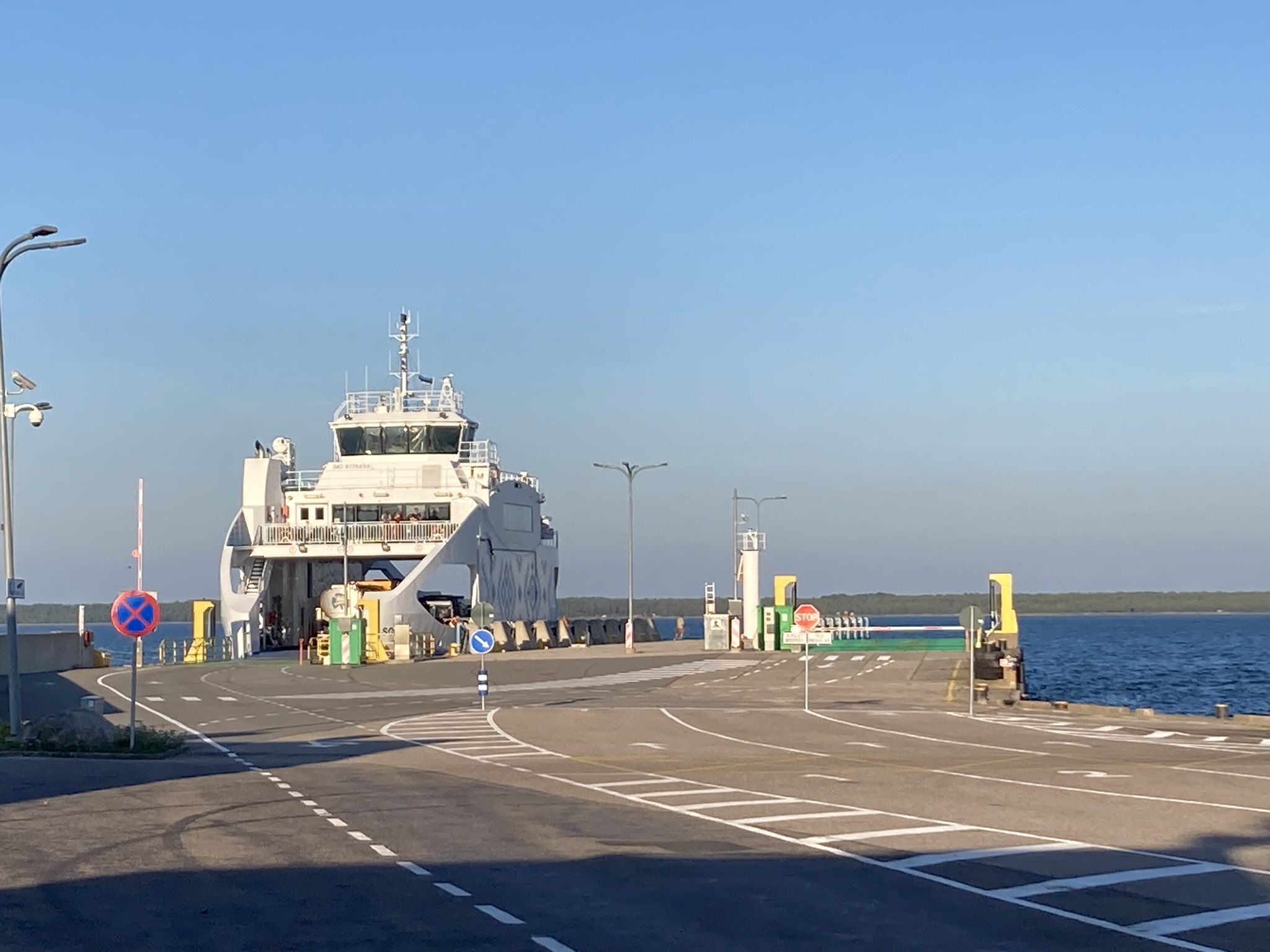
The ferry was about a half hour, and populated by mostly elderly people and blue-collar workers. While I was dozing in the sunlight, a guy about my age approached me and asked me something in Estonian. I looked up at him.
“I speak very good Estonian,” I said in Estonian.
He switched to English. “I’m trying to hitchhike into Kuressaare, do you have an extra spot?”
I apologized that I didn’t have a car and wished him luck. If I was responsible I would have helped search with him and save some money, but I was a little burnt out of hitchhiking and when we docked I called a Bolt.
The Bolt driver was quite bothersome. He asked why I had set the destination to the bus station– was I going to take a bus somewhere? No, I said, I just didn’t want to plug in my address. How long would I be in Saaremaa? Just a day, I said, and he clicked his tongue in disapproval and explained how that wasn’t enough time. As if I didn’t know that. Surely I was getting a car. No I wasn’t, I’ve been hitchhiking. He turned in his seat to give me a pitying stare. I hated that guy. He really killed my mood.
I walked from the bus station to my accommodation, and then shook off the exhaustion long enough to hunt for food. While I ate, I pondered the ice situation in Europe. How have they not discovered it yet? Why am I paying for lukewarm water? Estonia’s tap water is safe, do they not know that? When was the last time I drank something actually cold?
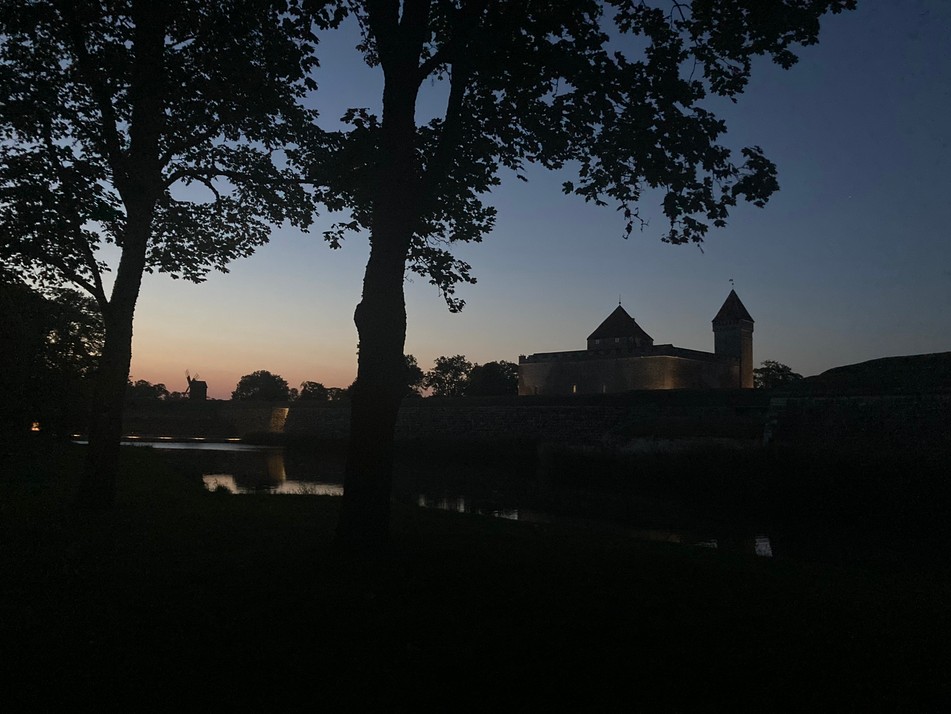
The sun set, and I found myself in a shady park that bled into the grounds of a castle, and from a bench in the harbor I watched the sky dim and fade the details of the turrets until they were just an outline, and then part of the sky.
Friday, August 30th
I woke up to the sound of seagulls in the harbor and noticed a terrific lack of ambition to explore the island, and lay there entertaining the notion of stillness. I was, after all, on an island in rural Estonia. Whether I explore the island or relax in town, I’ve already won. I decided to go back to sleep for a few hours and listen to the call of island life.
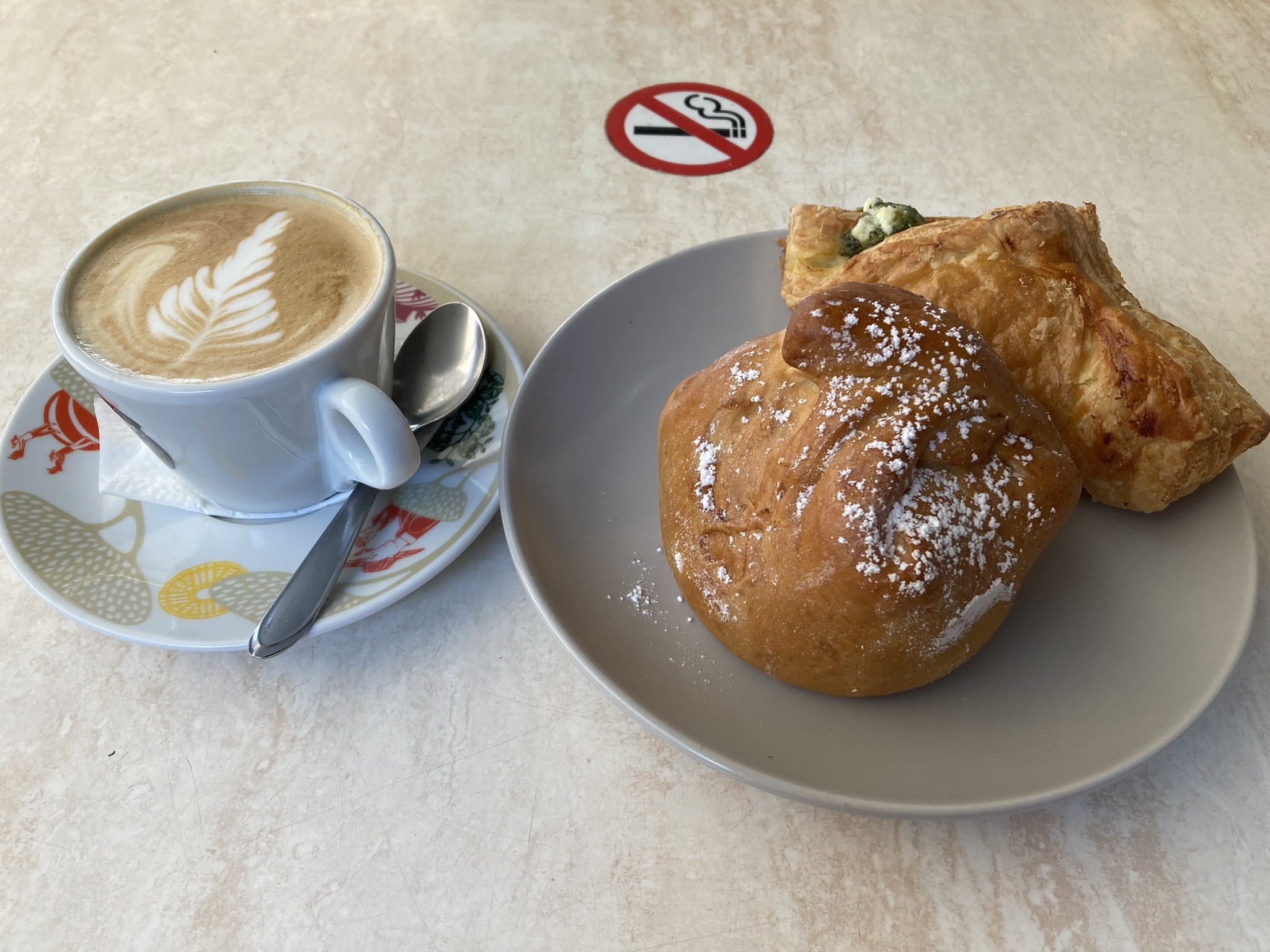
I got up again around nine, packed, and left the Airbnb, ducking into the cafe next door for breakfast. I had a cappuccino, an apple pastry and a goat cheese and spinach thing. I spent an hour or so watching people amble around on the street, then gathered my things and started walking.
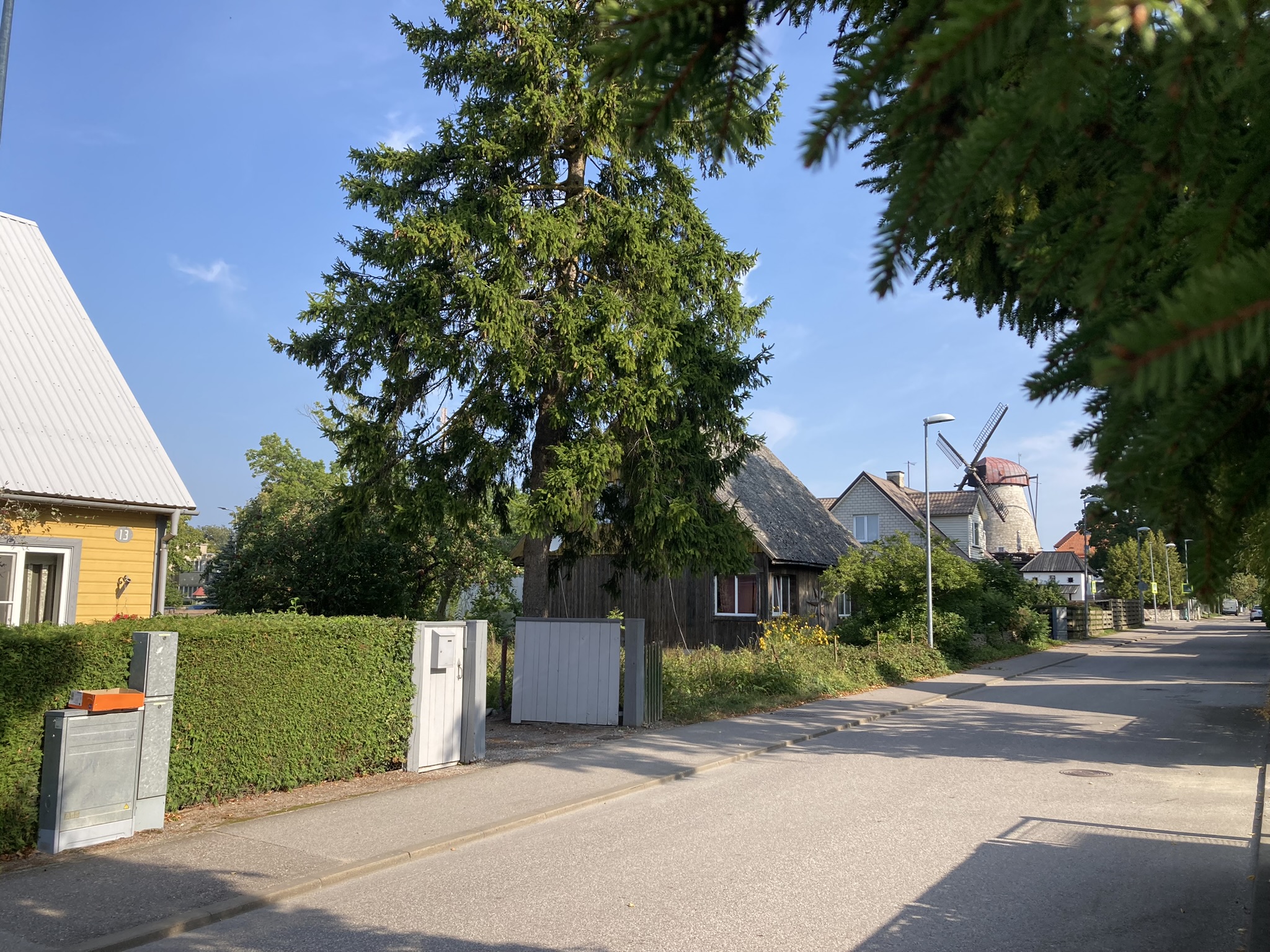
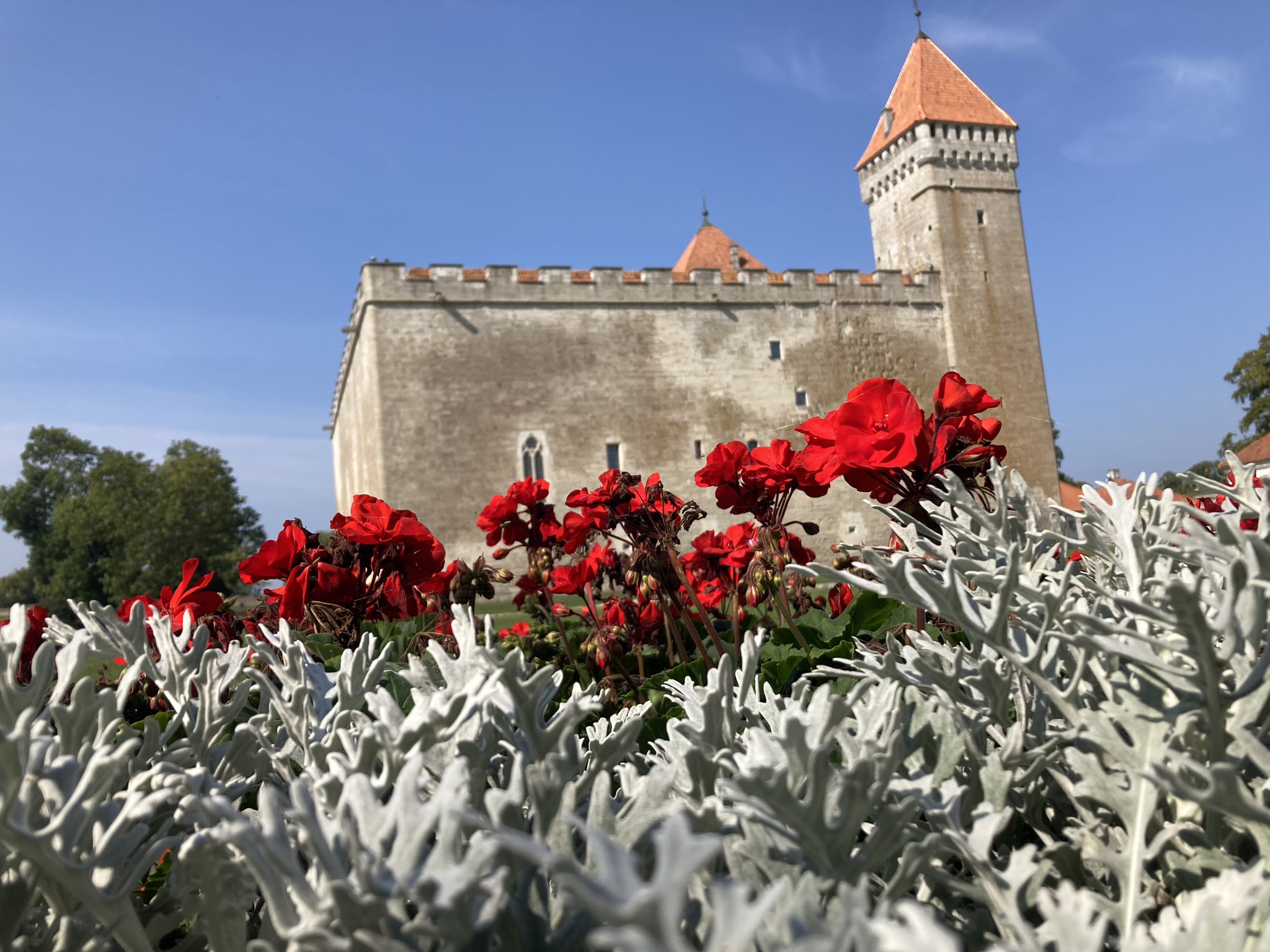
I went east, arbitrarily, which took me through some delightful little neighborhoods of colorful wooden houses, many of them with fruit trees in the front yards, littering the lawn and street with apples and the like. I came once more upon the park from last night, where I made for the castle again, and after exploring the grounds, headed inside.
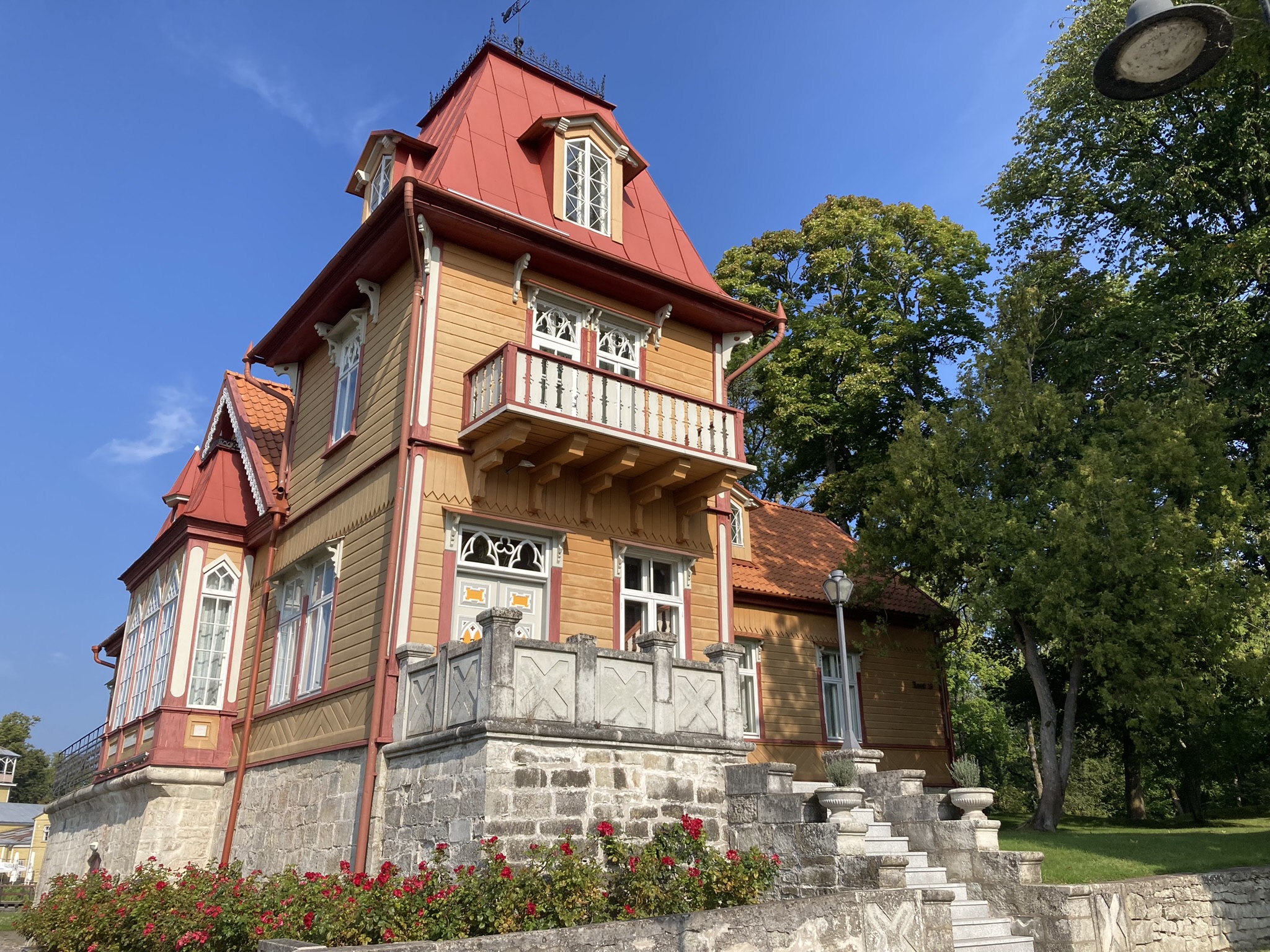
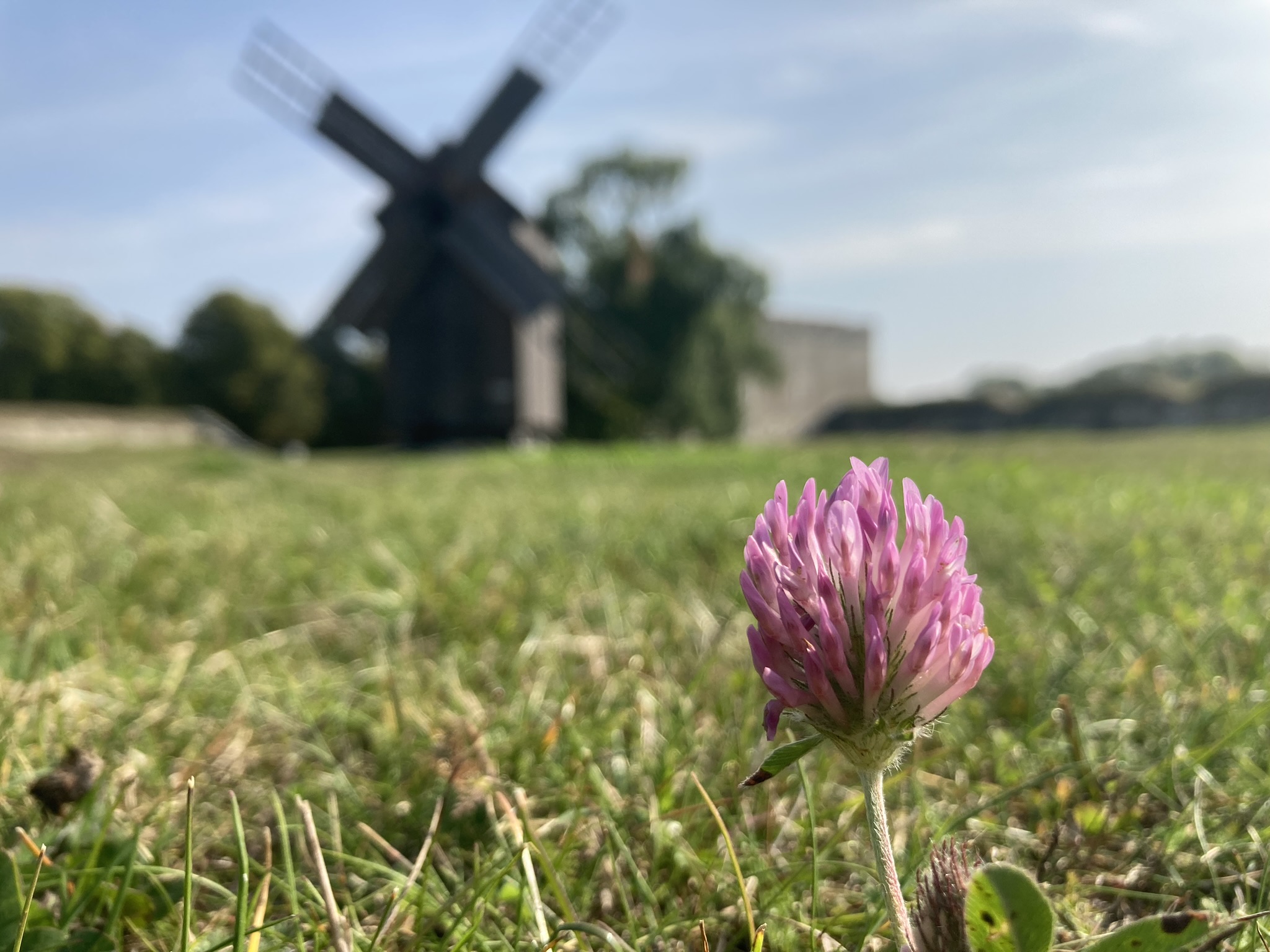
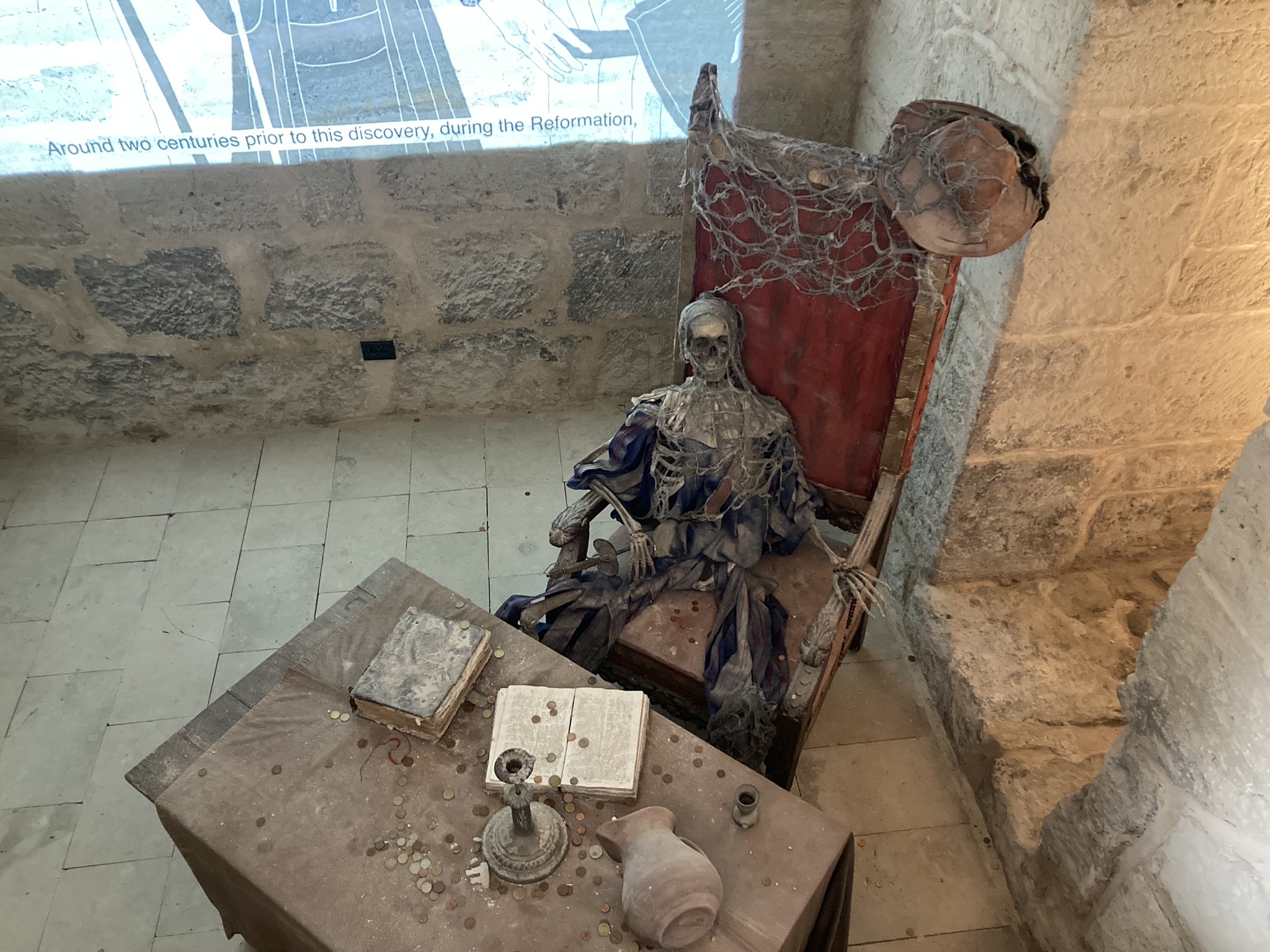
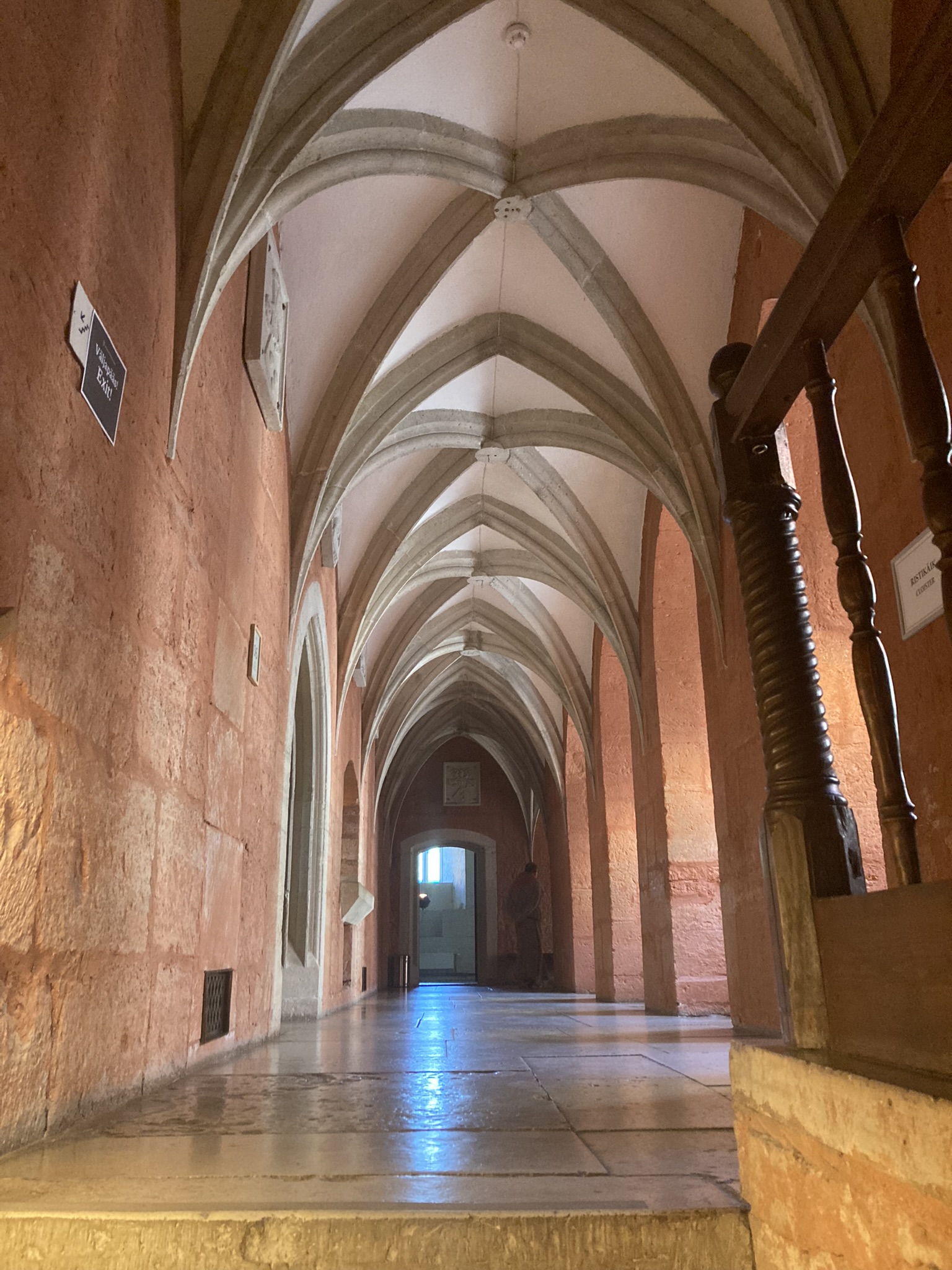
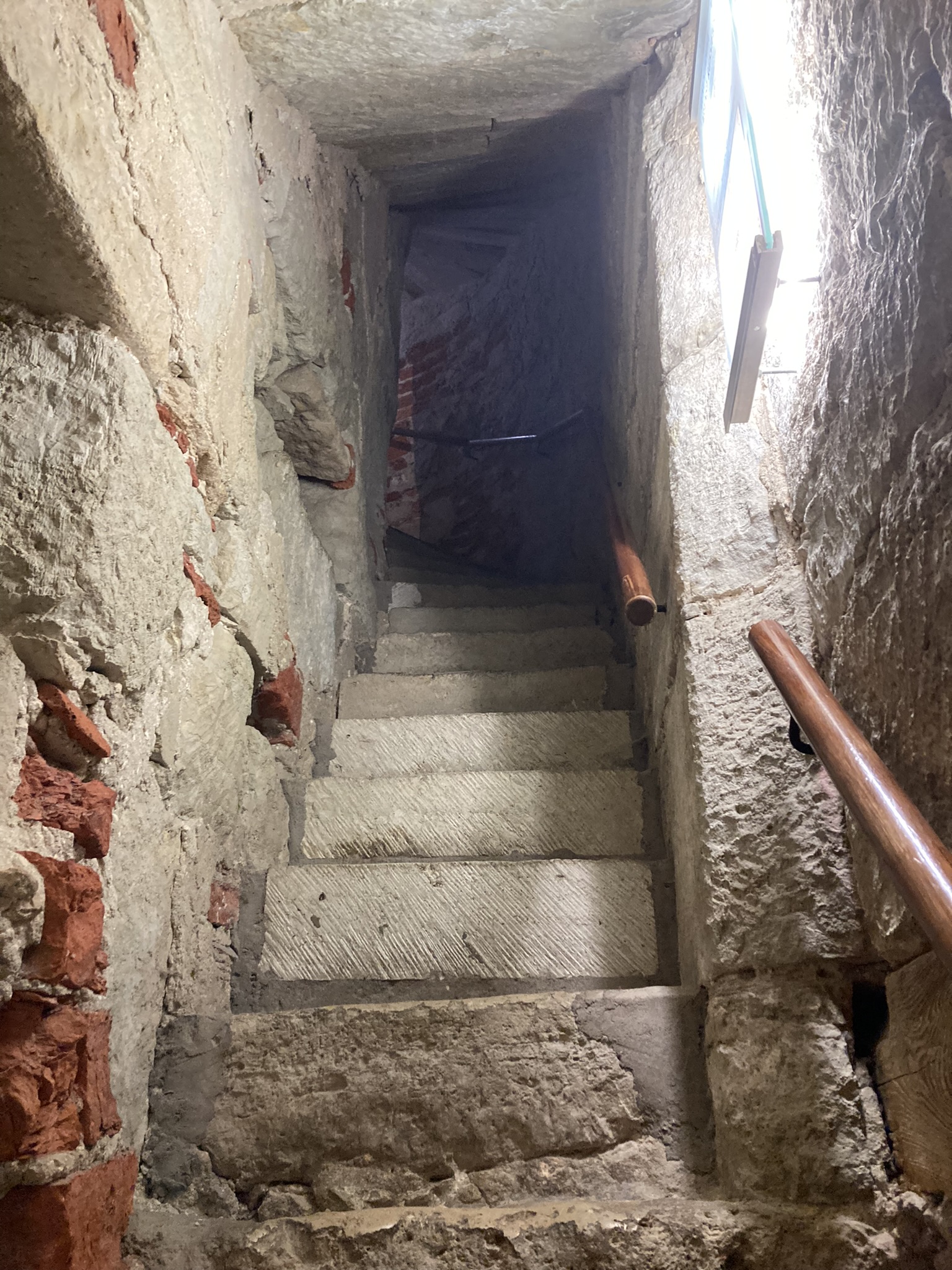
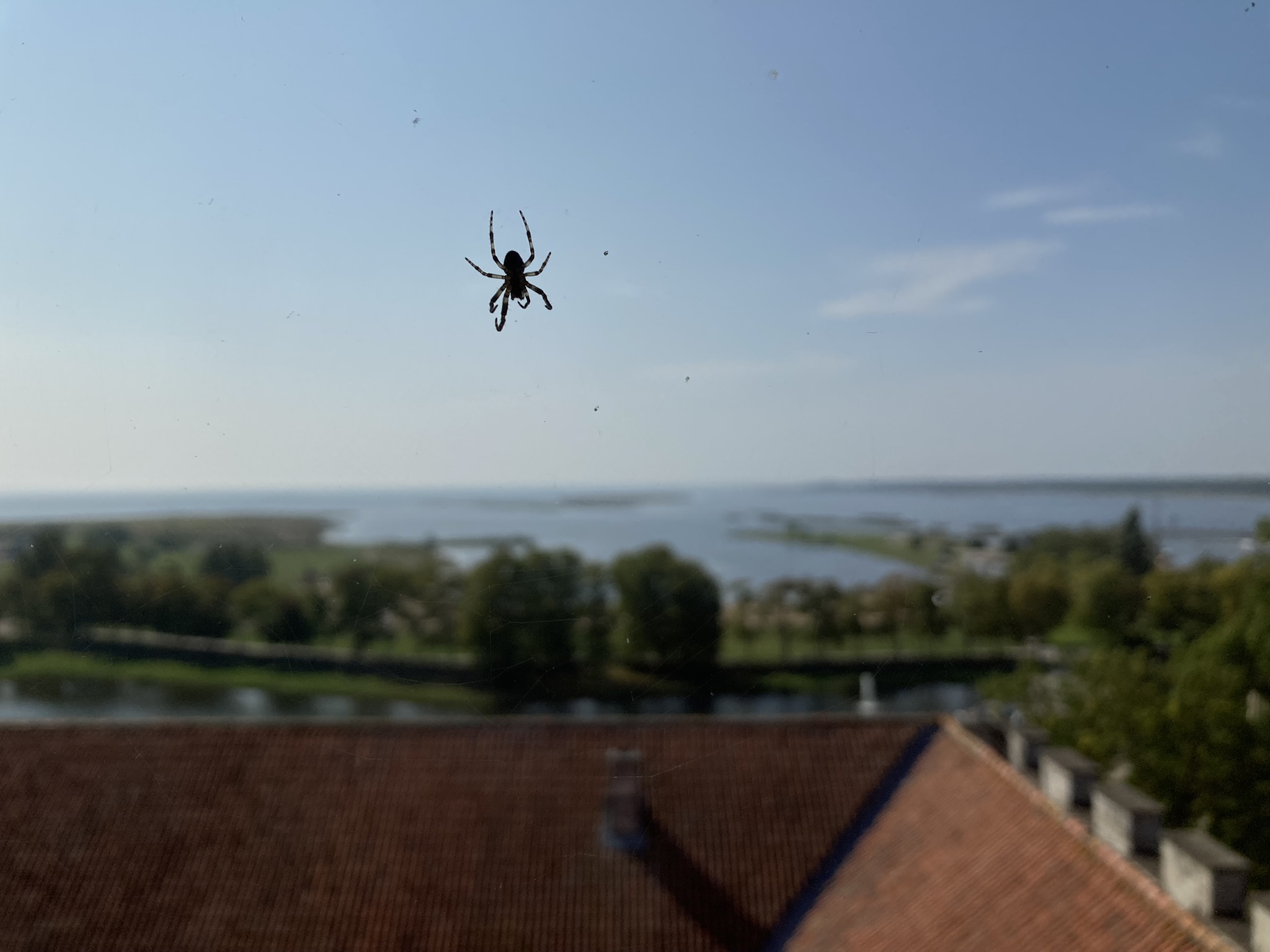
For 12 euros, I think I got a pretty hefty bang for my buck. The castle keep was massive, filled with all sorts of material culture and exhibits. Most interestingly, I enjoyed a hidden cellar discovered by the Russians in the 18th century containing a table at which a skeleton sat, a former knight supposedly condemned after breaking his vow of chastity. I wandered the steep staircases and meticulous exhibits for the better part of two hours, before reaching the highest room of the west tower, which had been converted into a cafe. It was a bit stuffy, but the panoramic view deserved far more than the current amount of customers (0). When I came in, a girl behind the counter startled.
My friend Surya has a line that he taught me in high school. It’s not so much a pickup line as much as a pretty easy way to talk to anyone you feel like talking to— ‘do you like working here?’ And the fun part is, it works in every country.
“Tere hommikust!”
“Tere!”
“Do you speak English?”
“Jah.”
“Do you like working here?”
She did, but she would rather be downstairs with the exhibits. She’s been here a while, and so she’s ready to start interacting with people and teaching history. She likes history, it’s her best subject after languages. Her grandmother is Latvian, so she speaks Estonian, English, Russian (everyone knows these three languages from school) as well as Latvian, and some Finnish, but the only Estonians who really know Finnish are the ones who want to go into construction. Estonian and Finnish are as different as Spanish and Italian. She didn’t know any Lithuanian, or Võro, but she was tickled I knew about that language. It’s a weird sounding one. Did she like living here? No, absolutely not— she answered that one fast. She’s a self-professed city girl that grew up in Tallinn. What’s wrong with it here? Not enough to do? No, people are just too sensitive here. Her parents sent her here for education, but she would have gone to a famous prep school back in Tallinn and could have known French! Her parents are from Saaremaa, for what it’s worth, and her grandmother (no, the other one) is a famous field archaeologist on this island. She’s even excavated before, with her grandmother’s team, and any archaeologist around here worth their salt would be happy to have an extra pair of hands. She doesn’t have much interest in excavating in the long term, however, cause for college she’s going to study international diplomacy, and then she’ll get her pilot’s license— no, for boats, not planes, her uncle owns a harbor— and then she’s off to law school.
“Here in Saaremaa, people pronounce õ and ö the same. It drives people from Tallinn wild.”
“What’s the difference?”
“Ö is pronounced ooh, õ is pronounced ooh.”
“Oh, I see.”
“No, ooh. Not oh.”
“Ooh.”
She smirked. “You’d fit in well here!”
We talked rapid fire for about an hour, and eventually I excused myself to finish exploring. I finished touring the remainder of the grounds, wandered through the gate and ended up on the strand.
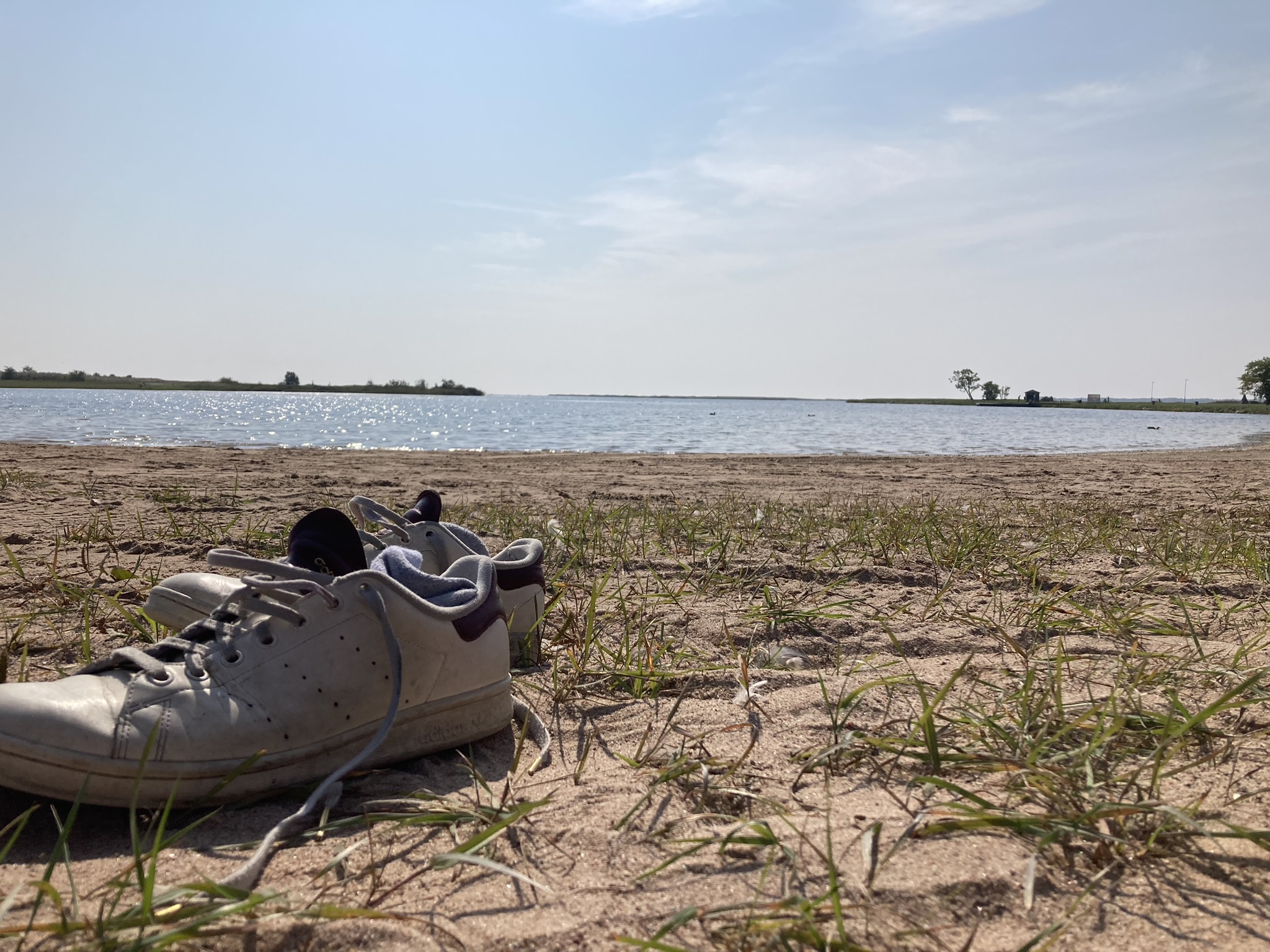
It was so quiet and peaceful on the beach that I couldn’t help but toss my backpack down, take off my shoes and lay in the sand. A couple of little ones were splashing around in the warm water near the shore, while some seabirds did the same further out. A few women were sunbathing nude further down the beach. I fell asleep. When I woke up the sunbathing women had all been replaced by octogenarians. I hiked up my linens and waded into the water until it was up to my knees. It was cool, not cold, and the protection of the harbor meant there weren’t any waves. I returned to shore, put my socks and shoes on, and went to a cafe for an early dinner.
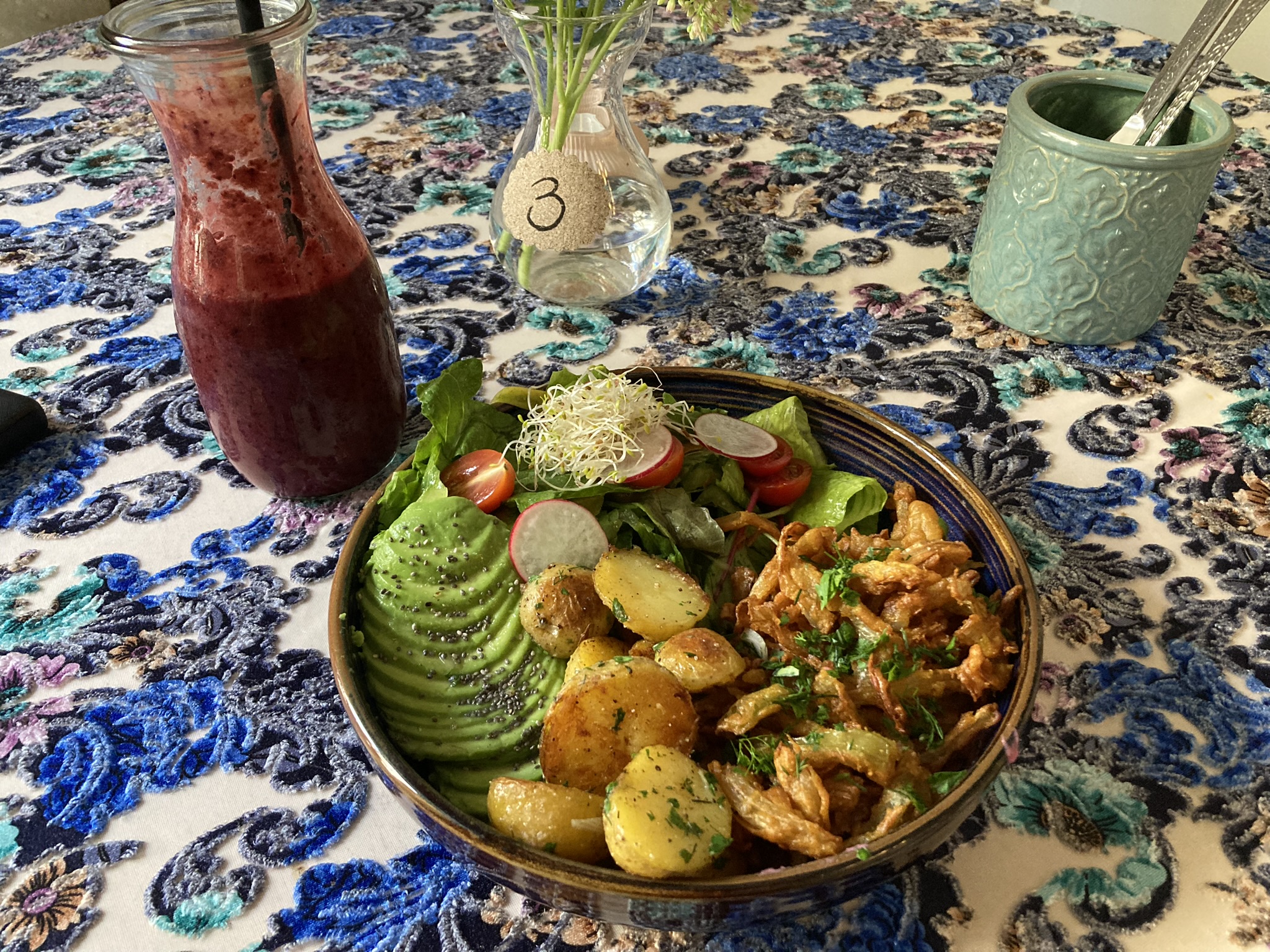
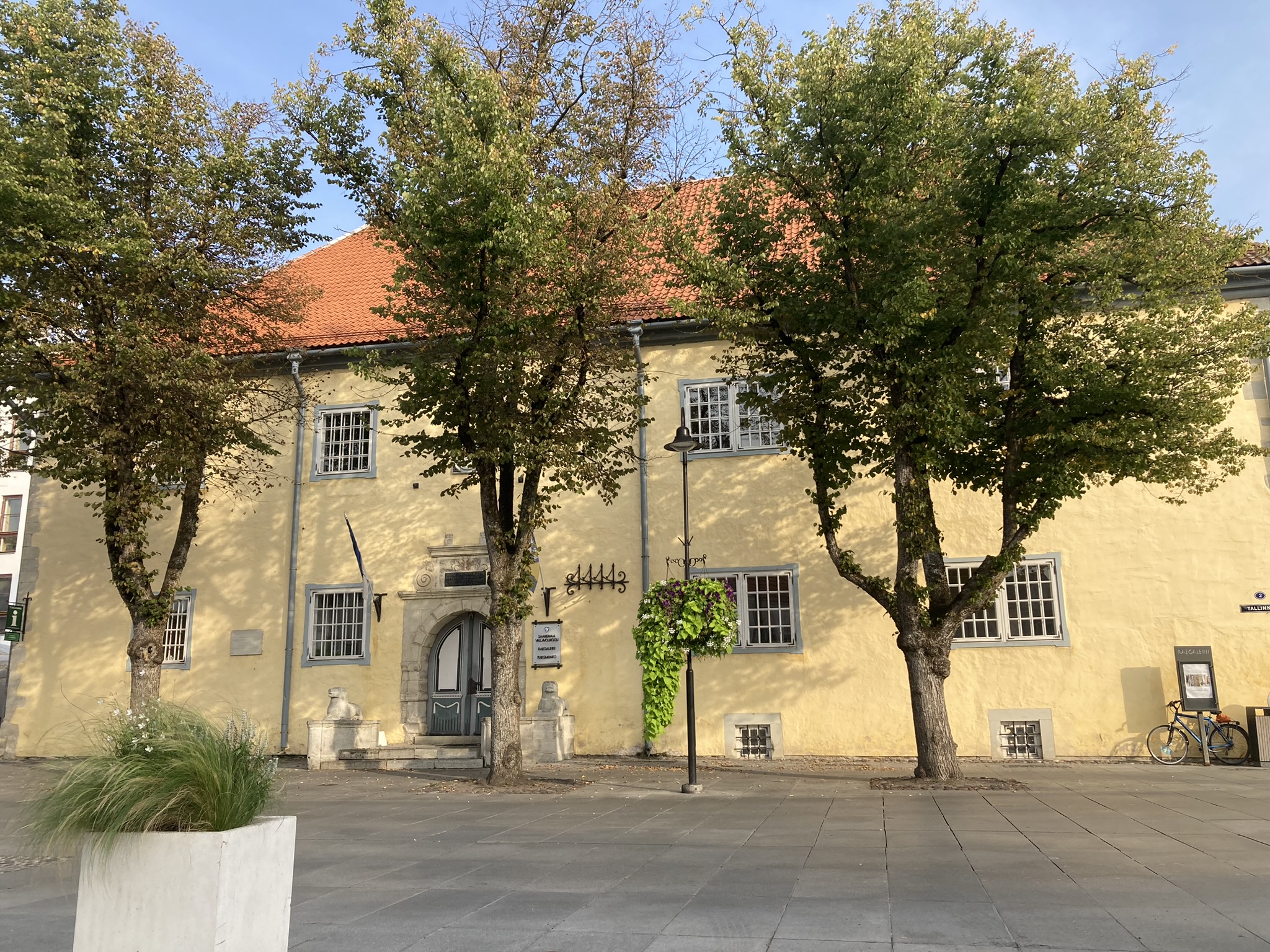
I was the only person dining at 4pm, and had a ‘vegan bowl’ and a blackcurrant and cocoa smoothie. These Estonians love their smoothies. I took a small walk around town to digest afterwards and found myself back in the town square, where I noticed the yellow building my friend at the coffee shop had told me about earlier, labeling it alongside the castle as one of the two historically important places in town. I hired a taxi to the airport. I was sad to leave Kuressaare.
The airport wasn’t quite as small as Kärdla’s, but it was by far the second smallest airport I’ve been in. The taxi dropped me off on the front steps, wished me luck, and I stepped into a room that looked more like a doctor’s office lobby with a few chairs than an airport. The lady at the desk straightened immediately.
“Check in?”
I shook my head and held up my boarding pass on my phone. “I’m already checked in. Security?”
She looked sideways at the door next to her where SECURITY was written in Estonian. “This door will open in, I don’t know, ten minutes? Does that sound okay?” I nodded and sat down to wait.
Security in Kuressaare was much tighter than Tallinn, but the equipment was also about thirty years older. I had to take out my liquids and the guy asked to inspect my power bank by hand. The flight itself was pretty crowded— unlike on my flight to Hiiumaa, nearly every seat on the plane was taken. It was bumpy, and I would have been nervous if I wasn’t so exhausted, but we landed and I hired a car back downtown.
“Tere õhtust,” I said to the driver as I sat down. “Tera”, she answered— her accent was even worse than mine. We listened to the Gnomeo and Juliet soundtrack in silence. When we arrived I switched to Russian. “спасибо,” I attempted in my best random-gangster-named-Dimitri voice. She turned around and smiled, and said what I hoped was something like “have a good night” and not “your wallet fell out of your pocket and slid under the seat.”
It was tough getting inside my next place. I fumbled with the lockbox before realizing it was the wrong one. There were about eight lockboxes all lined up on the drain pipe, and apparently one of them is mine. ‘Damn, I look shady as hell. I hope the door guard at the hotel behind me doesn’t ask me what I’m doing.’ I hear a voice behind me. “Excuse me, what are you doing?”
I went inside, showered, and fell asleep wishing I had asked the girl from the castle if she knew any Livonian. Livonian is cool. I should learn Livonian.
Saturday, August 31st
I woke up knowing I wasn’t feeling good, so I ate a protein bar and went back to sleep hoping it was just hunger. I woke up again and still felt shit, so figured I might as well get started with my day. I had a rough idea of what I wanted to do— take the train out to the town of Paldiski and see the lighthouse there. It was raining, and so I decided I’d start the morning off slowly with some cafe and book time.
After the girl at the Oa Coffeeshop had helped me so much with tipping the last time I was in Tallinn, I figured talking me off the ledge was, by most definitions, above and beyond service, and for that reason I wanted to make sure I had some cash on hand today. I slipped out of my apartment into the rain to find an ATM. This was gonna be my quest for the day— if nothing else gets done, I was sure as hell going to have cash on hand to give a tip. I hoped she’d find it funny. I withdrew 20 euros and headed for her coffeeshop at the Viru gate.
She was there, and she recognized me with a smile. “I assume you’ll be wanting your coffee For Here,” she said, eyeing the rain. I held my 20 euro banknote in my pocket ready to make change. My whole plan was contingent on getting change here. She rang me up. “That’ll be… 10 euros”— FUCK— “and fifty cents.” PHEW. I found a corner. She brought me my order, a large cappuccino and an avocado and hummus sandwich, and returned to her post.
I read some more Catcher, and lamented that for the first time I’ve read this, I didn’t find Holden relatable. That’s a good thing, obviously, but out of all American literature, he’s the character that I always felt I could identify best with. He’s a fellow victim of the adult world that swallows up all the innocence and leaves behind frustration and confusion. That’s Holden. And it was me, but this reread, I feel a bit more divorced from that. I don’t want to say I’ve accepted it, but I’ve certainly learned to live alongside the fact that in this postlapsarian world, we can’t return to Eden.
Anyway, while I was lost in thought over Salinger’s character-writing, I noticed the clock-hands were almost finished summiting and I ought to get moving. I placed 5 euros under my saucer and really hoped she’d get a kick out of it. I fled the scene.
I was feeling pretty bad, constitutionally, and heavily considered returning to my apartment. I wasn’t sure if it was the angel on my shoulder or the demon telling me to listen to my body and get some rest, but whichever it was, it lost and I was soon at Balti Jaam, the Tallinn train station.
There are a lot of random businesses inside the station, but for the life of me I couldn’t find a ticket office. The train was leaving in eight minutes and I had no idea how to gain passage. I waited in line behind some guy at a kiosk, but when he left I realized it was a coffee machine. Four minutes til departure. I turned to a woman who looked competent.
“Hello! How do I purchase a ticket!” Straight into English.
“Online,” she laughed. “It’s cheaper. Uhmmm…. Also you can buy them in that house over there, I think.”
I went over to the building she was pointing to but the door put up a stiff resistance. 1 minute til departure. I watched the doors close dejectedly. The next train was in an hour. Suddenly I saw her running towards me waving her arm.
“I forgot to tell you the most important part— you can buy them while you’re sitting on the train!”
“Thanks!” I replied, running onto the platform.
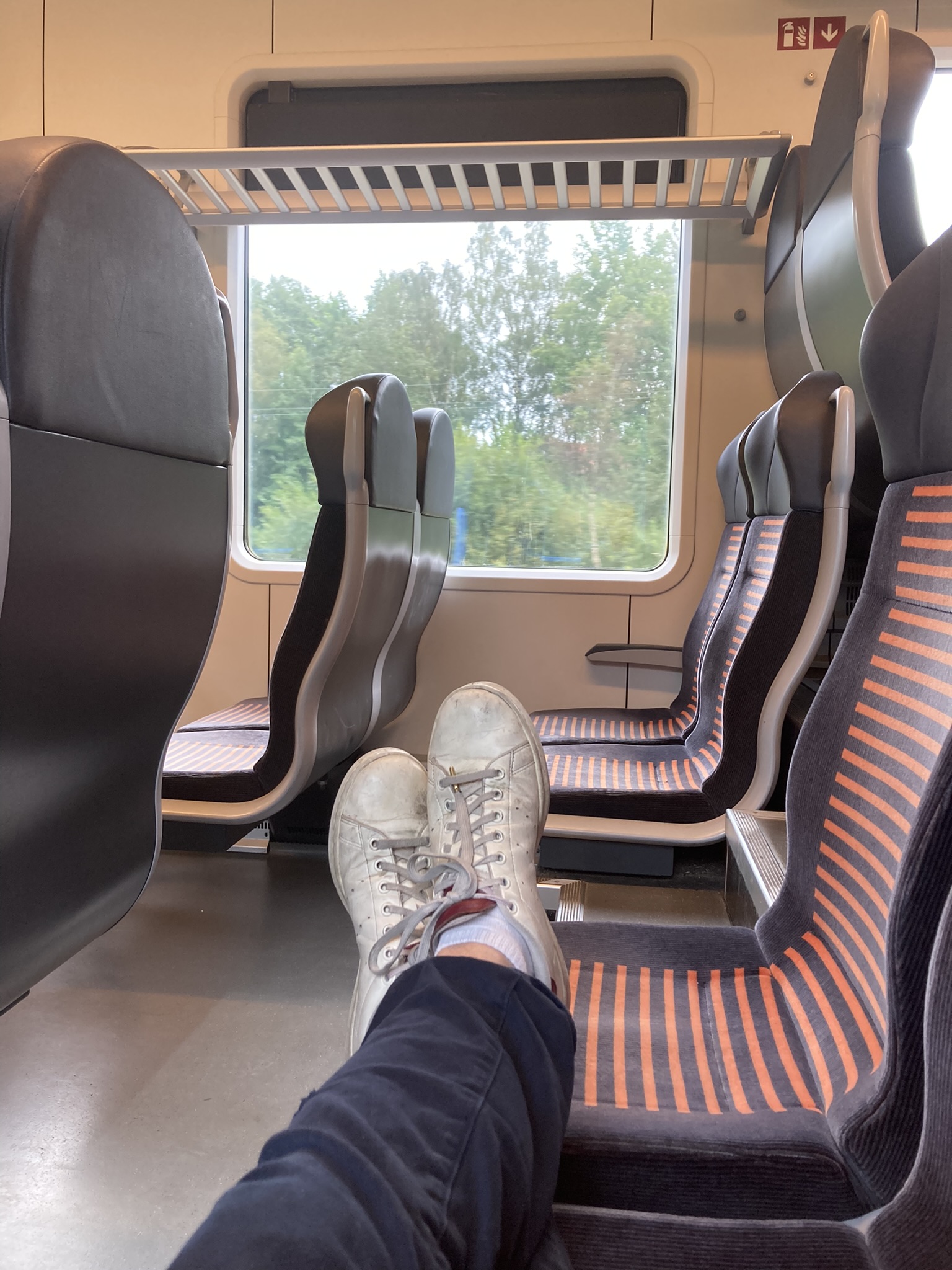
Like a character in a terrible movie, I made it on with seconds to spare and the train pulled out, headed for Paldiski. The ride was about an hour, and I was deposited at a station just outside of town. Now, to find the lighthouse. I looked at Google maps. One hour walk. Wait, what?
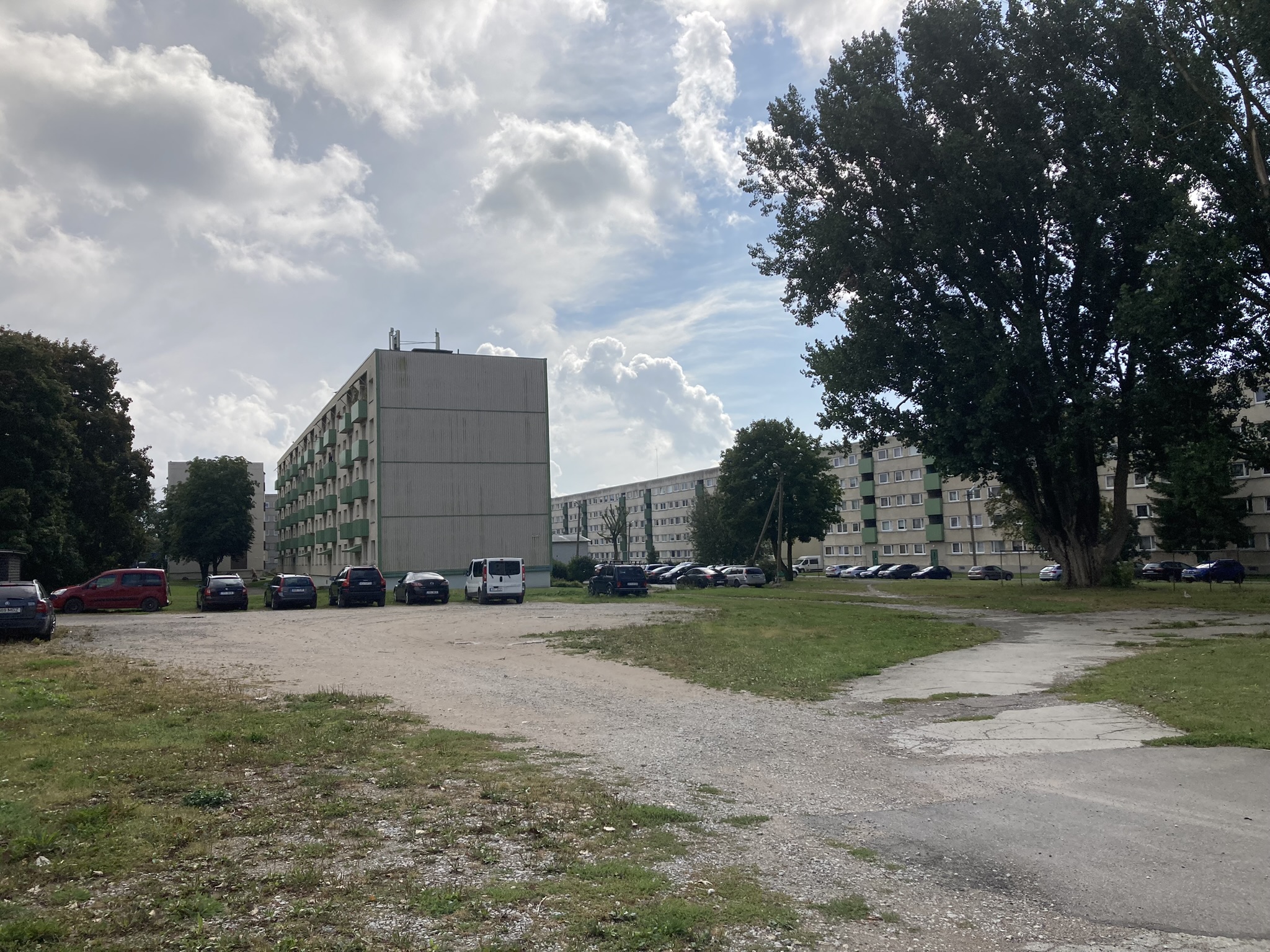
I began walking through town, and realized that almost every building here was one of those Soviet bloc style apartments that Rohan was sure I would see in abundance on my trip. The paint was peeling, laundry hung in the windows, many looked completely abandoned. With the gray sky, it felt pretty depressing. I passed the Paldiski Pub, and considered getting some food, since I was feeling worse and worse, but honestly I honestly I wanted to get this little adventure over with so I could go back to bed. I walked north out of town.
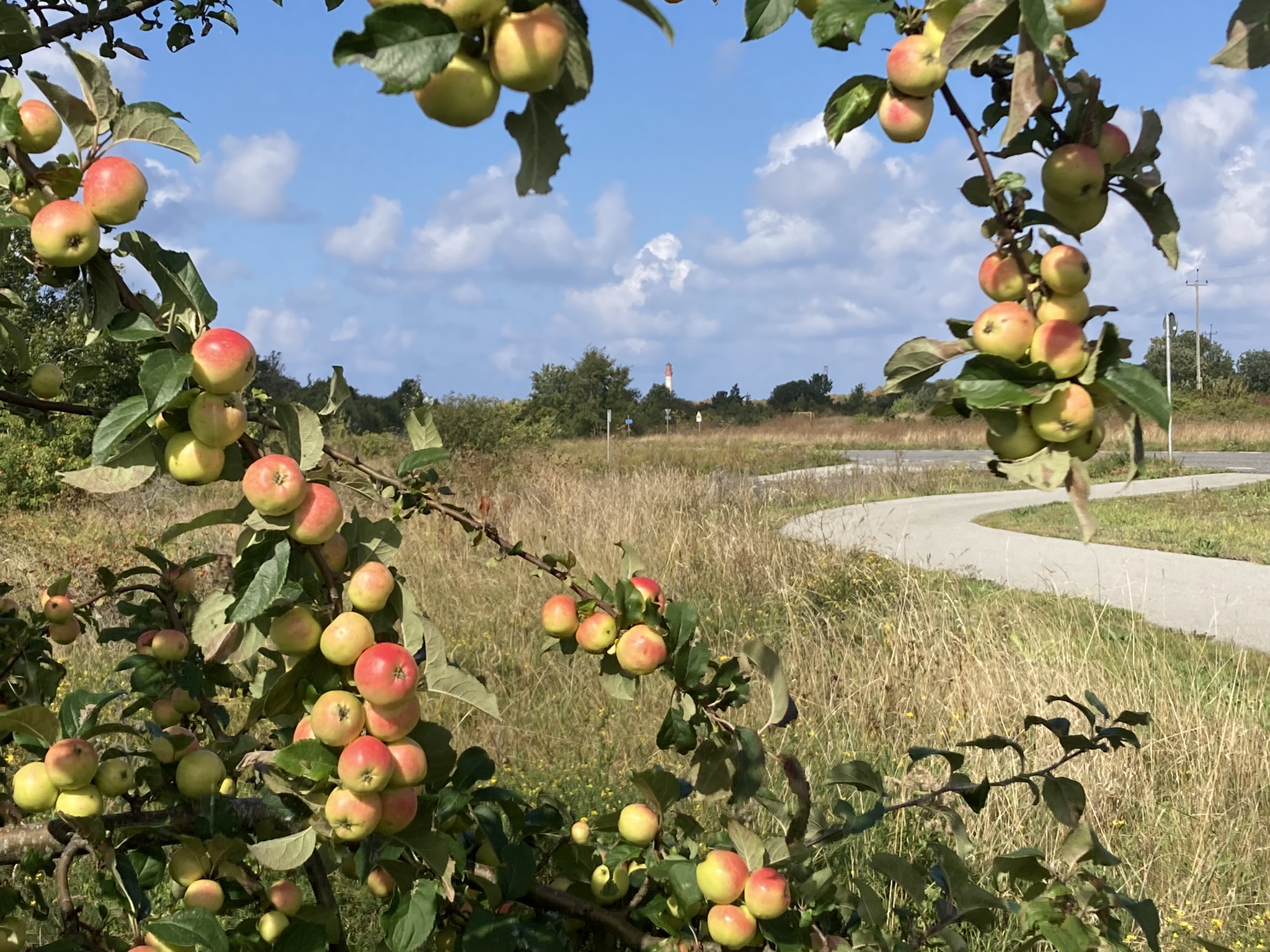
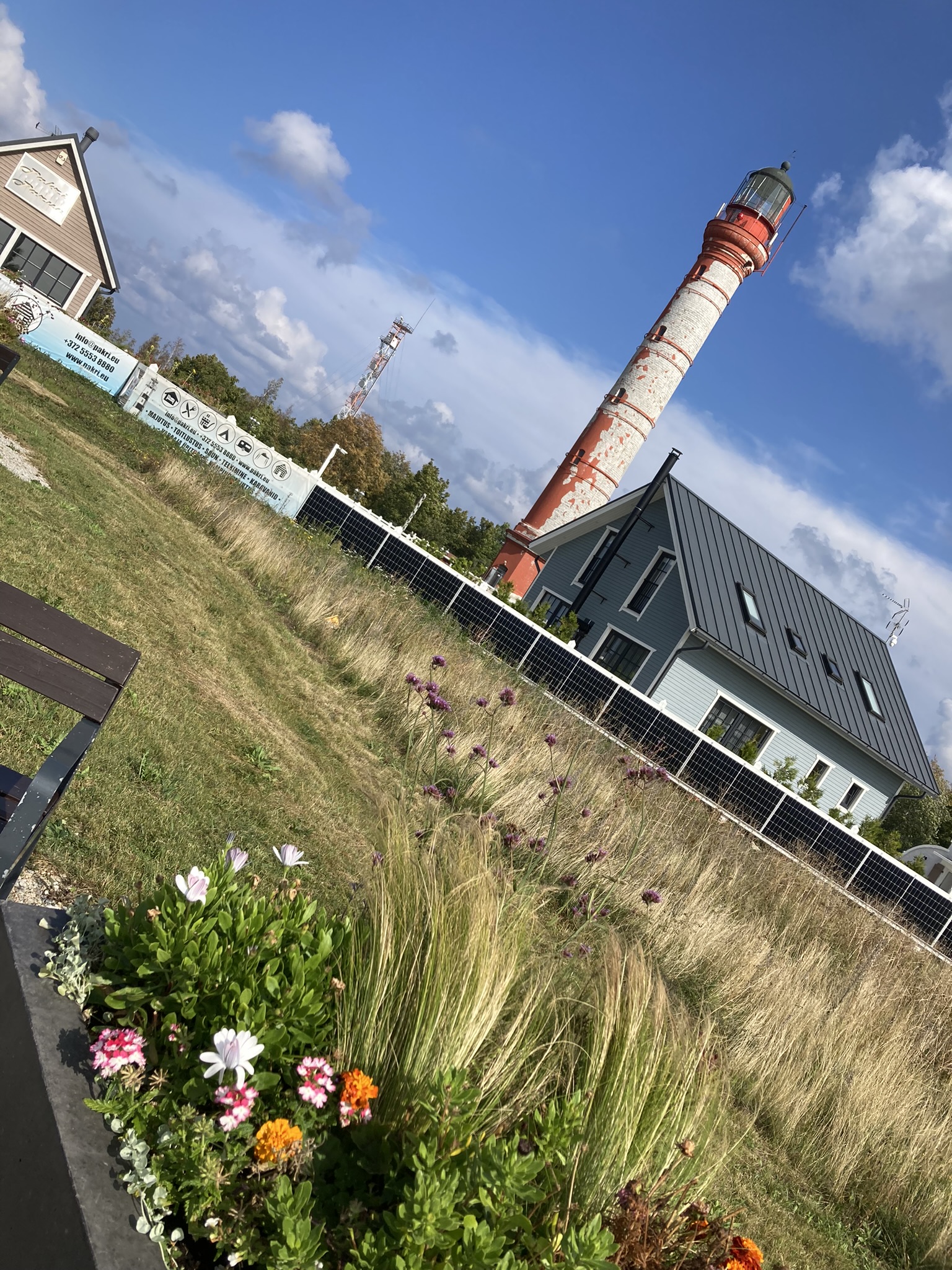
I would have hitchhiked, but unfortunately that necessitates a passing vehicle, and try as I might I could not will one to appear. So I walked. At some point the sun came out, and I realized that this area was actually really pretty. Along the sides of this one lane road were orchards of apple trees, shrubs with bright yellow and red berries, and wildflowers speckling the grass purple and white. The rain clouds had been blown away, leaving a deep azure sky supporting the fast passage of fluffy cotton ball cumuli from one horizon to the other. Off in the distance to my right, a squadron of wind turbines worked furiously to process the same winds that the clouds were leveraging. And then suddenly, I saw a red lantern room peak out above the trees. And I felt good. The Pakri Lighthouse was built in 1889 by the Russians straight into the cliff next to the ruins of the 1724 lighthouse that Peter the Great ordered. The base of the old lighthouse is still visible today, but erosion from the cliff will likely take it into the sea in the coming years.
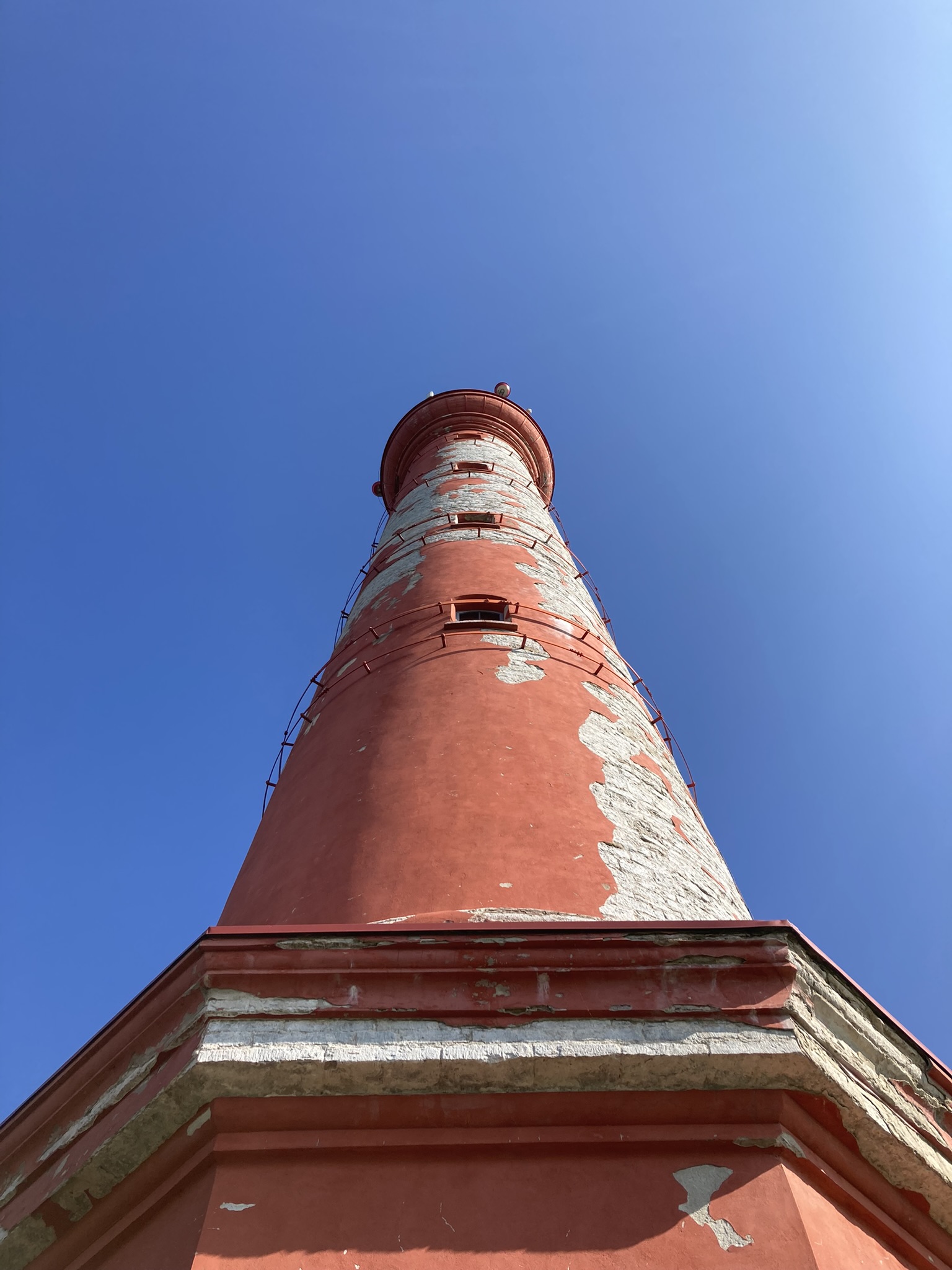
With my second wind, the remaining few miles were light and easy, and to my amazement all the trees around the lighthouse on this peninsula were dressed up in their best fall colors. Light green, cadmium, ochre, brown, the first whispers of the autumn season were testing the waters on this little country road in northern Estonia. The lighthouse itself boasted an impressive palette against the bright blue sky— a red coat of paint was slowly being eroded by the sea breezes to reveal crusty white brick underneath. And the sound of the waves crashing against the cliffside 20 meters below was all the soundtrack anyone could ask for. With my soles soaked in the helium of a beautiful afternoon, I purchased a ticket to the top.
It was possibly the most beautiful view I’ve ever seen. The wind was violent and battled against my shape, but it wasn’t cold, and the pressure felt good. The entire peninsula was visible. The Baltic was a dark, royal blue, and the stencil of freighters could be seen on the horizon. I took special care to carve everything into the walls of my head, should some winter morning come along that necessitated it.
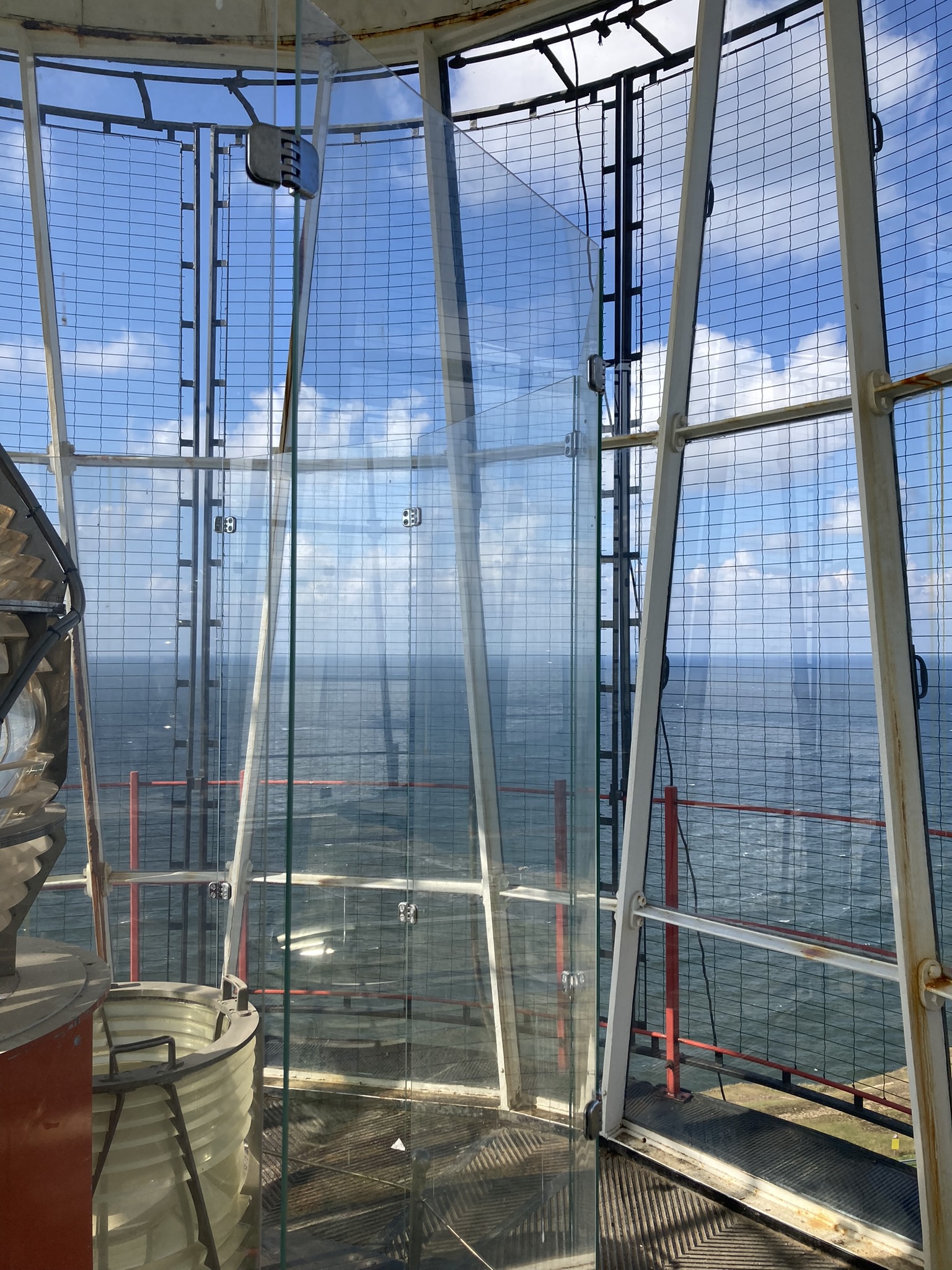
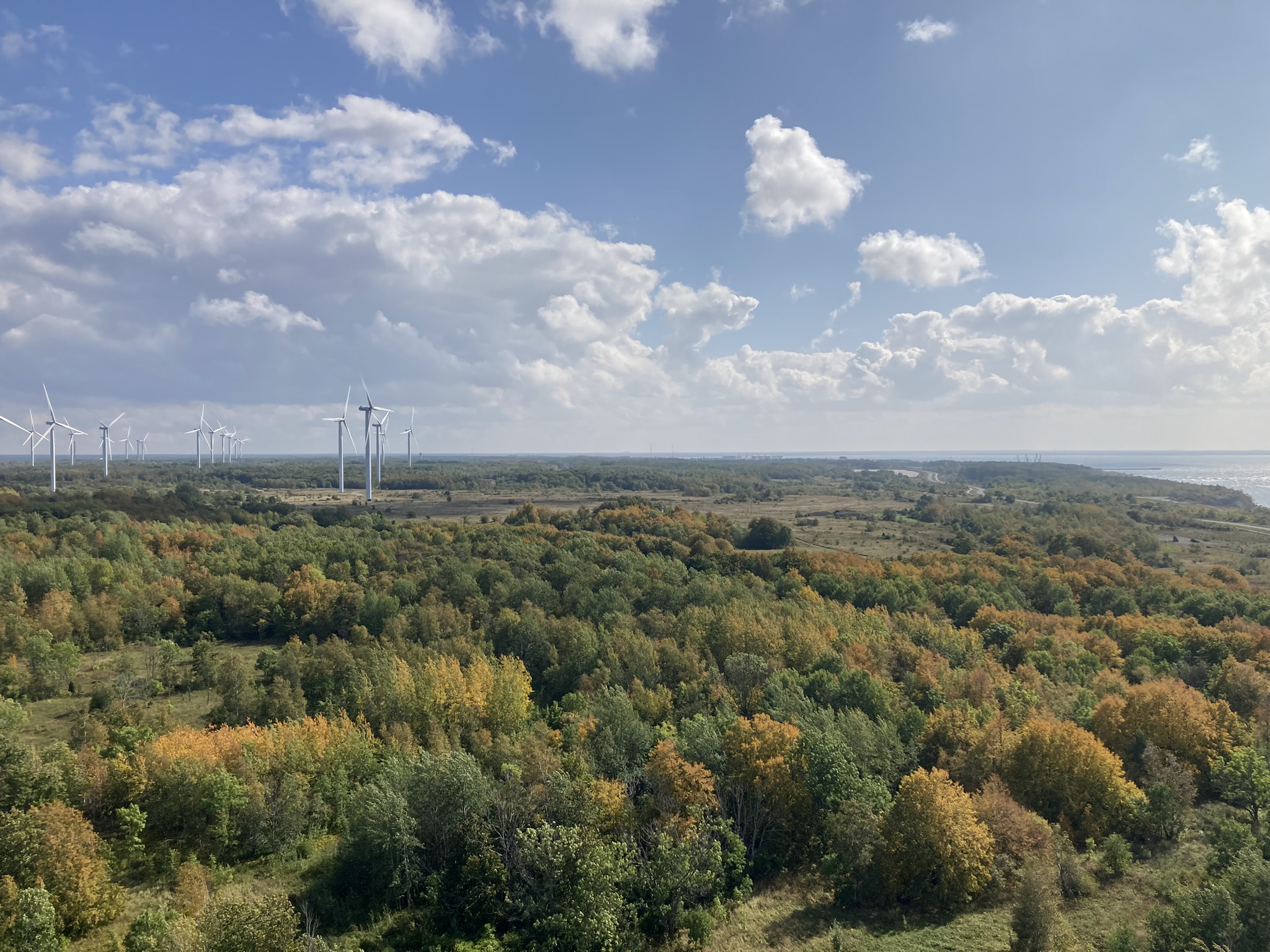
And then I descended. I almost crumpled when my foot met dirt. I was so locked into the experience I’d forgotten my body is actually fantastically weak, and without the adrenaline I didn’t have anything propping me up. There was a chair in the little shack of the woman that sold me the ticket, and I went inside and sat down.
“I’ve been to 102 lighthouses now, and this might be my favorite.” I said weakly, trying to gain an excuse to rest here for a bit.
Her eyes were piercing. “It’s a pretty easy climb, isn’t it? It’s the only active lighthouse in Estonia that was built with the idea that a keeper might climb it multiple times a day, and so the steps were made to be really manageable.”
“I noticed! I was at Kõpu the other day, and man, those steps were killer.”
“Kõpu is the third oldest in the world. What’s the oldest?” She was testing me. This was a test I could pass.
“That would be the Tower of Hercules in Spain.”
“Wrong! It’s the lighthouse at Alexandria.”
Okay, I guess technically that’s the canonical answer, but that lighthouse was destroyed thousands of years ago. If you count ancient, destroyed lights, Kõpu isn’t in the top five hundred. But I smiled and said yes of course.
“Do you know the second oldest?”
If ruins are in play, I could come up with a suitable answer. “It’s that Roman tower in England, no?”
“No. It’s Genoa. In Italy.”
I was pretty annoyed at this point and shifted the conversation back to the lighthouse towering through the window. She showed me some pictures of the lighthouse that she’d taken over the past three decades working there, and explained that the terrible paint job is the work of the Soviets. She changed the conversation to her son, a brilliant accountant that had recently gotten a job in New York. He has his mom’s talent with numbers. Moms will let you sit and talk until the sun sets as long as the conversations are about their sons, so after about twenty minutes of the filial award ceremony I excused myself, not before being instructed to find a yellow building in Paldiski that sells really big burgers— not like the small American kind— and it will be the best lunch I’ll have had in Estonia.
The walk back was rough as the temperature climbed, and I couldn’t get a car to stop for me, even a policeman. But I made it, and began looking for the building the lady had described. Sure enough, it was the Paldiski fucking Pub. I went inside, ordered two brownies, and drank half the water they had in the building.
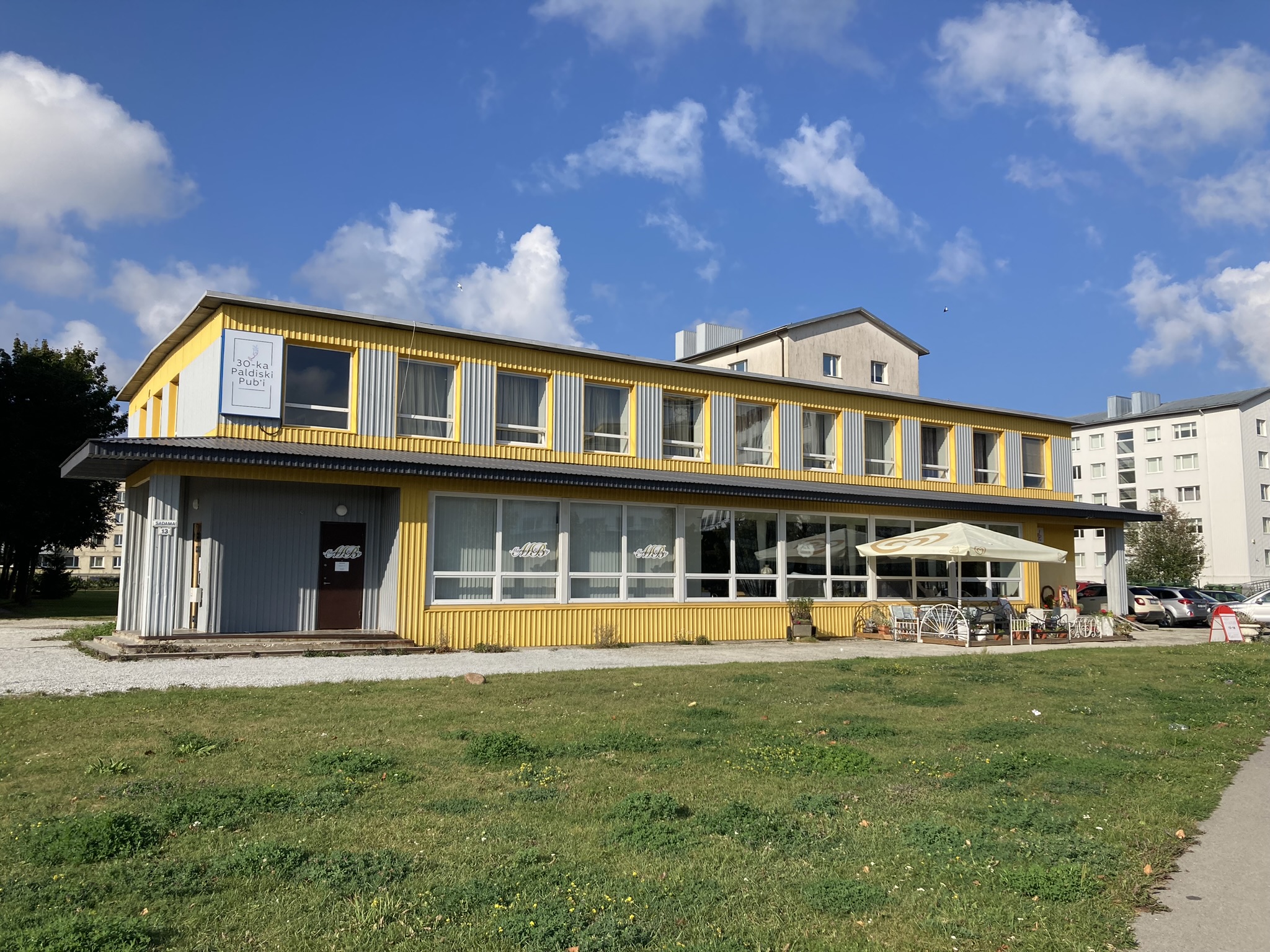
After they ran out of free water I abandoned the carcasses of my brownies and found the train. As I approached the tracks I realized that the building adjacent was actually the old Soviet train station.
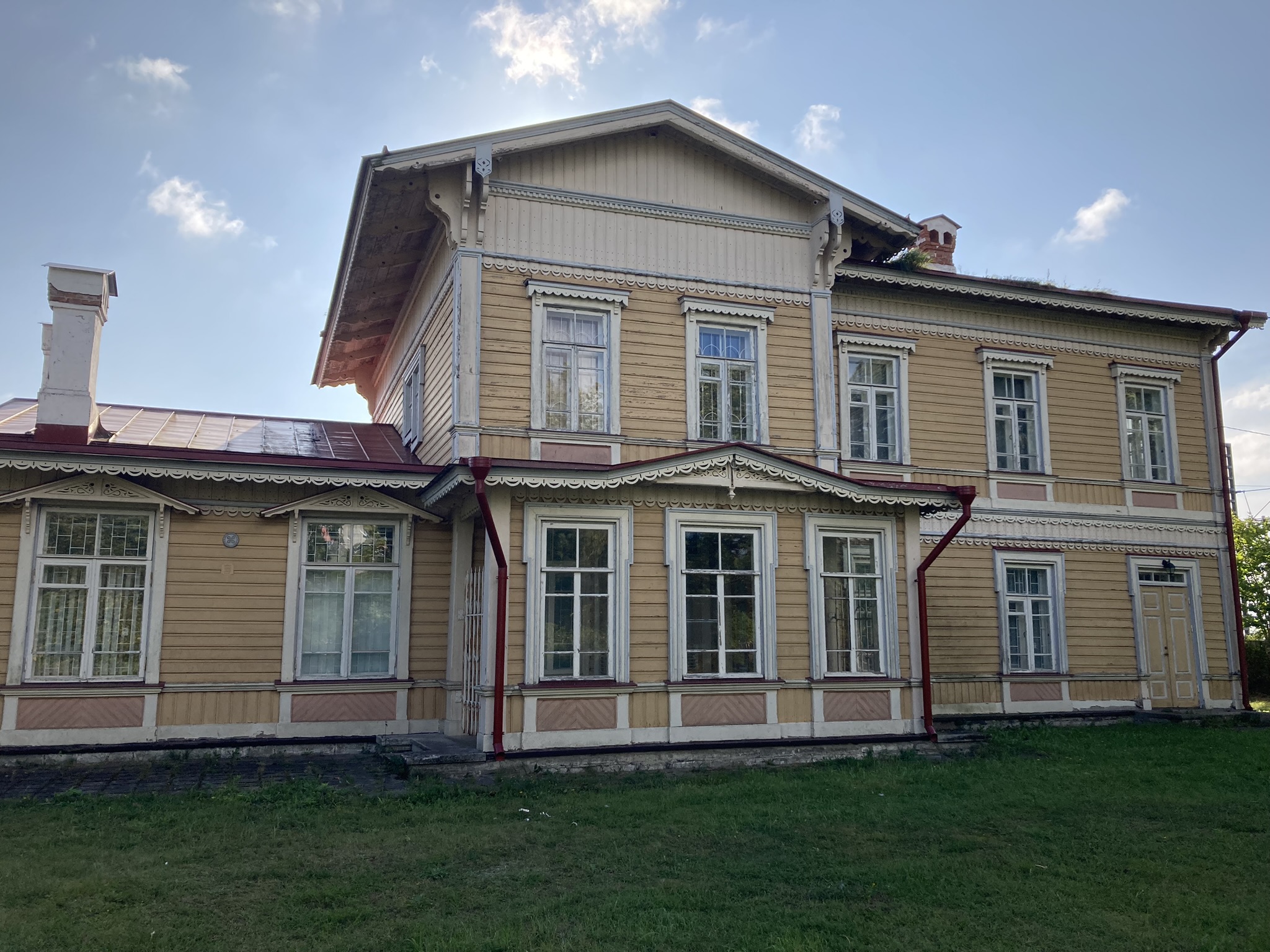
The ride back was nice and smooth. Trains are the best. I thought I could use some vitamin C, but my friend at the market smoothie booth was nowhere to be found, and I grabbed a vegan smashburger instead. I would have loved some Georgian food, as I can’t get that outside of Chicago, but I would have needed to order wine and I was too unwell for wine. I need to be in a very peaceful frame of mind for alcohol. That’s why I rarely drink with others around. You can never really guess if they’ll disrupt the peace.
My final evening in Estonia I spent revisiting some of my favorite places in Tallinn, and after the sun set I packed up my apartment and got a few hours of sleep before heading to the airport. Estonia is a lovely place. I should like to return someday.